Ch 10: Interactions and Potential Energy
Knight Calc - Physics for Scientists and Engineers 5th Edition
Knight Calc5th EditionPhysics for Scientists and EngineersISBN: 9780137344796Not the one you use?Change textbook
Chapter 10, Problem 54a

The spring shown in FIGURE P10.54 is compressed 50 cm and used to launch a 100 kg physics student. The track is frictionless until it starts up the incline. The student's coefficient of kinetic friction on the 30° incline is 0.15. What is the student's speed just after losing contact with the spring?
<Image>

Verified step by step guidance
1
Step 1: Identify the energy transformations involved. The spring's potential energy is converted into the student's kinetic energy as the spring releases. Use the formula for elastic potential energy: Espring=12kspringx2, where kspring is the spring constant and x is the compression distance.
Step 2: Relate the spring's potential energy to the student's kinetic energy using the work-energy principle. The kinetic energy of the student just after losing contact with the spring is given by Ekinetic=12mv2, where m is the mass of the student and v is the speed.
Step 3: Equate the spring's potential energy to the student's kinetic energy to solve for the speed v. The equation becomes 12kspringx2=12mv2. Rearrange to isolate v: v=kspringx2m.
Step 4: Substitute the given values into the equation. Use m=100 kg, x=0.50 m, and the spring constant kspring (value not provided in the problem, but it must be given or calculated).
Step 5: Perform the algebraic simplifications to find the expression for v. This will yield the student's speed just after losing contact with the spring. Ensure units are consistent throughout the calculation.

Verified video answer for a similar problem:

This video solution was recommended by our tutors as helpful for the problem above.
Video duration:
6m
Was this helpful?

Key Concepts

Here are the essential concepts you must grasp in order to answer the question correctly.

Hooke's Law

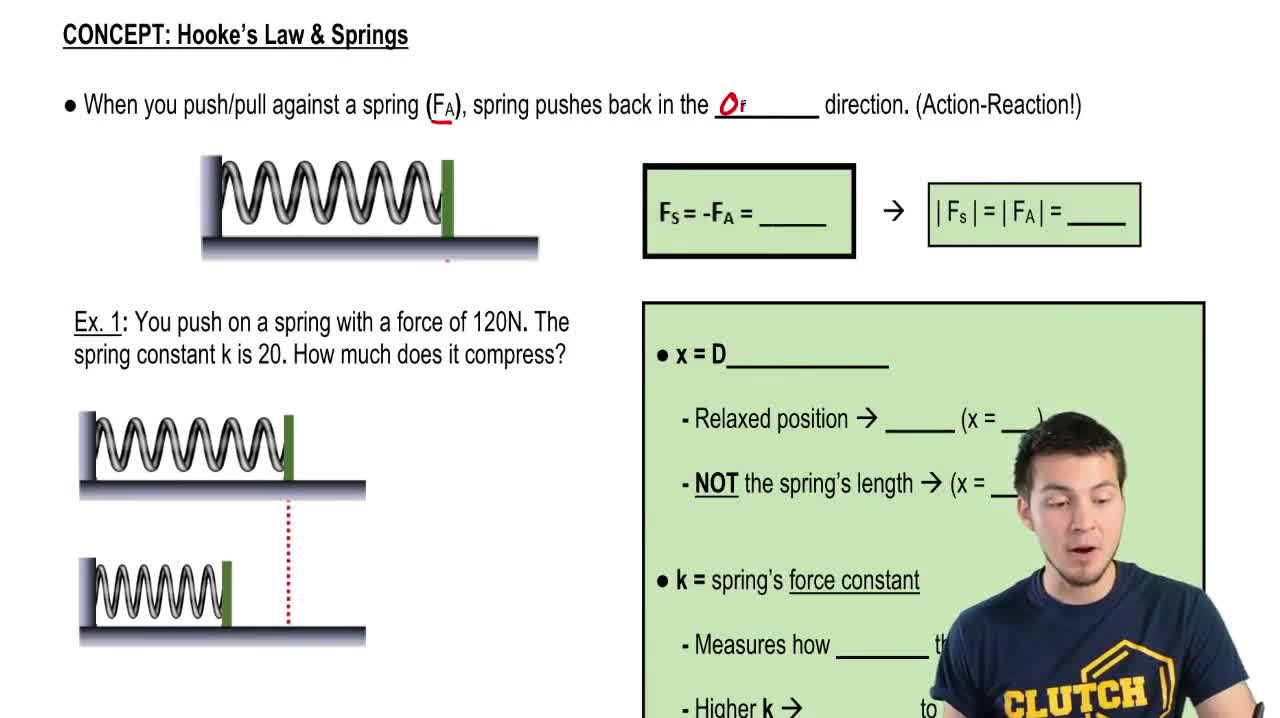
Hooke's Law states that the force exerted by a spring is directly proportional to its displacement from the equilibrium position, expressed as F = -kx, where k is the spring constant and x is the displacement. This principle is crucial for determining the potential energy stored in the spring when it is compressed, which is given by the formula PE = 1/2 kx².
Recommended video:
Guided course
05:27
Spring Force (Hooke's Law)

Conservation of Energy

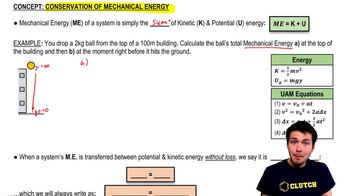
The principle of conservation of energy states that energy cannot be created or destroyed, only transformed from one form to another. In this scenario, the potential energy stored in the compressed spring is converted into kinetic energy as the student is launched, allowing us to calculate the speed just after losing contact with the spring using the equation KE = 1/2 mv².
Recommended video:
Guided course
06:24
Conservation Of Mechanical Energy

Friction and Inclined Planes

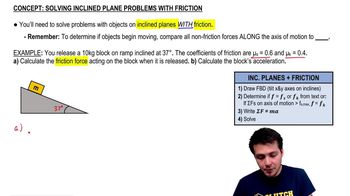
Friction is a force that opposes motion between two surfaces in contact. On an inclined plane, the force of kinetic friction can be calculated using the coefficient of kinetic friction (μk) and the normal force. This concept is essential for understanding how the student's speed will be affected as they move up the incline, where both gravitational and frictional forces will act against their motion.
Recommended video:
Guided course
05:24
Intro to Incline Plane with Friction
Related Practice
Textbook Question

Two blocks with masses mA and mB are connected by a massless string over a massless, frictionless pulley. Block B, which is more massive than block A, is released from height h and falls. A 1.0 kg block and a 2.0 kg block are connected by a massless string over a massless, frictionless pulley. The impact speed of the heavier block, after falling, is 1.8 m/s. From how high did it fall?

2479
views
Textbook Question

A freight company uses a compressed spring to shoot 2.0 kg packages up a 1.0-m-high frictionless ramp into a truck, as FIGURE P10.52 shows. The spring constant is 500 N/m and the spring is compressed 30 cm. What is the speed of the package when it reaches the truck?

1369
views
Textbook Question

The ice cube is replaced by a 50 g plastic cube whose coefficient of kinetic friction is 0.20. How far will the plastic cube travel up the slope? Use work and energy.

1433
views
Textbook Question

FIGURE 10.23 showed the potential-energy curve for the O2 molecule. Consider a molecule with the energy E1 shown in the figure. a. What is the maximum speed of an oxygen atom as it oscillates back and forth? Don't forget that the kinetic energy is the total kinetic energy of the system. The mass of an oxygen atom is 16 u, where 1u=1 atomic mass unit =1.66×10⁻²⁷ kg .

1645
views
Textbook Question

A sled starts from rest at the top of the frictionless, hemispherical, snow-covered hill shown in FIGURE P10.56. a. Find an expression for the sled's speed when it is at angle ϕ .

94
views
Textbook Question

CALC A 2.6 kg block is attached to a horizontal rope that exerts a variable force Fx = (20 − 5x) N, where x is in m. The coefficient of kinetic friction between the block and the floor is 0.25. Initially the block is at rest at x = 0 m. What is the block's speed when it has been pulled to x = 4.0 m?

2031
views