Ch 11: Impulse and Momentum
Knight Calc - Physics for Scientists and Engineers 5th Edition
Knight Calc5th EditionPhysics for Scientists and EngineersISBN: 9780137344796Not the one you use?Change textbook
Chapter 11, Problem 32

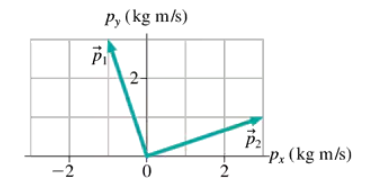
An object at rest explodes into three fragments. FIGURE EX11.32 shows the momentum vectors of two of the fragments. What is the momentum of the third fragment? Write your answer using unit vectors.

Verified step by step guidance
1
Step 1: Understand the principle of conservation of momentum. Since the object was initially at rest, the total momentum of the system after the explosion must be zero. This means the vector sum of the momenta of all three fragments must equal zero.
Step 2: Analyze the given momentum vectors in the diagram. Fragment P1 has a momentum vector of (-3 kg·m/s, 0 kg·m/s) in unit vector form, and fragment P2 has a momentum vector of (3 kg·m/s, 6 kg·m/s) in unit vector form.
Step 3: Represent the momentum of the third fragment, P3, as a vector (Px, Py). Using the conservation of momentum, the sum of the x-components and y-components of all three fragments must equal zero. Write two equations: ΣPx = 0 and ΣPy = 0.
Step 4: Solve for Px and Py. For the x-components: -3 + 3 + Px = 0, which simplifies to Px = 0. For the y-components: 0 + 6 + Py = 0, which simplifies to Py = -6.
Step 5: Combine the results to express the momentum of the third fragment in unit vector form. The momentum of P3 is (0 kg·m/s, -6 kg·m/s), or 0i - 6j in unit vector notation.

Verified video answer for a similar problem:

This video solution was recommended by our tutors as helpful for the problem above.
Video duration:
4m
Was this helpful?

Key Concepts

Here are the essential concepts you must grasp in order to answer the question correctly.

Conservation of Momentum

The principle of conservation of momentum states that the total momentum of a closed system remains constant if no external forces act on it. In the case of an explosion, the momentum before the explosion (which is zero for an object at rest) must equal the total momentum of the fragments after the explosion. This allows us to calculate the momentum of the third fragment by ensuring the vector sum of all fragments equals zero.
Recommended video:
Guided course
05:58
Conservation Of Momentum

Vector Addition

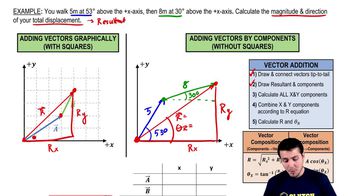
Momentum is a vector quantity, meaning it has both magnitude and direction. To find the momentum of the third fragment, we must use vector addition to combine the momentum vectors of the first two fragments. This involves breaking down the vectors into their components (x and y) and then summing these components to find the resultant vector, which represents the momentum of the third fragment.
Recommended video:
Guided course
07:30
Vector Addition By Components

Unit Vectors

Unit vectors are vectors with a magnitude of one, used to indicate direction. In this context, we can express the momentum of the fragments using unit vectors, typically denoted as i (for the x-direction) and j (for the y-direction). By calculating the components of the momentum vectors and expressing them in terms of unit vectors, we can clearly communicate the direction and magnitude of the momentum of the third fragment.
Recommended video:
Related Practice
Textbook Question

A 70.00 kg football player is gliding across very smooth ice at 2.00 m/s. He throws a 0.450 kg football straight forward. What is the player's speed afterward if the ball is thrown at 15.0 m/s relative to the ground?

1479
views
Textbook Question

Dan is gliding on his skateboard at 4.0 m/s. He suddenly jumps backward off the skateboard, kicking the skateboard forward at 8.0 m/s. How fast is Dan going as his feet hit the ground? Dan's mass is 50 kg and the skateboard's mass is 5.0 kg.

912
views
Textbook Question

Two objects collide and bounce apart. FIGURE EX11.31 shows the initial momenta of both and the final momentum of object 2. What is the final momentum of object 1? Write your answer using unit vectors.

1483
views
Textbook Question

At the center of a 50-m-diameter circular ice rink, a 75 kg skater traveling north at 2.5 m/s collides with and holds on to a 60 kg skater who had been heading west at 3.5 m/s. Where will they reach it? Give your answer as an angle north of west.

969
views
Textbook Question

A 20 g ball of clay traveling east at 3.0 m/s collides with a 30 g ball of clay traveling north at 2.0 m/s. What are the speed and the direction of the resulting 50 g ball of clay? Give your answer as an angle north of east.

1224
views
Textbook Question

A 550 g cart is released from rest on a frictionless, 30° ramp, 120 cm from the bottom of the ramp. It rolls down, bounces off a rubber block at the bottom, and then rolls 80 cm back up the ramp. A high-speed video shows that the cart was in contact with the rubber block for 25 ms. What was the average force exerted on the cart by the block?

1172
views
1
rank