Ch 14: Fluids and Elasticity
Knight Calc - Physics for Scientists and Engineers 5th Edition
Knight Calc5th EditionPhysics for Scientists and EngineersISBN: 9780137344796Not the one you use?Change textbook
Chapter 14, Problem 12

What is the height of a water barometer at atmospheric pressure?

Verified step by step guidance
1
Understand the principle: A water barometer works based on the principle of hydrostatic equilibrium, where the weight of the water column balances the atmospheric pressure. The equation governing this is: P=ρgh, where P is the atmospheric pressure, ρ is the density of water, g is the acceleration due to gravity, and h is the height of the water column.
Identify the known values: Atmospheric pressure at sea level is approximately 1.013×10^5 Pascals, the density of water is approximately 1000 kg/m³, and the acceleration due to gravity is 9.8 m/s².
Rearrange the hydrostatic equilibrium equation to solve for height: h=P÷ρg. This isolates the height of the water column.
Substitute the known values into the equation: Replace P with 1.013×10^5 Pa, ρ with 1000 kg/m³, and g with 9.8 m/s².
Perform the division to calculate the height: The result will give the height of the water column in meters, which represents the height of the water barometer at atmospheric pressure.

Verified video answer for a similar problem:

This video solution was recommended by our tutors as helpful for the problem above.
Video duration:
3m
Was this helpful?

Key Concepts

Here are the essential concepts you must grasp in order to answer the question correctly.

Atmospheric Pressure

Atmospheric pressure is the force exerted by the weight of air above a given point, typically measured in pascals (Pa) or millimeters of mercury (mmHg). At sea level, standard atmospheric pressure is approximately 101.3 kPa or 760 mmHg. This pressure is crucial for understanding how fluids behave in various contexts, including barometers.
Recommended video:
Guided course
17:04
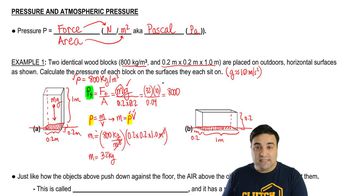
Pressure and Atmospheric Pressure

Barometer

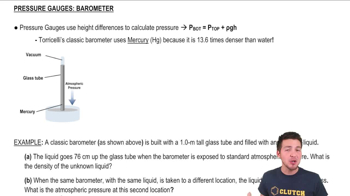
A barometer is an instrument used to measure atmospheric pressure. The most common type, the mercury barometer, consists of a glass tube filled with mercury, inverted in a dish of mercury. The height of the mercury column in the tube indicates the atmospheric pressure, with higher columns corresponding to higher pressure.
Recommended video:
Guided course
09:27
Pressure Gauges: Barometer

Hydrostatic Pressure

Hydrostatic pressure refers to the pressure exerted by a fluid at equilibrium due to the force of gravity. In the context of a barometer, this principle explains how the height of the liquid column (like mercury or water) is determined by the balance between atmospheric pressure and the weight of the liquid. The height of the liquid column is directly proportional to the atmospheric pressure acting on it.
Recommended video:
Guided course
17:04
Pressure and Atmospheric Pressure