Ch 14: Fluids and Elasticity
Knight Calc - Physics for Scientists and Engineers 5th Edition
Knight Calc5th EditionPhysics for Scientists and EngineersISBN: 9780137344796Not the one you use?Change textbook
Chapter 14, Problem 19

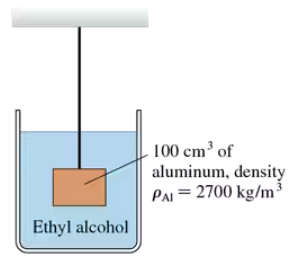
What is the tension of the string in FIGURE EX14.19?

Verified step by step guidance
1
Step 1: Analyze the forces acting on the object in the system. Identify all forces, including the tension in the string, gravitational force, and any other forces present in the diagram provided in FIGURE EX14.19.
Step 2: Write down Newton's second law of motion, \( F = ma \), for the object. Break the forces into components if necessary, such as horizontal and vertical directions.
Step 3: Use trigonometric relationships (e.g., sine, cosine) to resolve the tension force into its components if the string is at an angle. For example, \( T_x = T \cos(\theta) \) and \( T_y = T \sin(\theta) \).
Step 4: Set up equations based on the equilibrium conditions or the motion of the object. For equilibrium, the sum of forces in each direction should equal zero. For motion, account for acceleration using \( F = ma \).
Step 5: Solve the equations for the tension \( T \) in the string. Ensure all variables are substituted correctly, and check the units for consistency.

Verified video answer for a similar problem:

This video solution was recommended by our tutors as helpful for the problem above.
Video duration:
4m
Was this helpful?

Key Concepts

Here are the essential concepts you must grasp in order to answer the question correctly.

Tension in a String

Tension is the force exerted along the length of a string or rope when it is pulled tight by forces acting from opposite ends. It is a pulling force that acts along the string and is equal in magnitude at both ends, assuming the string is massless and there are no other forces acting on it. Understanding tension is crucial for analyzing systems involving strings, such as pulleys or hanging objects.
Recommended video:
Guided course
04:39
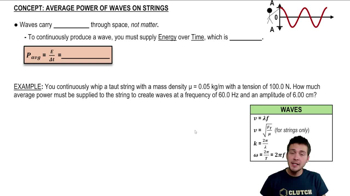
Energy & Power of Waves on Strings

Equilibrium Conditions

Equilibrium occurs when all the forces acting on an object are balanced, resulting in a state of rest or constant velocity. For a system in equilibrium, the sum of the forces in any direction must equal zero. This principle is essential for solving problems involving tension, as it allows us to set up equations based on the forces acting on the objects connected by the string.
Recommended video:
Guided course
10:13
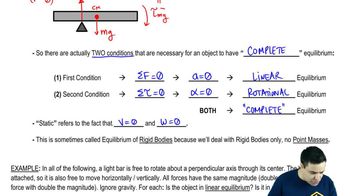
Torque & Equilibrium

Free Body Diagram (FBD)

A Free Body Diagram is a graphical representation used to visualize the forces acting on an object. It simplifies the analysis of forces by isolating the object and illustrating all the external forces, including tension, gravity, and any applied forces. Creating an FBD is a fundamental step in solving physics problems, as it helps identify the relationships between forces and facilitates the application of Newton's laws.
Recommended video:
Guided course
08:42
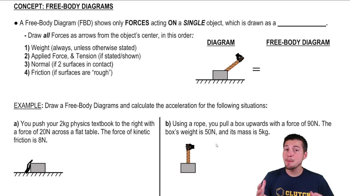
Free-Body Diagrams