Pearson+ LogoPearson+ Logo
Ch 20: The Micro/Macro Connection
Knight Calc - Physics for Scientists and Engineers 5th Edition
Knight Calc5th EditionPhysics for Scientists and EngineersISBN: 9780137344796Not the one you use?Change textbook
Chapter 20, Problem 21

1.0 mol of argon has 3100 J of thermal energy. What is the gas temperature in °C?

Verified step by step guidance
1
Identify the relationship between thermal energy and temperature for an ideal gas. The thermal energy of a monatomic ideal gas is given by the formula: U = 32nRT, where U is the thermal energy, n is the number of moles, R is the ideal gas constant (8.314 J/(mol·K)), and T is the temperature in kelvins.
Rearrange the formula to solve for temperature T: T = 23UnR.
Substitute the given values into the formula: U = 3100 J, n = 1.0 mol, and R = 8.314 J/(mol·K).
Perform the calculation to find the temperature in kelvins (T).
Convert the temperature from kelvins to degrees Celsius using the formula: T°C = TK - 273.15.

Verified video answer for a similar problem:

This video solution was recommended by our tutors as helpful for the problem above.
Video duration:
3m
Was this helpful?

Key Concepts

Here are the essential concepts you must grasp in order to answer the question correctly.

Thermal Energy

Thermal energy refers to the total kinetic energy of the particles in a substance due to their motion. In the context of gases, it is directly related to temperature, as higher thermal energy indicates greater particle movement. The relationship between thermal energy and temperature is crucial for understanding how energy is distributed among gas particles.
Recommended video:
Guided course
05:21
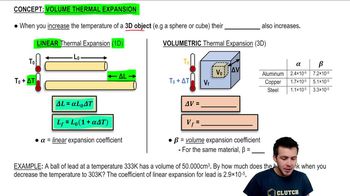
Volume Thermal Expansion

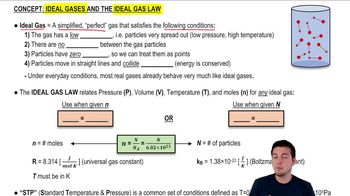
Ideal Gas Law

The Ideal Gas Law is a fundamental equation in thermodynamics that relates pressure, volume, temperature, and the number of moles of a gas. It is expressed as PV = nRT, where P is pressure, V is volume, n is the number of moles, R is the ideal gas constant, and T is temperature in Kelvin. This law helps in calculating the temperature of a gas when its thermal energy and amount are known.
Recommended video:
Guided course
07:21
Ideal Gases and the Ideal Gas Law

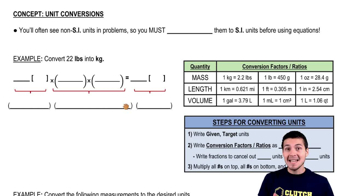
Temperature Conversion

Temperature conversion is the process of changing temperature values from one scale to another, such as from Kelvin to Celsius. The conversion from Kelvin to Celsius is done using the formula °C = K - 273.15. Understanding this conversion is essential for accurately interpreting temperature readings in different contexts, especially in thermodynamic calculations.
Recommended video:
Guided course
07:46
Unit Conversions