Pearson+ LogoPearson+ Logo
Ch 20: The Micro/Macro Connection
Knight Calc - Physics for Scientists and Engineers 5th Edition
Knight Calc5th EditionPhysics for Scientists and EngineersISBN: 9780137344796Not the one you use?Change textbook
Chapter 20, Problem 22

Liquid helium boils at 4.2 K. In a flask, the helium gas above the boiling liquid is at the same temperature. What are (a) the mean free path in the gas, (b) the rms speed of the atoms, and (c) the average energy per atom?

Verified step by step guidance
1
Step 1: To calculate the mean free path (a), use the formula \( \lambda = \frac{k_B T}{\sqrt{2} \pi d^2 P} \), where \( k_B \) is the Boltzmann constant, \( T \) is the temperature, \( d \) is the diameter of a helium atom, and \( P \) is the pressure. Assume the pressure is at standard atmospheric pressure unless otherwise specified.
Step 2: For the rms speed (b), use the formula \( v_{rms} = \sqrt{\frac{3 k_B T}{m}} \), where \( k_B \) is the Boltzmann constant, \( T \) is the temperature, and \( m \) is the mass of a helium atom. The mass can be calculated using the molar mass of helium and Avogadro's number.
Step 3: To find the average energy per atom (c), use the formula \( E_{avg} = \frac{3}{2} k_B T \), which represents the average kinetic energy of a single atom in a monatomic ideal gas.
Step 4: Substitute the given temperature \( T = 4.2 \, \text{K} \) into each formula. Use the known values for \( k_B \) (Boltzmann constant), \( d \) (atomic diameter of helium), \( P \) (pressure), and \( m \) (mass of a helium atom).
Step 5: Perform the calculations step by step for each part (a), (b), and (c) using the substituted values. Ensure units are consistent throughout the calculations (e.g., Kelvin for temperature, meters for distance, etc.).

Verified video answer for a similar problem:

This video solution was recommended by our tutors as helpful for the problem above.
Video duration:
9m
Was this helpful?

Key Concepts

Here are the essential concepts you must grasp in order to answer the question correctly.

Mean Free Path

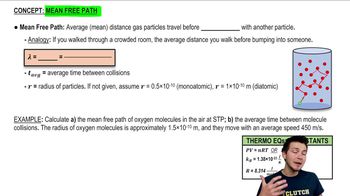
The mean free path is the average distance a particle travels between collisions with other particles. In gases, this concept is crucial for understanding how particles interact and move. It depends on factors such as the density of the gas and the size of the particles. A shorter mean free path indicates more frequent collisions, while a longer mean free path suggests that particles can travel further without interacting.
Recommended video:
Guided course
08:20
Mean Free Path

Root Mean Square (RMS) Speed

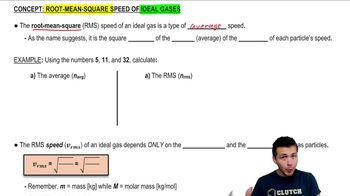
The root mean square speed is a measure of the average speed of particles in a gas, calculated from the kinetic theory of gases. It is defined as the square root of the average of the squares of the speeds of all particles. The RMS speed is important because it relates to the temperature of the gas and provides insight into the kinetic energy of the particles. Higher temperatures correspond to higher RMS speeds.
Recommended video:
Guided course
05:21
Root-Mean-Square Speed of Ideal Gases

Average Energy per Atom

The average energy per atom in a gas is derived from the kinetic theory and is directly related to the temperature of the gas. For an ideal monatomic gas, the average kinetic energy per atom can be expressed as (3/2)kT, where k is the Boltzmann constant and T is the temperature in Kelvin. This concept helps in understanding how thermal energy is distributed among the particles in the gas and is essential for calculating thermodynamic properties.
Recommended video:
Guided course
05:44
Solving Constant and Average Velocity Problems