Pearson+ LogoPearson+ Logo
Ch 21: Heat Engines and Refrigerators
Knight Calc - Physics for Scientists and Engineers 5th Edition
Knight Calc5th EditionPhysics for Scientists and EngineersISBN: 9780137344796Not the one you use?Change textbook
Chapter 21, Problem 16

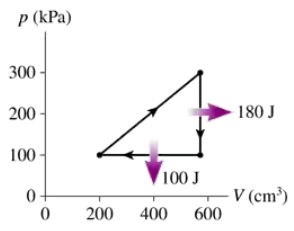
What are (a) the thermal efficiency and (b) the heat extracted from the hot reservoir for the heat engine shown in FIGURE EX21.16?

Verified step by step guidance
1
Step 1: Understand the concept of thermal efficiency. Thermal efficiency (η) is defined as the ratio of the work output (W) to the heat input (Q_h) from the hot reservoir. The formula is η = W / Q_h. Familiarize yourself with this formula as it will be used to calculate part (a).
Step 2: Identify the given values from the problem or figure. Look for the values of work output (W), heat input (Q_h), and heat rejected to the cold reservoir (Q_c). These values are typically provided in the problem or figure.
Step 3: Use the first law of thermodynamics to relate the quantities. The first law states that Q_h = W + Q_c, where Q_h is the heat extracted from the hot reservoir, W is the work done by the engine, and Q_c is the heat rejected to the cold reservoir. Rearrange this equation if necessary to solve for Q_h in part (b).
Step 4: Calculate the thermal efficiency for part (a). Substitute the values of W and Q_h into the formula η = W / Q_h. Ensure the units are consistent (e.g., joules) before performing the calculation.
Step 5: Solve for the heat extracted from the hot reservoir for part (b). Use the equation Q_h = W + Q_c and substitute the given values of W and Q_c. This will give you the amount of heat extracted from the hot reservoir.

Verified video answer for a similar problem:

This video solution was recommended by our tutors as helpful for the problem above.
Video duration:
6m
Was this helpful?

Key Concepts

Here are the essential concepts you must grasp in order to answer the question correctly.

Thermal Efficiency

Thermal efficiency is a measure of how effectively a heat engine converts heat from a hot reservoir into work. It is defined as the ratio of the work output to the heat input from the hot reservoir, often expressed as a percentage. The formula for thermal efficiency (η) is η = W/Qh, where W is the work done by the engine and Qh is the heat absorbed from the hot reservoir.
Recommended video:
Guided course
06:01
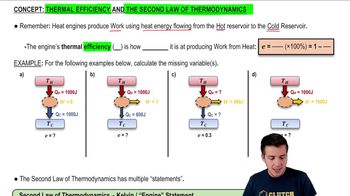
Thermal Efficiency & The Second Law of Thermodynamics

Heat Reservoirs

Heat reservoirs are systems that can supply or absorb heat without undergoing a significant change in temperature. In the context of heat engines, the hot reservoir provides heat to the engine, while the cold reservoir absorbs waste heat. Understanding the properties and roles of these reservoirs is crucial for analyzing the performance and efficiency of heat engines.
Recommended video:
Guided course
07:35
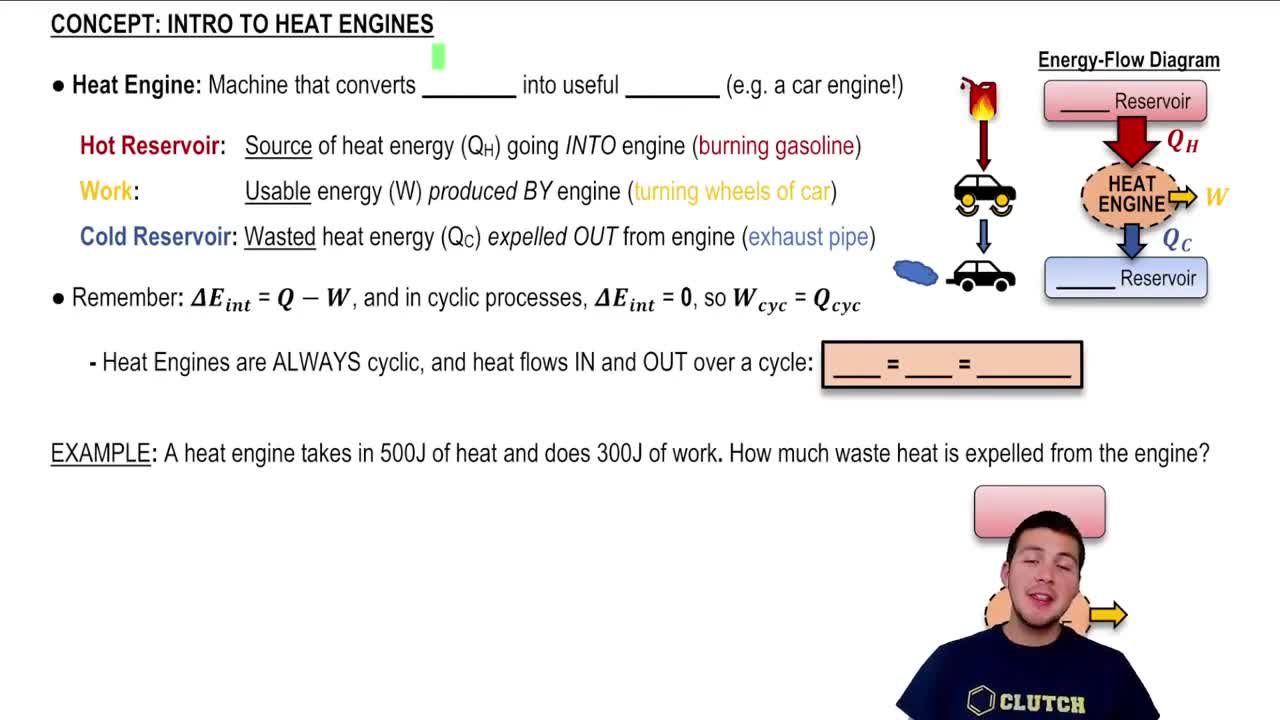
Introduction to Heat Engines

First Law of Thermodynamics

The First Law of Thermodynamics, also known as the law of energy conservation, states that energy cannot be created or destroyed, only transformed from one form to another. In a heat engine, this principle implies that the heat energy supplied from the hot reservoir is converted into work and waste heat, maintaining a balance in energy transfer. This law is fundamental for calculating the heat extracted from the hot reservoir and the work output of the engine.
Recommended video:
Guided course
08:04
The First Law of Thermodynamics