Pearson+ LogoPearson+ Logo
Ch 04: Newton's Laws of Motion
Young & Freedman Calc - University Physics 14th Edition
Young & Freedman Calc14th EditionUniversity PhysicsISBN: 9780321973610Not the one you use?Change textbook
Chapter 4, Problem 19a

At the surface of Jupiter's moon Io, the acceleration due to gravity is g=1.81g = 1.81 m/s2. A watermelon weighs 44.044.0 N at the surface of the earth. What is the watermelon's mass on the earth's surface?

Verified step by step guidance
1
Step 1: Recall the relationship between weight and mass, which is given by the formula: W=mg, where W is the weight, m is the mass, and g is the acceleration due to gravity.
Step 2: Identify the values provided in the problem. The weight of the watermelon on Earth's surface is 44.0 N, and the acceleration due to gravity on Earth is approximately 9.81 m/s2.
Step 3: Rearrange the formula to solve for mass: m=Wg. Substitute the given values into the equation.
Step 4: Perform the division: Divide the weight of the watermelon (44.0 N) by the acceleration due to gravity on Earth (9.81 m/s2).
Step 5: The result of the division will give the mass of the watermelon on Earth's surface in kilograms (kg).

Verified video answer for a similar problem:

This video solution was recommended by our tutors as helpful for the problem above.
Video duration:
1m
Was this helpful?

Key Concepts

Here are the essential concepts you must grasp in order to answer the question correctly.

Weight and Mass

Weight is the force exerted by gravity on an object, calculated as the product of mass and gravitational acceleration (W = mg). Mass is a measure of the amount of matter in an object and remains constant regardless of location. Understanding the distinction between weight and mass is crucial for solving problems involving gravitational forces.
Recommended video:
Guided course
10:19
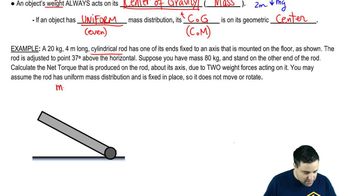
Torque Due to Weight

Gravitational Acceleration

Gravitational acceleration is the acceleration experienced by an object due to the force of gravity acting on it. On Earth, this value is approximately 9.81 m/s², but it varies on other celestial bodies, such as Jupiter's moon Io, where it is 1.81 m/s². This concept is essential for calculating weight and understanding how it changes with different gravitational fields.
Recommended video:
Guided course
07:32
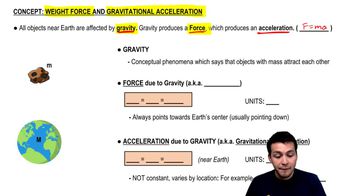
Weight Force & Gravitational Acceleration

Newton's Second Law of Motion

Newton's Second Law states that the force acting on an object is equal to the mass of that object multiplied by its acceleration (F = ma). This principle is fundamental in physics for analyzing the relationship between force, mass, and acceleration, and is particularly relevant when calculating weight as a force due to gravity.
Recommended video:
Guided course
06:54
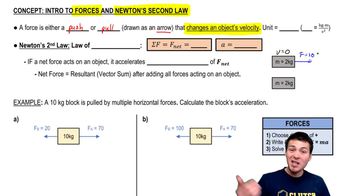
Intro to Forces & Newton's Second Law
Related Practice
Textbook Question

A 4.504.50-kg experimental cart undergoes an acceleration in a straight line (the xx-axis). The graph in Fig. E4.134.13 shows this acceleration as a function of time. During what times is the net force on the cart a constant?

966
views
Textbook Question

A small 8.008.00-kg rocket burns fuel that exerts a time-varying upward force on the rocket (assume constant mass) as the rocket moves upward from the launch pad. This force obeys the equation F=A+Bt2F=A+Bt^2. Measurements show that at t=0t = 0, the force is 100.0100.0 N, and at the end of the first 2.002.00 s, it is 150.0150.0 N. Find the constants AA and BB, including their SI units.

2497
views
Textbook Question

An astronaut's pack weighs 17.517.5 N when she is on the earth but only 3.243.24 N when she is at the surface of a moon. What is the acceleration due to gravity on this moon?

3442
views
Textbook Question

At the surface of Jupiter's moon Io, the acceleration due to gravity is g=1.81g = 1.81 m/s2. A watermelon weighs 44.044.0 N at the surface of the earth. What would be its mass and weight on the surface of Io?

4473
views
Textbook Question

A small car of mass 380380 kg is pushing a large truck of mass 900900 kg due east on a level road. The car exerts a horizontal force of 16001600 N on the truck. What is the magnitude of the force that the truck exerts on the car?

3751
views
Textbook Question

World-class sprinters can accelerate out of the starting blocks with an acceleration that is nearly horizontal and has magnitude 1515 m/s2. How much horizontal force must a 55 55-kg sprinter exert on the starting blocks to produce this acceleration? Which body exerts the force that propels the sprinter: the blocks or the sprinter herself?

2999
views