

Ch 05: Applying Newton's Laws
Chapter 5, Problem 50a

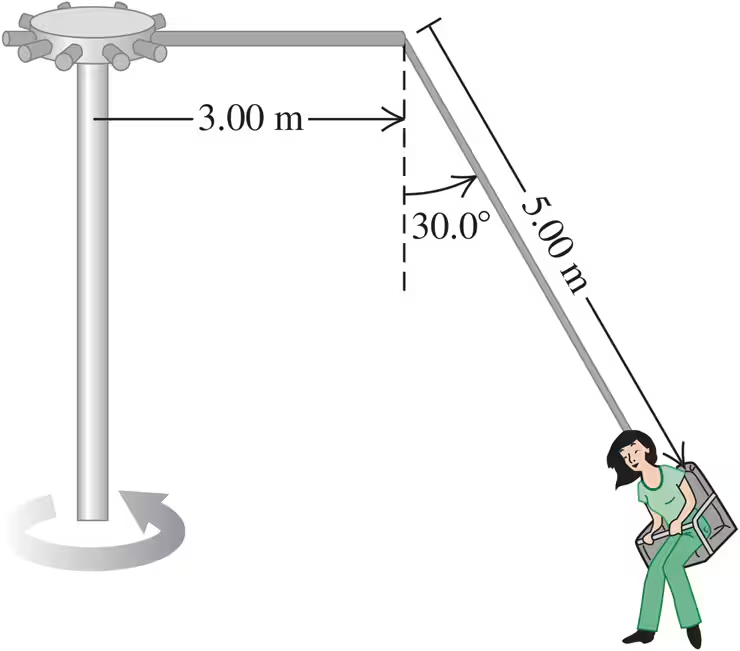
The 'Giant Swing' at a county fair consists of a vertical central shaft with a number of horizontal arms attached at its upper end. Each arm supports a seat suspended from a cable 5.005.00 m long, and the upper end of the cable is fastened to the arm at a point 3.003.00 m from the central shaft (Fig. E5.505.50). Find the time of one revolution of the swing if the cable supporting a seat makes an angle of 30.0°30.0° with the vertical.
Illustration of a giant swing with a vertical shaft, arms, and a seat at a 30° angle, showing dimensions of 3.00 m and 5.00 m.

Verified step by step guidance
1
Step 1: Analyze the geometry of the swing system. The cable length is given as 5.00 m, and it makes an angle of 30.0° with the vertical. Use trigonometry to determine the horizontal and vertical components of the cable's length. The horizontal component is given by \( L_{horizontal} = L \cdot \sin(\theta) \), and the vertical component is \( L_{vertical} = L \cdot \cos(\theta) \).
Step 2: Determine the radius of the circular motion. The radius is the sum of the horizontal distance from the central shaft to the cable attachment point (3.00 m) and the horizontal component of the cable's length calculated in Step 1. Use \( R = 3.00 \text{ m} + L_{horizontal} \).
Step 3: Apply the centripetal force equation to relate the tension in the cable to the circular motion. The centripetal force is provided by the horizontal component of the tension in the cable. Use \( F_{centripetal} = \frac{m \cdot v^2}{R} \), where \( v \) is the tangential velocity, \( R \) is the radius, and \( m \) is the mass of the seat and rider.
Step 4: Relate the forces acting on the cable. The vertical component of the tension balances the gravitational force, \( T_{vertical} = m \cdot g \). The horizontal component of the tension provides the centripetal force, \( T_{horizontal} = \frac{m \cdot v^2}{R} \). Use trigonometry to express \( T_{vertical} \) and \( T_{horizontal} \) in terms of the total tension \( T \) and the angle \( \theta \).
Step 5: Calculate the period of the swing's revolution. The tangential velocity \( v \) is related to the period \( T \) by \( v = \frac{2 \pi R}{T} \). Rearrange this equation to solve for \( T \), the time for one revolution: \( T = \frac{2 \pi R}{v} \). Substitute the values for \( R \) and \( v \) obtained from the previous steps.

Verified video answer for a similar problem:

This video solution was recommended by our tutors as helpful for the problem above.
Video duration:
6m
Was this helpful?

Key Concepts

Here are the essential concepts you must grasp in order to answer the question correctly.

Centripetal Force

Centripetal force is the net force that acts on an object moving in a circular path, directed towards the center of the circle. In the context of the Giant Swing, this force is necessary to keep the seats moving in a circular motion as they swing outwards. It is provided by the tension in the cable and the gravitational force acting on the riders.
Recommended video:
Guided course
06:48
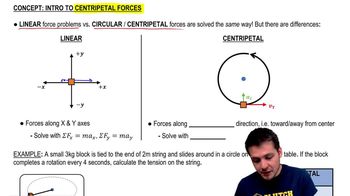
Intro to Centripetal Forces

Pendulum Motion

Pendulum motion refers to the oscillatory movement of a mass attached to a fixed point by a cable or rod. In this scenario, the seats of the Giant Swing can be modeled as pendulums, where the angle of the cable with the vertical affects the period of the swing. The period is influenced by the length of the cable and the angle, which determines the effective gravitational force acting on the pendulum.
Recommended video:
Guided course
07:52
Simple Harmonic Motion of Pendulums

Period of Revolution

The period of revolution is the time it takes for an object to complete one full cycle of motion around a circular path. For the Giant Swing, this period can be calculated using the geometry of the swing and the forces acting on it. The angle of the cable and the length of the cable are critical in determining how quickly the swing completes its circular motion.
Recommended video:
Guided course
06:28
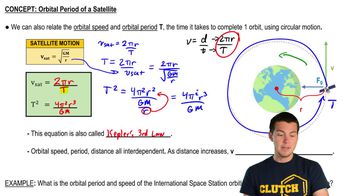
Satellite Period
Related Practice
Textbook Question

A small car with mass 0.8000.800 kg travels at constant speed on the inside of a track that is a vertical circle with radius 5.005.00 m (Fig. E5.455.45). If the normal force exerted by the track on the car when it is at the top of the track (point BB) is 6.006.00 N, what is the normal force on the car when it is at the bottom of the track (point AA)?

3184
views
1
comments
Textbook Question

A flat (unbanked) curve on a highway has a radius of 170.0170.0 m. A car rounds the curve at a speed of 25.025.0 m/s. What is the minimum coefficient of static friction that will prevent sliding?

1856
views
Textbook Question

A 11251125-kg car and a 22502250-kg pickup truck approach a curve on a highway that has a radius of 225 225 m. At what angle should the highway engineer bank this curve so that vehicles traveling at 65.065.0 mi/h can safely round it regardless of the condition of their tires? Should the heavy truck go slower than the lighter car?

2850
views
Textbook Question

In another version of the 'Giant Swing' (see Exercise 5.505.50), the seat is connected to two cables, one of which is horizontal (Fig. E5.515.51). The seat swings in a horizontal circle at a rate of 28.028.0 rpm (rev/min). If the seat weighs 255255 N and an 825825-N person is sitting in it, find the tension in each cable.

3900
views
1
rank
1
comments
Textbook Question

One problem for humans living in outer space is that they are apparently weightless. One way around this problem is to design a space station that spins about its center at a constant rate. This creates 'artificial gravity' at the outside rim of the station. If the diameter of the space station is 800800 m, how many revolutions per minute are needed for the 'artificial gravity' acceleration to be 9.809.80 m/s2?

1564
views
Textbook Question

The Cosmo Clock 21 Ferris wheel in Yokohama, Japan, has a diameter of 100100 m. Its name comes from its 6060 arms, each of which can function as a second hand (so that it makes one revolution every 60.060.0 s). Find the speed of the passengers when the Ferris wheel is rotating at this rate.

2010
views