
Ch 09: Rotation of Rigid Bodies
Young & Freedman Calc - University Physics 14th Edition
Young & Freedman Calc14th EditionUniversity PhysicsISBN: 9780321973610Not the one you use?Change textbook
Chapter 9, Problem 33

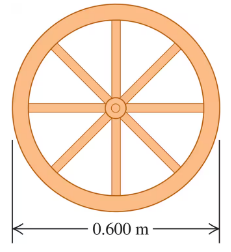
A wagon wheel is constructed as shown in Fig. E9.33. The radius of the wheel is 0.300 m, and the rim has mass 1.40 kg. Each of the eight spokes that lie along a diameter and are 0.300 m long has mass 0.280 kg. What is the moment of inertia of the wheel about an axis through its center and perpendicular to the plane of the wheel? (Use Table 9.2.)
Illustration of a wagon wheel with a radius of 0.300 m, featuring eight spokes and labeled dimensions.

Verified step by step guidance
1
Step 1: Identify the components of the wagon wheel that contribute to the moment of inertia. The wheel consists of a rim and eight spokes. The rim is a circular hoop, and the spokes are rods extending from the center to the rim.
Step 2: Use the formula for the moment of inertia of a hoop about an axis perpendicular to its plane and passing through its center. The formula is I_hoop = m * r^2, where m is the mass of the hoop (rim) and r is its radius.
Step 3: Calculate the moment of inertia for each spoke. Each spoke is modeled as a thin rod rotating about one end. The formula for the moment of inertia of a rod about one end is I_rod = (1/3) * m * L^2, where m is the mass of the rod and L is its length.
Step 4: Multiply the moment of inertia of one spoke by 8 to account for all eight spokes. Add this value to the moment of inertia of the rim to find the total moment of inertia of the wheel.
Step 5: Combine the results from Step 2 and Step 4 to express the total moment of inertia of the wheel. Ensure all units are consistent and verify the calculation setup before proceeding to numerical evaluation.

Verified video answer for a similar problem:

This video solution was recommended by our tutors as helpful for the problem above.
Video duration:
6m
Was this helpful?

Key Concepts

Here are the essential concepts you must grasp in order to answer the question correctly.

Moment of Inertia

The moment of inertia is a measure of an object's resistance to changes in its rotational motion about a specific axis. It depends on the mass distribution relative to that axis. For composite objects, the total moment of inertia is the sum of the moments of inertia of individual components, calculated using their respective mass and distance from the axis of rotation.
Recommended video:
Guided course
11:47
Intro to Moment of Inertia

Parallel Axis Theorem

The parallel axis theorem allows for the calculation of the moment of inertia of an object about any axis, given its moment of inertia about a parallel axis through its center of mass. It states that the moment of inertia about the new axis is equal to the moment of inertia about the center of mass plus the product of the mass and the square of the distance between the two axes.
Recommended video:
Guided course
13:46
Parallel Axis Theorem

Composite Bodies

Composite bodies consist of multiple shapes or components, each with its own moment of inertia. To find the total moment of inertia for such bodies, one must calculate the moment of inertia for each component about the same axis and then sum these values. This approach is essential for complex shapes like the wagon wheel, which includes a rim and spokes.
Recommended video:
Guided course
07:47
Vector Composition & Decomposition
Related Practice
Textbook Question

A uniform bar has two small balls glued to its ends. The bar is 2.00 m long and has mass 4.00 kg, while the balls each have mass 0.300 kg and can be treated as point masses. Find the moment of inertia of this combination about an axis parallel to the bar and 0.500 m from it.

1014
views
Textbook Question

You are a project manager for a manufacturing company. One of the machine parts on the assembly line is a thin, uniform rod that is 60.0 cm long and has mass 0.400 kg. What is the moment of inertia of this rod for an axis at its center, perpendicular to the rod?

1041
views
1
rank
Textbook Question

You are a project manager for a manufacturing company. One of the machine parts on the assembly line is a thin, uniform rod that is 60.0 cm long and has mass 0.400 kg. One of your engineers has proposed to reduce the moment of inertia by bending the rod at its center into a V-shape, with a 60.0o angle at its vertex. What would be the moment of inertia of this bent rod about an axis perpendicular to the plane of the V at its vertex?

2713
views
1
comments
Textbook Question

An airplane propeller is 2.08 m in length (from tip to tip) with mass 117 kg and is rotating at 2400 rpm (rev/min) about an axis through its center. You can model the propeller as a slender rod.

(a) What is its rotational kinetic energy?

(b) Suppose that, due to weight constraints, you had to reduce the propeller's mass to 75.0% of its original mass, but you still needed to keep the same size and kinetic energy. What would its angular speed have to be, in rpm?

2304
views
Textbook Question

A compound disk of outside diameter 140.0 cm is made up of a uniform solid disk of radius 50.0 cm and area density 3.00 g/cm2 surrounded by a concentric ring of inner radius 50.0 cm, outer radius 70.0 cm, and area density 2.00 g/cm2. Find the moment of inertia of this object about an axis perpendicular to the plane of the object and passing through its center.

1341
views
Textbook Question

A wheel is turning about an axis through its center with constant angular acceleration. Starting from rest, at t = 0, the wheel turns through 8.20 revolutions in 12.0 s. At t = 12.0 s the kinetic energy of the wheel is 36.0 J. For an axis through its center, what is the moment of inertia of the wheel?

1737
views