
Pearson+ LogoPearson+ Logo
Ch 09: Rotation of Rigid Bodies
Young & Freedman Calc - University Physics 14th Edition
Young & Freedman Calc14th EditionUniversity PhysicsISBN: 9780321973610Not the one you use?Change textbook
Chapter 9, Problem 8c

A wheel is rotating about an axis that is in the z-direction. The angular velocity ωz is -6.00 rad/s at t = 0, increases linearly with time, and is +4.00 rad/s at t = 7.00 s. We have taken counterclockwise rotation to be positive. What is the angular displacement of the wheel at t = 7.00 s?

Verified step by step guidance
1
Determine the angular acceleration (α) of the wheel. Since the angular velocity (ω_z) changes linearly with time, the angular acceleration is constant. Use the formula: α=ωfωit, where ωf is the final angular velocity, ωi is the initial angular velocity, and t is the time interval.
Substitute the given values into the formula for angular acceleration: ωf = +4.00 rad/s, ωi = -6.00 rad/s, and t = 7.00 s. This will give you the value of α.
Use the kinematic equation for angular displacement: θ = ωit + 12αt2. Here, θ is the angular displacement, ωi is the initial angular velocity, t is the time, and α is the angular acceleration.
Substitute the known values into the angular displacement equation: ωi = -6.00 rad/s, t = 7.00 s, and the calculated value of α from step 2. Simplify the terms to find θ.
Interpret the result. The sign of the angular displacement will indicate the direction of rotation (positive for counterclockwise and negative for clockwise). Ensure the units of the final angular displacement are in radians.

Verified video answer for a similar problem:

This video solution was recommended by our tutors as helpful for the problem above.
Video duration:
1m
Was this helpful?

Key Concepts

Here are the essential concepts you must grasp in order to answer the question correctly.

Angular Velocity

Angular velocity is a vector quantity that represents the rate of rotation of an object around an axis. It is measured in radians per second (rad/s) and indicates both the speed and direction of the rotation. In this question, the angular velocity changes from -6.00 rad/s to +4.00 rad/s, indicating a change in the direction of rotation over time.
Recommended video:
Guided course
06:18
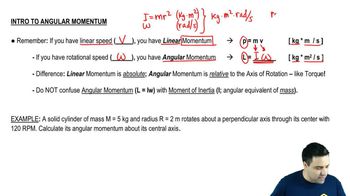
Intro to Angular Momentum

Angular Displacement

Angular displacement refers to the angle through which an object has rotated about a specific axis in a given time period. It is typically measured in radians and can be calculated by integrating angular velocity over time. In this scenario, the angular displacement can be determined by finding the area under the angular velocity-time graph from t = 0 to t = 7.00 s.
Recommended video:
Guided course
14:03
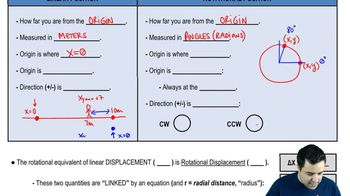
Rotational Position & Displacement

Kinematics of Rotational Motion

The kinematics of rotational motion describes the relationships between angular displacement, angular velocity, and angular acceleration. When angular velocity changes linearly, as in this case, the angular acceleration can be calculated as the change in angular velocity divided by the time interval. This concept is essential for determining the total angular displacement when the angular velocity is not constant.
Recommended video:
Guided course
07:18
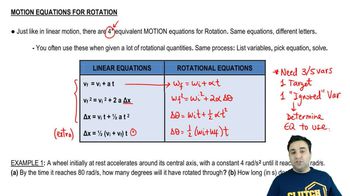
Equations of Rotational Motion
Related Practice
Textbook Question

The angle θ through which a disk drive turns is given by θ(t) = a + bt - ct3, where a, b, and c are constants, t is in seconds, and θ is in radians. When t = 0, θ = π/4 rad and the angular velocity is 2.00 rad/s. When t = 1.50 s, the angular acceleration is 1.25 rad/s2. What are θ and the angular velocity when the angular acceleration is 3.50 rad/s2?

1308
views
Textbook Question

A wheel is rotating about an axis that is in the z-direction. The angular velocity ωz is -6.00 rad/s at t = 0, increases linearly with time, and is +4.00 rad/s at t = 7.00 s. We have taken counterclockwise rotation to be positive. Is the angular acceleration during this time interval positive or negative?

1594
views
Textbook Question

A wheel is rotating about an axis that is in the z-direction. The angular velocity ωz is -6.00 rad/s at t = 0, increases linearly with time, and is +4.00 rad/s at t = 7.00 s. We have taken counterclockwise rotation to be positive. During what time interval is the speed of the wheel increasing? Decreasing?

786
views
Textbook Question

A bicycle wheel has an initial angular velocity of 1.50 rad/s. (a) If its angular acceleration is constant and equal to 0.200 rad/s2, what is its angular velocity at t = 2.50 s? (b) Through what angle has the wheel turned between t = 0 and t = 2.50 s?

524
views
Textbook Question

An electric fan is turned off, and its angular velocity decreases uniformly from 500 rev/min to 200 rev/min in 4.00 s. Find the angular acceleration in rev/s2 and the number of revolutions made by the motor in the 4.00-s interval.

1656
views
Textbook Question

An electric fan is turned off, and its angular velocity decreases uniformly from 500 rev/min to 200 rev/min in 4.00 s. How many more seconds are required for the fan to come to rest if the angular acceleration remains constant at the value calculated in part (a)?

2451
views