Ch 09: Rotation of Rigid Bodies
Young & Freedman Calc - University Physics 14th Edition
Young & Freedman Calc14th EditionUniversity PhysicsISBN: 9780321973610Not the one you use?Change textbook
Chapter 9, Problem 3b

The angular velocity of a flywheel obeys the equation ωz(t) = A + Bt2, where t is in seconds and A and B are constants having numerical values 2.75 (for A) and 1.50 (for B). What is the angular acceleration of the wheel at (i) t = 0 and (ii) t = 5.00 s?

Verified step by step guidance
1
Understand the problem: The angular velocity of the flywheel is given as a function of time, \( \omega_z(t) = A + B t^2 \), where \( A = 2.75 \) and \( B = 1.50 \). Angular acceleration is the time derivative of angular velocity, \( \alpha(t) = \frac{d\omega_z(t)}{dt} \). We need to calculate \( \alpha(t) \) at \( t = 0 \) and \( t = 5.00 \ \text{s} \).
Differentiate the angular velocity equation with respect to time to find the angular acceleration: \( \alpha(t) = \frac{d}{dt}(A + B t^2) \). Since \( A \) is a constant, its derivative is zero, and the derivative of \( B t^2 \) is \( 2 B t \). Thus, \( \alpha(t) = 2 B t \).
Substitute the value of \( B = 1.50 \) into the angular acceleration equation: \( \alpha(t) = 2 (1.50) t = 3.00 t \). This is the expression for angular acceleration as a function of time.
To find the angular acceleration at \( t = 0 \), substitute \( t = 0 \) into \( \alpha(t) = 3.00 t \): \( \alpha(0) = 3.00 (0) \). Simplify to find the angular acceleration at \( t = 0 \).
To find the angular acceleration at \( t = 5.00 \ \text{s} \), substitute \( t = 5.00 \) into \( \alpha(t) = 3.00 t \): \( \alpha(5.00) = 3.00 (5.00) \). Simplify to find the angular acceleration at \( t = 5.00 \ \text{s} \).

Verified video answer for a similar problem:

This video solution was recommended by our tutors as helpful for the problem above.
Video duration:
2m
Was this helpful?

Key Concepts

Here are the essential concepts you must grasp in order to answer the question correctly.

Angular Velocity

Angular velocity is a measure of how quickly an object rotates around an axis, typically expressed in radians per second. In the given equation, ω_z(t) = A + Bt², the angular velocity depends on time and is influenced by constants A and B. Understanding this concept is crucial for analyzing rotational motion and determining how the speed of rotation changes over time.
Recommended video:
Guided course
06:18
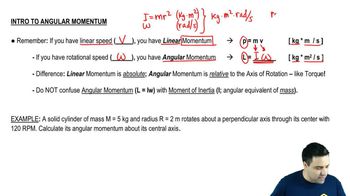
Intro to Angular Momentum

Angular Acceleration

Angular acceleration refers to the rate of change of angular velocity over time, usually expressed in radians per second squared. It can be calculated as the derivative of angular velocity with respect to time. In this case, to find the angular acceleration, we differentiate the given equation for angular velocity, which will provide insights into how the rotation speed of the flywheel changes at specific moments.
Recommended video:
Guided course
12:12
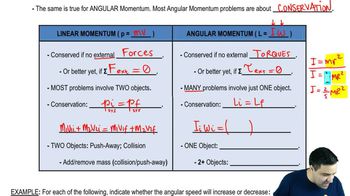
Conservation of Angular Momentum

Differentiation in Physics

Differentiation is a fundamental mathematical process used in physics to determine rates of change. In the context of the problem, differentiating the angular velocity function with respect to time allows us to find the angular acceleration. This concept is essential for analyzing dynamic systems, as it helps relate position, velocity, and acceleration in both linear and rotational motion.
Recommended video:
Guided course
13:04
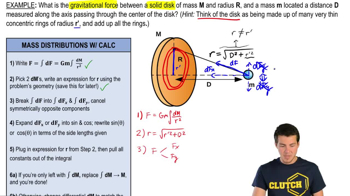
Gravitational Force from a Solid Disk