

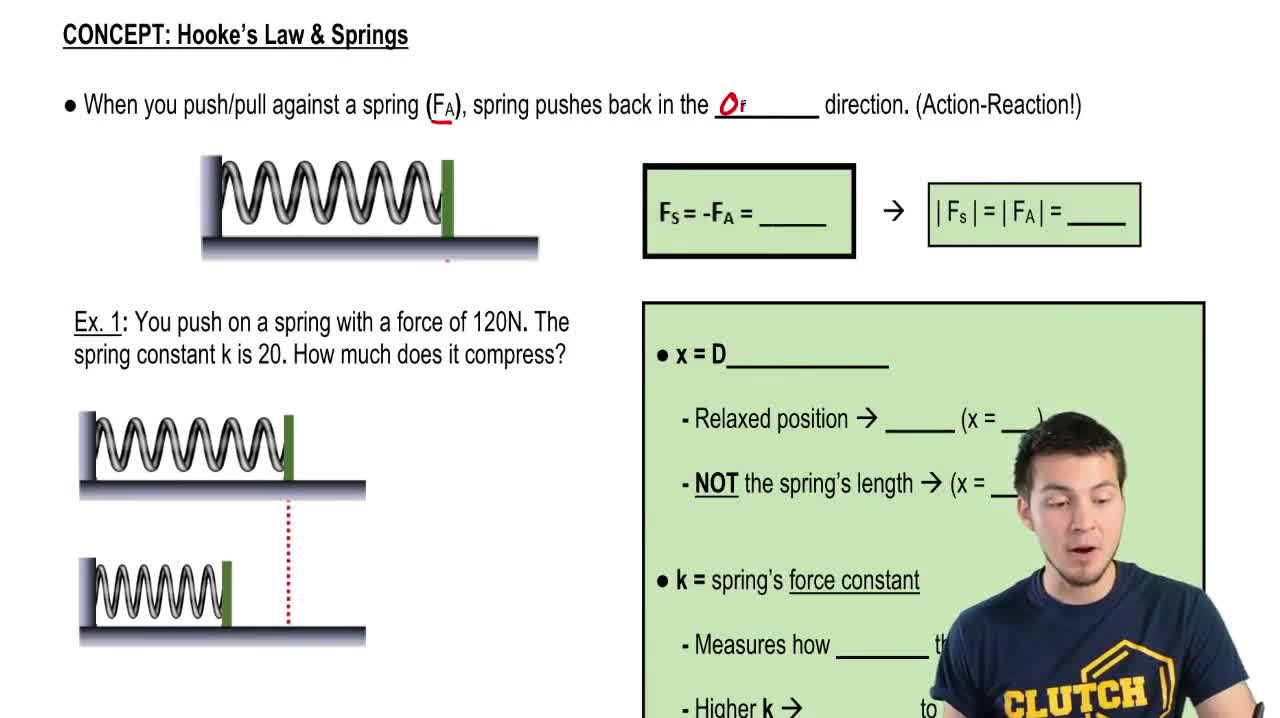
A small block is attached to an ideal spring and is moving in SHM on a horizontal frictionless surface. The amplitude of the motion is 0.165 m. The maximum speed of the block is 3.90 m/s. What is the maximum magnitude of the acceleration of the block?
A 0.500-kg glider, attached to the end of an ideal spring with force constant k = 450 N/m, undergoes SHM with an amplitude of 0.040 m. Compute the total mechanical energy of the glider at any point in its motion
Verified step by step guidance
Verified video answer for a similar problem:
Key Concepts
Simple Harmonic Motion (SHM)
Hooke's Law
Total Mechanical Energy in SHM
A small block is attached to an ideal spring and is moving in SHM on a horizontal, frictionless surface. The amplitude of the motion is 0.250 m and the period is 3.20 s. What are the speed and acceleration of the block when x = 0.160 m?
A 0.500-kg glider, attached to the end of an ideal spring with force constant k = 450 N/m, undergoes SHM with an amplitude of 0.040 m. Compute the speed of the glider when it is at x = -0.015 m.
A cheerleader waves her pom-pom in SHM with an amplitude of 18.0 cm and a frequency of 0.850 Hz. Find (a) the maximum magnitude of the acceleration and of the velocity; (b) the acceleration and speed when the pom-pom's coordinate is x = +9.0 cm; (c) the time required to move from the equilibrium position directly to a point 12.0 cm away. (d) Which of the quantities asked for in parts (a), (b), and (c) can be found by using the energy approach used in Section 14.3, and which cannot? Explain.
A mass is oscillating with amplitude A at the end of a spring. How far (in terms of A) is this mass from the equilibrium position of the spring when the elastic potential energy equals the kinetic energy?
A thrill-seeking cat with mass 4.00 kg is attached by a harness to an ideal spring of negligible mass and oscillates vertically in SHM. The amplitude is 0.050 m, and at the highest point of the motion the spring has its natural unstretched length. Calculate the elastic potential energy of the spring (take it to be zero for the unstretched spring), the kinetic energy of the cat, the gravitational potential energy of the system relative to the lowest point of the motion, and the sum of these three energies when the cat is at its highest point.
