Pearson+ LogoPearson+ Logo
Ch 16: Sound & Hearing
Young & Freedman Calc - University Physics 14th Edition
Young & Freedman Calc14th EditionUniversity PhysicsISBN: 9780321973610Not the one you use?Change textbook
Chapter 16, Problem 25a

Standing sound waves are produced in a pipe that is 1.20 m long. For the fundamental and first two overtones, determine the locations along the pipe (measured from the left end) of the displacement nodes and the pressure nodes if (a) the pipe is open at both ends

Verified step by step guidance
1
Understand the concept of standing waves in an open pipe: In a pipe open at both ends, standing waves form with displacement antinodes at the open ends and displacement nodes within the pipe. Pressure nodes and antinodes are opposite to displacement nodes and antinodes.
Identify the fundamental frequency: For the fundamental frequency, the pipe length is equal to half the wavelength (λ/2). Therefore, the wavelength λ can be calculated using the formula: λ=2L, where L is the length of the pipe.
Determine the locations of displacement nodes for the fundamental frequency: Since the pipe is open at both ends, the displacement nodes are located at the midpoint of the pipe. Calculate the position using: x=L2.
Calculate the first overtone: For the first overtone, the pipe length is equal to the full wavelength (λ). The displacement nodes are located at one-third and two-thirds of the pipe length. Use the formula: x=L3 and x=2L3.
Calculate the second overtone: For the second overtone, the pipe length is equal to one and a half wavelengths (3λ/2). The displacement nodes are located at one-fourth, one-half, and three-fourths of the pipe length. Use the formula: x=L4, x=L2, and x=3L4.

Verified video answer for a similar problem:

This video solution was recommended by our tutors as helpful for the problem above.
Video duration:
10m
Was this helpful?

Key Concepts

Here are the essential concepts you must grasp in order to answer the question correctly.

Standing Waves

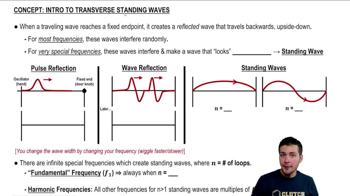
Standing waves are a pattern of vibration that occurs when two waves of the same frequency and amplitude travel in opposite directions and interfere with each other. In a pipe, standing waves are characterized by nodes, where the displacement is always zero, and antinodes, where the displacement is maximum. Understanding standing waves is crucial for determining the positions of nodes and antinodes in the pipe.
Recommended video:
Guided course
07:58
Intro to Transverse Standing Waves

Open Pipe Harmonics

An open pipe supports standing waves with nodes at both ends. The fundamental frequency, or first harmonic, has one node at each end and one antinode in the middle. The first overtone, or second harmonic, has two nodes and two antinodes, while the second overtone, or third harmonic, has three nodes and three antinodes. The pattern of nodes and antinodes helps determine their positions along the pipe.
Recommended video:
Guided course
07:52
Simple Harmonic Motion of Pendulums

Displacement and Pressure Nodes

In a standing wave, displacement nodes are points where the medium does not move, while pressure nodes are points where the pressure variation is minimal. In an open pipe, displacement nodes coincide with pressure antinodes and vice versa. Understanding the relationship between displacement and pressure nodes is essential for identifying their locations in the pipe.
Recommended video:
Guided course
17:04
Pressure and Atmospheric Pressure