
Textbook Question
The fundamental frequency of a pipe that is open at both ends is 524 Hz. If one end is now closed, find the wavelength
2856
views

 Verified step by step guidance
 05:08
05:08
 09:39
09:39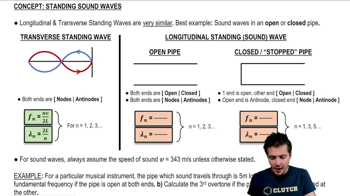 05:17
05:17The fundamental frequency of a pipe that is open at both ends is 524 Hz. If one end is now closed, find the wavelength
Small speakers A and B are driven in phase at 725 Hz by the same audio oscillator. Both speakers start out 4.50 m from the listener, but speaker A is slowly moved away (Fig. E16.34). At what distance d will the sound from the speakers first produce destructive interference at the listener's location?
<Image>
Standing sound waves are produced in a pipe that is 1.20 m long. For the fundamental and first two overtones, determine the locations along the pipe (measured from the left end) of the displacement nodes and the pressure nodes if the pipe is closed at the left end and open at the right end.
Standing sound waves are produced in a pipe that is 1.20 m long. For the fundamental and first two overtones, determine the locations along the pipe (measured from the left end) of the displacement nodes and the pressure nodes if (a) the pipe is open at both ends
A baby's mouth is 30 cm from her father's ear and 1.50 m from her mother's ear. What is the difference between the sound intensity levels heard by the father and by the mother?
The fundamental frequency of a pipe that is open at both ends is 524 Hz. the frequency of the new fundamental.