Ch 25: Current, Resistance, and EMF
Chapter 25, Problem 15c

A cylindrical tungsten filament 15.015.0 cm long with a diameter of 1.001.00 mm is to be used in a machine for which the temperature will range from room temperature (2020°C) up to 120120°C. It will carry a current of 12.512.5 A at all temperatures. What will be the maximum potential drop over the full length of the filament?

Verified step by step guidance
1
First, understand that the potential drop across the filament can be calculated using Ohm's Law, which states that the potential drop (V) is equal to the current (I) multiplied by the resistance (R) of the filament: V=IR.
Next, calculate the resistance of the filament using the formula for resistance: R=ρLA, where ρ is the resistivity of tungsten, L is the length of the filament, and A is the cross-sectional area.
Determine the cross-sectional area of the filament using the formula for the area of a circle: A=πr2, where r is the radius of the filament. Given the diameter is 1.00 mm, convert this to meters and find the radius.
Account for the change in resistivity with temperature. The resistivity of tungsten changes with temperature, and this can be calculated using the formula: ρ=ρ0(1+α(T-T0)), where ρ0 is the resistivity at room temperature, α is the temperature coefficient of resistivity, T is the final temperature, and T0 is the initial temperature.
Finally, substitute the maximum resistivity value (at 120°C) into the resistance formula, calculate the resistance, and then use Ohm's Law to find the maximum potential drop across the filament.

Verified video answer for a similar problem:

This video solution was recommended by our tutors as helpful for the problem above.
Video duration:
7m
Was this helpful?

Key Concepts

Here are the essential concepts you must grasp in order to answer the question correctly.

Resistivity and Temperature Dependence

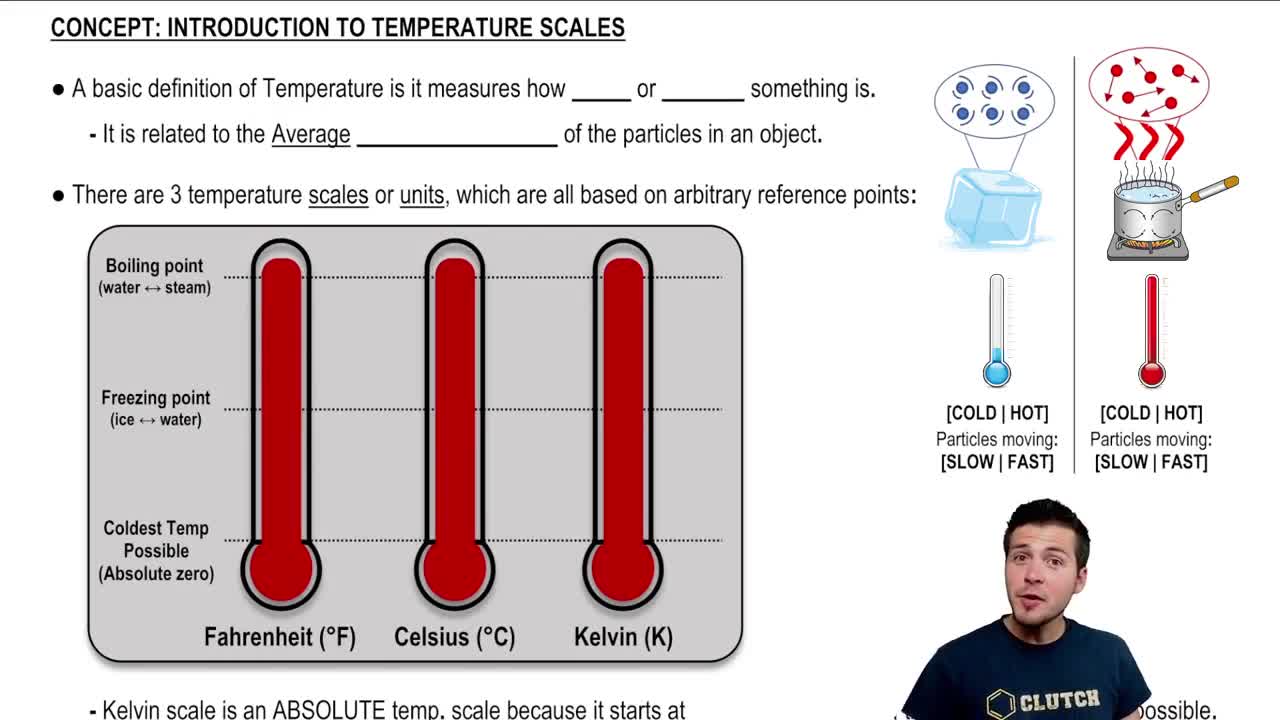
Resistivity is a material property that quantifies how strongly a material opposes the flow of electric current. For metals like tungsten, resistivity increases with temperature. The relationship is often linear over small temperature ranges, described by the formula ρ(T) = ρ₀[1 + α(T - T₀)], where ρ₀ is the resistivity at a reference temperature T₀, and α is the temperature coefficient of resistivity.
Recommended video:
Guided course
04:54
Introduction To Temperature Scales

Ohm's Law

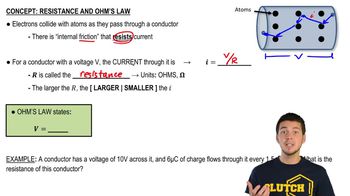
Ohm's Law is a fundamental principle in electronics and physics, stating that the current through a conductor between two points is directly proportional to the voltage across the two points, and inversely proportional to the resistance. It is expressed as V = IR, where V is the voltage, I is the current, and R is the resistance. This law is crucial for calculating the potential drop across the filament.
Recommended video:
Guided course
03:07
Resistance and Ohm's Law

Resistance Calculation for Cylindrical Conductors

The resistance of a cylindrical conductor is calculated using the formula R = ρL/A, where R is the resistance, ρ is the resistivity, L is the length, and A is the cross-sectional area. For a cylinder, A = π(d/2)², where d is the diameter. This formula helps determine how the filament's resistance changes with temperature, affecting the potential drop.
Recommended video:
Guided course
07:43
Electric Fields in Conductors