
Ch 28: Sources of Magnetic Field
Chapter 28, Problem 29b

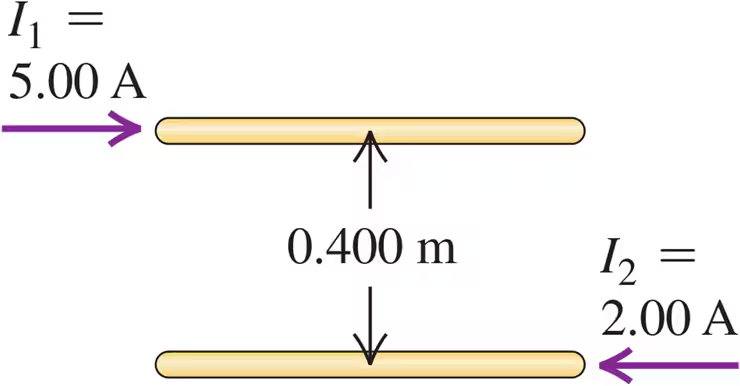
Two long, parallel wires are separated by a distance of 0.400 m (Fig. E28.29). The currents I1 and I2 have the directions shown. Each current is doubled, so that I1 becomes 10.0 A and I2 becomes 4.00 A. Now what is the magnitude of the force that each wire exerts on a 1.20 m length of the other?

Verified step by step guidance
1
Identify the formula for the magnetic force between two parallel currents: The force per unit length between two parallel wires carrying currents I1 and I2 separated by a distance d is given by the formula: μo0I1I22πd, where μo0 is the permeability of free space.
Substitute the given values into the formula: Use the values I1 = 10.0 A, I2 = 4.00 A, and d = 0.400 m. The permeability of free space μo0 is approximately 4π*107 T·m/A.
Calculate the force per unit length: Plug the values into the formula to find the force per unit length between the wires. This will give you the force in newtons per meter.
Determine the total force on a 1.20-m length: Multiply the force per unit length by the length of the wire segment, which is 1.20 m, to find the total force exerted by one wire on the other.
Consider the direction of the force: Since the currents are in the same direction, the force will be attractive. Ensure that the direction of the force is consistent with the right-hand rule for magnetic forces.

Verified video answer for a similar problem:

This video solution was recommended by our tutors as helpful for the problem above.
Video duration:
2m
Was this helpful?

Key Concepts

Here are the essential concepts you must grasp in order to answer the question correctly.

Magnetic Force Between Parallel Currents

The magnetic force between two parallel wires carrying currents is determined by the Ampère's force law. The force per unit length between two wires is proportional to the product of the currents and inversely proportional to the distance between them. This concept is crucial for calculating the force exerted when the currents are doubled.
Recommended video:
Guided course
10:11
Magnetic Force Between Parallel Currents

Biot-Savart Law

The Biot-Savart Law describes how currents produce magnetic fields. For a long, straight wire, the magnetic field at a distance from the wire is proportional to the current and inversely proportional to the distance from the wire. Understanding this helps in determining the magnetic field around each wire, which is essential for calculating the force between them.
Recommended video:
Guided course
04:53
Biot-Savart Law with Calculus

Superposition Principle

The superposition principle states that the net magnetic field at a point is the vector sum of the magnetic fields produced by each current source independently. This principle is important when considering the effects of both wires on each other, especially when the currents are altered, as it allows for the calculation of the resultant force on each wire.
Recommended video:
Guided course
03:32
Superposition of Sinusoidal Wave Functions
Related Practice
Textbook Question

Currents in dc transmission lines can be 100 A or higher. Some people are concerned that the electromagnetic fields from such lines near their homes could pose health dangers. For a line that has current 150 A and a height of 8.0 m above the ground, what magnetic field does the line produce at ground level? Express your answer in teslas and as a percentage of the earth's magnetic field, which is 0.50 G. Is this value cause for worry?

1418
views
Textbook Question

Four long, parallel power lines each carry 100 A currents. A cross-sectional diagram of these lines is a square, 20.0 cm on each side. For each of the three cases shown in Fig. E28.25, calculate the magnetic field at the center of the square.

1617
views
2
rank
Textbook Question

Two long, parallel wires are separated by a distance of 0.400 m (Fig. E28.29). The currents I1 and I2 have the directions shown. Calculate the magnitude of the force exerted by each wire on a 1.20-m length of the other. Is the force attractive or repulsive?

1084
views
Textbook Question

A closed curve encircles several conductors. The line integral Bdl\oint B\cdot dl around this curve is 3.83×10⁴ T m3.83\times10^{-4}\text{ T m}. If you were to integrate around the curve in the opposite direction, what would be the value of the line integral? Explain.

793
views
Textbook Question

As a new electrical technician, you are designing a large solenoid to produce a uniform 0.150 T magnetic field near the center of the solenoid. You have enough wire for 4000 circular turns. This solenoid must be 55.0 cm long and 2.80 cm in diameter. What current will you need to produce the necessary field?

1703
views
Textbook Question

A solid conductor with radius a is supported by insulating disks on the axis of a conducting tube with inner radius b and outer radius c (Fig. E28.43). The central conductor and tube carry equal currents I in opposite directions. The currents are distributed uniformly over the cross sections of each conductor. Derive an expression for the magnitude of the magnetic field at points outside the tube (r > c).

1390
views
1
rank