
Ch 26: Direct-Current Circuits
Young & Freedman Calc - University Physics 14th Edition
Young & Freedman Calc14th EditionUniversity PhysicsISBN: 9780321973610Not the one you use?Change textbook
Chapter 26, Problem 5d

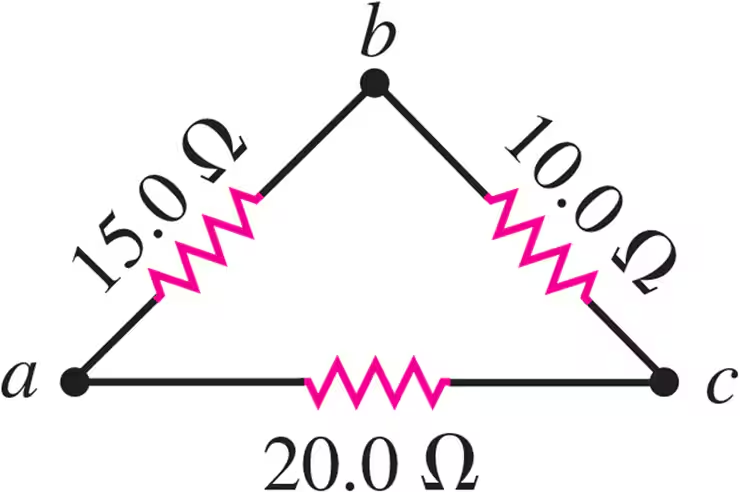
A triangular array of resistors is shown in Fig. E26.5. If the battery has an internal resistance of 3.00Ω, what current will the array draw if the battery is connected across bc?

Verified step by step guidance
1
Identify the resistors in the triangular array. The resistors are labeled as follows: 11.0Ω between points p and s, 13.0Ω between points p and q, and 9.0Ω between points s and r.
Determine the configuration of the resistors. The resistors are arranged in a triangular shape, which suggests a combination of series and parallel connections.
Calculate the equivalent resistance of the array. First, find the resistance between points p and s (11.0Ω) and between points s and r (9.0Ω) as they are in series. Add these resistances: R_series = 11.0Ω + 9.0Ω = 20.0Ω.
Next, consider the parallel connection between the series resistance (20.0Ω) and the resistor between points p and q (13.0Ω). Use the formula for parallel resistances: \( \frac{1}{R_{parallel}} = \frac{1}{R_{series}} + \frac{1}{R_{pq}} \). Substitute the values: \( \frac{1}{R_{parallel}} = \frac{1}{20.0\Omega} + \frac{1}{13.0\Omega} \).
Finally, add the internal resistance of the battery (3.00Ω) to the equivalent resistance of the array to find the total resistance. Use Ohm's Law \( I = \frac{V}{R_{total}} \) to calculate the current drawn by the array, where \( R_{total} = R_{parallel} + 3.00\Omega \).

Verified video answer for a similar problem:

This video solution was recommended by our tutors as helpful for the problem above.
Video duration:
8m
Was this helpful?

Key Concepts

Here are the essential concepts you must grasp in order to answer the question correctly.

Ohm's Law

Ohm's Law is a fundamental principle in electronics and physics that relates voltage (V), current (I), and resistance (R) in an electrical circuit. It is expressed as V = IR, indicating that the voltage across a resistor is the product of the current flowing through it and its resistance. This law is essential for calculating the current in a circuit when the voltage and resistance are known.
Recommended video:
Guided course
03:07
Resistance and Ohm's Law

Series and Parallel Resistor Networks

In electrical circuits, resistors can be arranged in series or parallel configurations. In a series configuration, resistors are connected end-to-end, and the total resistance is the sum of individual resistances. In a parallel configuration, resistors are connected across the same two points, and the total resistance is found using the reciprocal formula: 1/R_total = 1/R1 + 1/R2 + ... + 1/Rn. Understanding these configurations is crucial for analyzing complex resistor networks.
Recommended video:
Guided course
12:42
Combining Resistors in Series & Parallel

Internal Resistance of a Battery

The internal resistance of a battery is the resistance within the battery that impedes the flow of current. It causes a voltage drop inside the battery, reducing the voltage available to the external circuit. When calculating the current drawn by a circuit, the internal resistance must be considered, as it affects the total resistance and, consequently, the current according to Ohm's Law.
Recommended video:
Guided course
04:54
Total Internal Energy
Related Practice
Textbook Question

A triangular array of resistors is shown in Fig. E26.5. What current will this array draw from a 35.0 V battery having negligible internal resistance if we connect it across ab?

824
views
Textbook Question

A triangular array of resistors is shown in Fig. E26.5. What current will this array draw from a 35.0 V battery having negligible internal resistance if we connect it across bc?

808
views
1
rank
Textbook Question

A triangular array of resistors is shown in Fig. E26.5. What current will this array draw from a 35.0 V battery having negligible internal resistance if we connect it across ac?

671
views
Textbook Question

Power Rating of a Resistor. The power rating of a resistor is the maximum power the resistor can safely dissipate without too great a rise in temperature and hence damage to the resistor. If the power rating of a 15 kΩ resistor is 5.0 W, what is the maximum allowable potential difference across the terminals of the resistor?

819
views
Textbook Question

Power Rating of a Resistor. The power rating of a resistor is the maximum power the resistor can safely dissipate without too great a rise in temperature and hence damage to the resistor. A 9.0 kΩ resistor is to be connected across a 120 V potential difference. What power rating is required?

810
views
Textbook Question

Power Rating of a Resistor. The power rating of a resistor is the maximum power the resistor can safely dissipate without too great a rise in temperature and hence damage to the resistor. A 100.0 Ω and a 150.0 Ω resistor, both rated at 2.00 W, are connected in series across a variable potential difference. What is the greatest this potential difference can be without overheating either resistor, and what is the rate of heat generated in each resistor under these conditions?

2197
views