
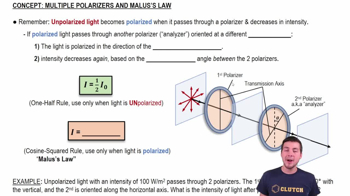
Unpolarized light with intensity I0 is incident on two polarizing filters. The axis of the first filter makes an angle of 60.0° with the vertical, and the axis of the second filter is horizontal. What is the intensity of the light after it has passed through the second filter?
Young & Freedman Calc 14th Edition
Ch 33: The Nature and Propagation of Light
Problem 28bLight of original intensity I0 passes through two ideal polarizing filters having their polarizing axes oriented as shown in Fig. E33.28. You want to adjust the angle f so that the intensity at point P is equal to I0/10. If the original light is linearly polarized in the same direction as the polarizing axis of the first polarizer the light reaches, what should Φ be?
Verified step by step guidance
Verified video answer for a similar problem:
Key Concepts
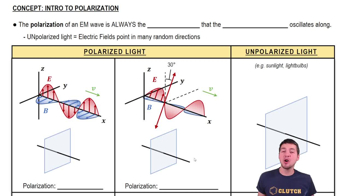
Polarization of Light
Malus's Law
Angle of Polarization
A beam of unpolarized light of intensity I0 passes through a series of ideal polarizing filters with their polarizing axes turned to various angles as shown in Fig. E33.27. If we remove the middle filter, what will be the light intensity at point C?
Light of original intensity I0 passes through two ideal polarizing filters having their polarizing axes oriented as shown in Fig. E33.28. You want to adjust the angle f so that the intensity at point P is equal to I0/10. If the original light is unpolarized, what should Φ be?
A beam of white light passes through a uniform thickness of air. If the intensity of the scattered light in the middle of the green part of the visible spectrum is I, find the intensity (in terms of I) of scattered light in the middle of the red part of the spectrum.