In Exercises 39–46, find the unit vector that has the same direction as the vector v. v = 8i - 6j
Verified step by step guidance
1
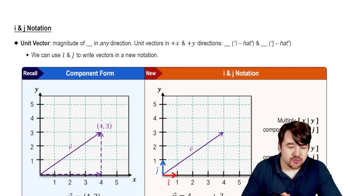
Identify the given vector \( \mathbf{v} = 8\mathbf{i} - 6\mathbf{j} \). This means the vector has components \( x = 8 \) and \( y = -6 \).
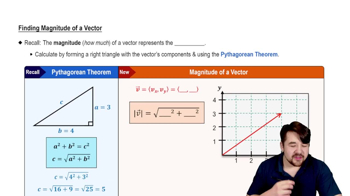
Calculate the magnitude (length) of the vector \( \mathbf{v} \) using the formula:
\[ \|\mathbf{v}\| = \sqrt{(x)^2 + (y)^2} = \sqrt{8^2 + (-6)^2} \]
Simplify the expression under the square root to find the magnitude:
\[ \|\mathbf{v}\| = \sqrt{64 + 36} \]
To find the unit vector in the same direction as \( \mathbf{v} \), divide each component of \( \mathbf{v} \) by its magnitude:
\[ \mathbf{u} = \left( \frac{8}{\|\mathbf{v}\|}, \frac{-6}{\|\mathbf{v}\|} \right) \]
Express the unit vector \( \mathbf{u} \) in terms of \( \mathbf{i} \) and \( \mathbf{j} \):
\[ \mathbf{u} = \frac{8}{\|\mathbf{v}\|} \mathbf{i} - \frac{6}{\|\mathbf{v}\|} \mathbf{j} \]
Verified video answer for a similar problem:
This video solution was recommended by our tutors as helpful for the problem above
Video duration:
1m
Play a video:
0 Comments
Key Concepts
Here are the essential concepts you must grasp in order to answer the question correctly.
Vector Components and Notation
A vector in two dimensions is expressed using unit vectors i and j, representing the x and y directions respectively. For example, v = 8i - 6j means the vector has an x-component of 8 and a y-component of -6. Understanding this notation is essential for manipulating and analyzing vectors.
The magnitude (or length) of a vector v = ai + bj is found using the Pythagorean theorem: |v| = √(a² + b²). This scalar value represents the distance from the origin to the point defined by the vector components and is crucial for normalizing vectors.
A unit vector has a magnitude of 1 and points in the same direction as the original vector. It is found by dividing each component of the vector by its magnitude, effectively scaling the vector to length one while preserving direction.