Teacher technology adoption: What’s age got to do with it?

Jennifer Williams
A older techer sat with students, in particular looking at a laptop with one of the students
Okuma zamanı: 4 minutes

Educators, by design, are innovators. Living and working in a constant state of beta, teachers bring to the classroom a natural desire to explore and better understand new practices and methodologies to support students in their search for knowledge.

Guided by an internal drive to make the world a better place and powered by the rewards of working daily with the youth that can create that positive change, teachers collectively are part of a profession different from any other. Within one classroom on any single day, a teacher can become a scientist, a historian, an inventor, or a scholar. Over time, whether in a one-room schoolhouse a century ago or in a technology enhanced classroom of the digital age, these defining characteristics of “teacher” have seemed to stay constant.

Bridging the generational and digital divide

Today, as citizens of our digital and global world, we are in an extraordinary time where divides are closing and collaboration becomes standard – where differences are truly celebrated and associations are surpassing separations in society. As educators, this change reflects what we have consistently asserted in our classrooms.

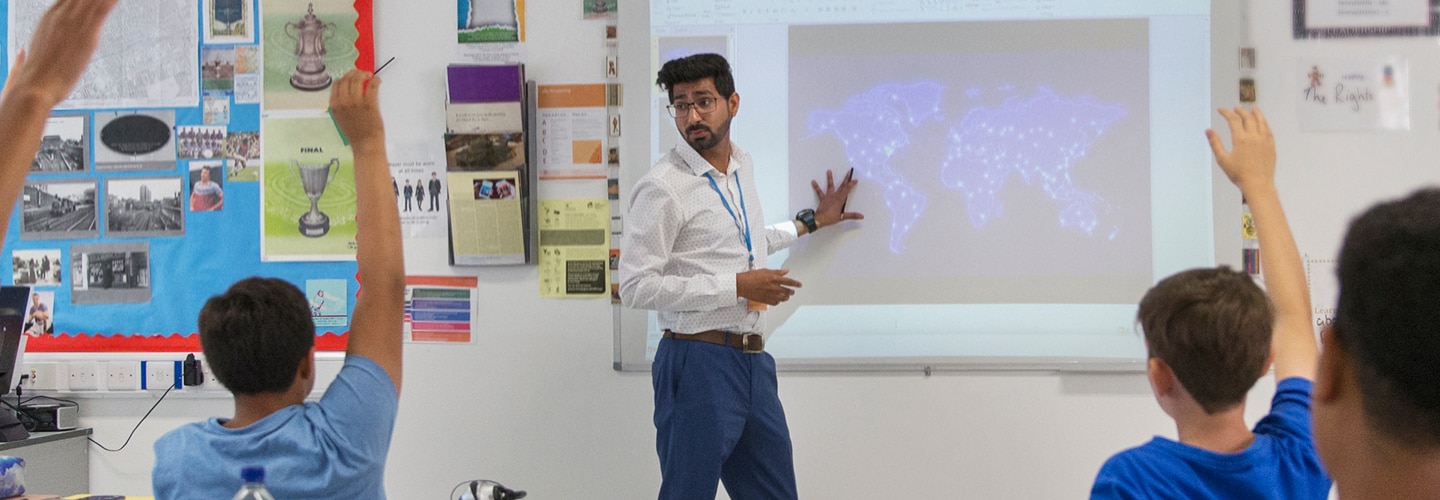
Yet, terms like 'generational gap” and “digital divide” suggest a significant separation between us as teachers and our students. In truth, teachers and students are increasingly using a shared language of innovation and exploration. Rather than sticking to notions of a technology-based generational divide, many are transcending the labels of “digital immigrants” and “digital natives”.

This is further reinforced by current research demonstrating that technology adoption in education has less to do with age and instead is based more on exposure and experience (Bennett & Maton, 2010; Bullen, Morgan, & Qayyum, 2011; Guo, Dobson, & Petrina, 2008; Helsper & Eynon, 2010).  As opposed to a focus on divides, this new evidence offers supportive pathways of possibilities to bring together older and younger generations in the process of learning in our world through exploration and wonder.

Embracing skill development

Moving attention away from a fixed age factor to emphasizing a continuum of proficiency based on exposure and experience enables teachers of all ages to identify as part of this digital age of education. Though digital technologies are fixtures in the daily lives of many (if not most) of our students, the ways students use technologies are not always consistent.

Students of today – like students of previous generations – continue to need the guidance of teachers in finding ways to take and apply their understanding of technology to effectively convey perspectives with the world, influence the opinions of others, and contextualize and synthesize information in meaningful ways.

Timeless lessons from teachers

Teachers as innovators – young and old, tech-savvy and tech-novice – have extraordinary gifts to bring to their students, who are also navigating through digital environments. Though there are countless lessons teachers bring to students, here are several timeless ones that transcend any generation of teaching. Teachers guide students to use advanced technologies so that they can be...

Critical consumers

Today, students in our classrooms are bombarded with information at nearly every moment in time. With basic searches for information often leading students in multiple directions, research at every level has now become a highly complex and sophisticated process. The result is that we now see learning practices shifting from finding answers to discovering more questions.

Teachers can guide students to evaluate and consume information critically. By promoting transparency and sharing, they help learners consider context and sources, reason with evidence and build knowledge.

Creators of rich content

As classrooms advance as blended learning environments, seamless integration of technologies and innovative teaching practices offers students opportunities to transform from passive learners to active content creators. With countless digital tools available for content creation, students can seek guidance from teachers on matching the best tool to a particular communicative purpose.

Teachers who are skillful in creating synthesized messages can show students ways to comprehend and compose with combinations of digital technologies. Less in the role of directing lessons, the teacher becomes a catalyst for learning, inspiring students to work creatively and collaboratively to solve problems and respond to instructional lessons as producers of information.

Centered on relationships

A defining quality of a master teacher is the ability to create a positive learning community built on empathy and understanding. The focus on relationships in these classrooms models the continued importance of valuing alliances and friendships.

Soft skills, such as joy, honesty, trust and respect, become even more essential as our students continue to interact in a highly networked and diverse world. Balance, too, becomes a critical area for discussion as students look to divide attention, time and social-emotional reserves between onscreen and in-person experiences.

Within responsive classrooms and digital learning spaces that keep emphasis on the formation of relationships, teachers can offer opportunities for students to develop through collaboration, teamwork, solidarity and conflict resolution.

Resilient in endeavors

Our students are looking out onto a world where anything is possible. Digital age technologies are empowering students to believe: “if you can dream it, you can do it”. The impossible is within reach, and a mindset of grit and determination moves sparked ideas to a place of accomplishment and excellence.

Through the creation of learner-driven classrooms centered on the student, teachers can help guide students to narrow their interests and ultimately find their passions. With relevance and authentic purpose, teachers can connect students in the process of learning through design thinking and trial and error – shifting the outlook from fear of failure to resilience and 'stick-to-itiveness' to advance learning to a place of discovery and invention.

And it is this mindset – a position of inquiry and exploration – held by students and teachers, young and old, that can show that great will come from risk. We all just need to be ready to try.

References

Bennett, S. J. & Maton, K. (2010). Beyond the 'digital natives' debate: towards a more nuanced understanding of students' technology experiences. Journal of Computer Assisted Learning, 26(5), 321-331

Bullen, M., Morgan, T. & Qayyum, A. (2011). Digital learners in higher education: generation is not the issue. Canadian Journal of Learning & Technology, 37(1)

Guo, R. X., Dobson, T. & Petrina, S. (2008). Digital natives, digital immigrants: an analysis of age and ICT competency in teacher education. Journal of Educational Computing Research, 38(3), 235–254

Helsper, E. J., & Eynon, R. (2010). Digital natives: Where is the evidence? British Educational Research Journal, 36(3), 503-520

More blogs from Pearson

  • Young students in a classroom raising their hands and smiling
    Putting inquiry-based learning into practice with young learners
    By Jeanne Perrett
    Okuma zamanı: 5 minutes

    What are the benefits of inquiry-based learning?

    Inquiry-based learning is all about using questions to generate interest. Starting a class with a question helps young learners engage with the topic straight away. Introductory questions can be big or small, and here are some examples of big questions: 

    • What makes someone a hero? 
    • Why do we go to school? 
    • Why do people live in cities? 

    These open questions get students thinking about lots of different aspects of each topic. However, small questions can work as well: 

    • What is your favourite superhero called? 
    • Do you like your school? 
    • Do you live in a village or a city?

    These closed questions don’t necessarily lead to further discussion. However, they are a way to introduce a topic and give learners an easy way to contribute without the pressure of getting an answer right or wrong. 

    When students are invited to share their opinions, they feel that their contributions are valuable. It also lets the teacher gain insight into what the learners already know. 

    How can we help students explore big questions?

    Inquiry-based learning can support students to answer these big questions in an easy and satisfying way, including:

    • Making notes on their ideas, or drawing a sketch
    • Working in pairs or groups to share ideas
    • Using a bulletin board

    A bulletin board fits in well with the concept of inquiry-based learning. The teacher pins a big question to the center and then encourages learners to add their notes, sketches and ideas to the board. 

    Because there are many possible answers to the big questions, it’s important to emphasize that learners can change their minds as they learn more: after all, that’s the whole point of learning.

    The Now I Know! series follows this structure. Each unit has language aims based around a big question to get learners thinking more deeply.

    How can inquiry-based learning work in practice?

    You can put it into practice in your own classroom by starting off with a topic, and then thinking of a big question to get things started. So, for example, if your topic is outer space, your big question could be: Why do we explore space? 

    That will get your students thinking and sharing their knowledge about space travel, moon landings, astronauts, aliens – you might be surprised at some of their answers. Ask them to write notes, do a sketch or do a mind map, then pin their contributions to your bulletin board. 

    There are lots of options for follow-up activities: 

    • Assign pairs a planet from the solar system to research
    • Share an interesting fact about an unnamed planet and encourage students to research which planet it is
    • Allow students to play to their strengths: one student can draw the planets and another can name their order from the sun (for example)
    • Create a game: get learners to write two false facts and one true fact about their planet, and the rest of the class has to guess which is which

    Once you’ve piqued their interest and the students are excited about the topic, it’s time to channel that enthusiasm into a more focused activity. For example, you could introduce the story of the Golden Record on the Voyager space probe. At the time of the Voyager launch in 1977, a phonograph record was included onboard which contained, in the words of then-president Jimmy Carter, “a present from a small, distant world, a token of our sounds, our science, our images, our music, our thoughts and our feelings.” The record included music from different cultures, greetings in 55 languages and sounds of the natural world. There were also 115 images of life on Earth, many annotated with explanations. 

    Bring it back to inquiry-based learning, and instead of telling students what is on the record, ask them what they think might have been included. Again, they can add their ideas to the bulletin board. 

    Follow-up activities could include: 

    • Making their own recording for an interplanetary space voyage
    • Doing a sound quiz where students record sounds and ask their classmates to guess what each sound is 
    • Making a modern playlist for aliens to listen to 
    • Taking photographs of their daily lives and adding comments, just as the NASA committee did, and doing more research into the Voyager space probe
    • Checking its progress through interstellar space on the NASA website

    This is just one example of a topic, but any topic can be treated in the same way. If you, as a teacher, share your curiosity and enthusiasm with your students, they’ll pick up on that and become enthused in turn.

    How do we nurture enquiring minds?

    The spirit of enquiry is one of the most important things we can instill in our young learners. Inquiring minds are innate - just think of the way toddlers ask “Why?” about everything. The mistake that adults can sometimes make is to reply to the ‘why’ questions with an answer, when actually, sometimes children just want to have a discussion. 

    As educators, it’s important to reply to children’s questions by opening up a discussion, no matter how abstract the question. For example, if a toddler asks something like “Why a leaf?”, you can expand that conversation to talk about colours, trees, nature, things that grow... the possibilities are endless. 

    In fact, this is our main role as educators: to facilitate and continue those conversations, to pique our learners’ curiosity, to share our enthusiasm and wonder rather than simply teach the correct answer.

    Show your students that you don’t have to find immediate answers, that there’s no such thing as a silly answer. It’s okay to wonder and muse. In your lessons, focus not on giving students the answers but on equipping them with the tools to research and find them themselves. In this way, you’ll create lifelong learners with a passion for education. 

  • A group of teenagers working on a activity gathered around a table smiling
    Helping students get out of the holiday slump
    By Charlotte Guest
    Okuma zamanı: 4 minutes

    The first days back can be slow. Routines are rusty. Focus is short. That is normal. You do not need to start again. With a few high-impact moves, you can help students switch back on, feel confident and build momentum for the term.

    Start with a short check, then act fast on feedback

    Open with a quick, low-stakes check of key ideas from last term. Keep it short (6–8 items). Include a mix of multiple-choice and one or two short answers. This is not for grades. It is to see what students still remember and where the gaps are. Even when students get items wrong, trying to retrieve helps learning later (Richland, Kornell and Kao, 2009).

    Follow up with clear, task-focused feedback so students know the next step (“Add units to your answer”; “Show the first step”) rather than general comments. Use the results to form two or three quick groups and assign a short, targeted task to each.

  • Two business professionals loooking at notes together
    GSE, KPIs and ROI (Part 2): Turning language data into business value
    By Łukasz Pakuła
    Okuma zamanı: 5 minutes

    In Part 1, we looked at how to build a sensible measurement philosophy for language training using KPIs and the Global Scale of English (GSE). We’ve established that language programs shouldn’t be treated as a calendar entry, but as a strategic lever, and that independence, granularity and credibility are the secret sauce.

    Now it’s time to move from how to why: how these datapoints translate into tangible business outcomes, and how to make sure your investment in English doesn’t just look good on slides but actually delivers value when the CFO walks in.

    From measuring to meaning: translating KPIs into ROI

    Let’s be blunt: only a reckless stakeholder invests without expecting a return. Weighing costs and benefits, however, can get tricky. Without some operational clarity, ROI quickly becomes either a fairy tale or a labyrinth, both of which are bad news in risk-averse corporate cultures.

    From a client’s perspective, it’s vital to include all components in your calculation: direct delivery fees, platform access, materials and, ideally, a provider capable of offering the full package. And please don’t forget the indirect cost of time. Two hours of lessons per week equals more than 100 hours per learner per year. Add the asynchronous learning that every serious learner contributes, and we’re suddenly talking about real numbers.

    If you skip that, the ROI will look spectacular on paper until someone performs a reality check and the budget line gets a little uncomfortable. If you’re an L&D manager reading this, add sensible estimates for coordination and reporting. Ideally, your provider helps you keep those to a minimum. At choices®, which provides language services, we see this as part of the service rather than a side quest. Trust me, it saves everyone time and sanity.