
English: the best second language for your child to learn

Steffanie Zazulak
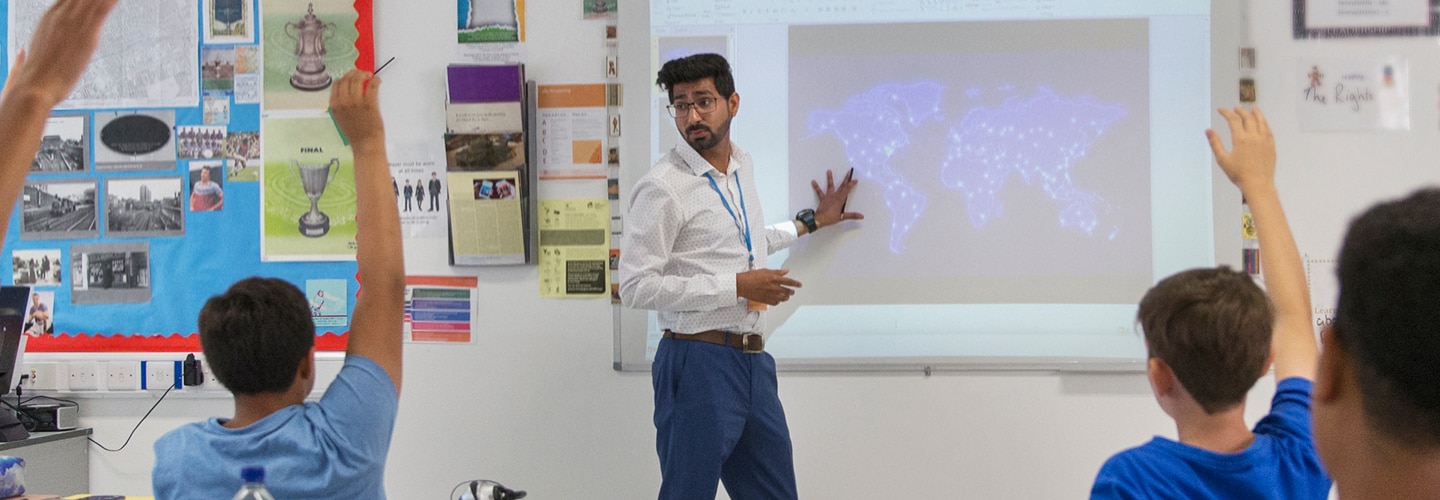
Children sat at desks in a classroom, one is smiling and looking to the front of the class
Okuma zamanı: 2 minutes

As adult learners, our very motivation for learning English can sometimes hinder our progress because we are focusing too much on the end result. The informal way in which children learn English – through music, games and fun activities – offers an environment where they can learn and practise without worrying about the importance of it all. This relaxed attitude, in turn, gives them confidence in learning English and sets them up for more opportunities in their academic pursuits and future career options.

Research has shown the positive impact bilingualism has on a child’s cognitive development. Catherine Ford, head teacher of Moreton First Prep School, says that children should begin learning as young as age three: “Before children become self-conscious they can try out their newly acquired languages without fear of embarrassment”.

Starting the English learning process at a young age will provide the head start that most parents are keen to give their children in life, education and career. More than 77% of parents who were interviewed as part of HSBC’s global study said they would consider sending their child to study at a university abroad, which involves studying in English.

Educational benefits

The number of students pursuing postgraduate studies overseas continues to rise, reflecting the global nature of education. According to the OECD, millions of students choose to study abroad each year, seeking diverse academic experiences and cultural immersion. One crucial factor in this journey is having the right level of English skills, especially when applying to universities in popular destinations such as the US, UK, and Australia.

Learning English from a young age provides a solid foundation, enabling students to tackle more complex language skills tailored to their academic goals. Traditional English teaching often emphasizes reading, writing, and grammar, but studying abroad offers a unique opportunity to immerse oneself in an English-speaking culture, enhancing speaking and listening skills.

Future career benefits

Mastering English at an early age can be a transformative asset for future career success. English is the lingua franca of business, opening doors to global opportunities and enabling individuals to pursue diverse career paths across borders. As the most widely used language in business worldwide, proficiency in English is a powerful motivator for students aspiring to join global companies.

Bilingualism is becoming increasingly advantageous in the job market, improving employability and making candidates more appealing to employers. Research highlights that bilinguals are often preferred over monolinguals with similar credentials, underscoring the competitive edge that language skills provide.

Empowering the next generation

The benefits your children are given by learning English at a young age are invaluable and as they go through life, the possibilities for advancement in their academic and business careers will be wide open. Children are fortunate to have intuitive language learning capabilities from a young age and this is certainly something to capitalize on.

More blogs from Pearson

  • Agents stood outside looking at a tablet smiling
    Trust is the strategy: Why partnerships flourish with Pearson
    By Alice Bazzi
    Okuma zamanı: 2 minutes

    In international education, trust is the foundation of every partnership. Institutions need confidence in test results and families want assurance that their investment is secure. As an agent, your reputation is on the line and part of it is linked to the quality of the solutions you recommend. By introducing PTE Express to your clients, you tap into Pearson’s global reputation, a name that stands out for integrity, innovation and expertise.

    Pearson: A name institutions and people trust globally

    Pearson has decades of experience in education and assessments. This heritage is reflected in PTE Express, a secure and reliable test designed to meet US admissions standards. When you present PTE Express, you are not just offering speed, but you are also offering credibility. Institutions recognize Pearson as a trusted partner, and families are assured that their test scores come from a globally respected brand.

  • Students sat outside sat on grass, with a teacher in the middle on a laptop
    Green education: Integrating sustainability into English lessons
    By Charlotte Guest
    Okuma zamanı: 5 minutes

    If you teach English, you already know the subject is secretly a life skills course in disguise. You don’t just teach grammar and essays; you teach students how to notice, question, empathize, argue, imagine and make meaning. That’s exactly why English is one of the most natural places to weave in sustainability.

    Green education doesn’t have to mean swapping your entire curriculum for climate documentaries or forcing every creative writing prompt to involve melting ice caps. It can be quieter (and often more powerful): selecting texts with environmental angles, inviting students to think critically about the language used in climate communication, and encouraging them to write for real audiences and with real-world stakes.

    Below are ways to integrate sustainability into English lessons while still meeting literacy goals, plus a note on using AI consciously – because even our digital tools come with an environmental footprint.

    1. Start with “green reading”: texts that open doors, not close them

    The simplest entry point is text selection. Sustainability themes appear across genres and time periods, and you can choose materials that fit your students’ maturity level and your existing curriculum goals.

    Ideas to try:

    • Short stories that explore human-nature relationships, scarcity, or future societies shaped by environmental change.
    • Poetry that foregrounds place, seasons, biodiversity or loss. Nature poetry is an easy bridge into imagery, tone and figurative language.
    • Nonfiction articles on fast fashion, food waste, wildfires, local conservation projects or “greenwashing” in advertising.
    • Speeches and opinion pieces that let students analyze rhetoric, claims, evidence, emotional appeals and bias.

    A useful approach is to build a “paired text” routine: pair a literary text with a current nonfiction piece. Students can practice comparative analysis while also seeing how themes evolve from art into public discourse.

    2. Teach language as power: sustainability is a rhetoric unit waiting to happen

    Sustainability conversations are full of persuasive language, sometimes honest, sometimes manipulative. That makes them perfect material for rhetoric and media literacy.

    Mini-lessons you can try:

    • Greenwashing detective work: bring in ads or brand sustainability statements. Ask: What claims are being made? What evidence is offered? What’s vague? What’s measurable?
    • Framing and connotation: compare “climate change” vs. “climate crisis,” “carbon-neutral” vs. “net zero,” “natural” vs. “organic.” What do these terms imply and who benefits?
    • Tone analysis: how do different outlets report the same environmental story? Neutral? Alarmist? Dismissive? Hopeful? Students can annotate for diction and bias.

    This helps students become more thoughtful readers and more ethical communicators, two outcomes worth aiming for even when the topic isn’t sustainability.

    3. Make writing real: sustainability projects with authentic audiences

    When students feel their writing has a purpose beyond “hand it in, get a grade”, quality and investment usually rise. Sustainability offers plenty of authentic writing opportunities, even at a small scale.

    Writing tasks that work well:

    • Letters or emails to the school administration proposing a realistic change (recycling signage, reducing single-use plastics at events, a second-hand uniform swap).
    • Op-eds for the school newsletter on an issue students care about (food waste in the cafeteria, bus vs. car drop-offs, energy use).
    • Instructional writing: “How to…” guides for greener habits (thrifting, repairing clothes, reducing digital clutter).
    • Podcast scripts or short documentary-style narration about a local environmental story.

    The trick is to keep the scope manageable. Sustainability writing doesn’t need to save the planet; it needs to strengthen students’ ability to argue clearly, use credible evidence and write with voice.

    4. Use storytelling to build empathy and avoid burnout

    Many students feel overwhelmed by environmental news. English teachers are well placed to counter “doom fatigue” by using narrative, especially stories that hold complexity.

    Try prompts that balance realism with agency:

    • Write a scene where a character makes a small decision that has ripple effects.
    • Create a “future news report” set 20 years from now, showing both challenges and adaptations.
    • Write from a non-human perspective (a river, an old tree, an urban fox) to practice voice and point of view.

    The goal isn’t to sugarcoat realities, but to make room for imagination and nuance: people can be contradictory; systems shape choices; hope can be practical, not sentimental.

    5. Build sustainability into routine classroom habits (so it’s not just a topic)

    Sometimes, green education is less about what you teach and more about how the classroom runs.

    Small changes can become teachable moments:

    • Encourage digital submissions only when they truly help, and be mindful of unnecessary printing (but also avoid assuming digital is “free”; more on that below).
    • Reuse materials. Create a “paper bank” for scrap writing and drafting.
    • Do a short “language + environment” warm-up once a week: a new word (like “circular economy” or “biodiversity”) used in a sentence, then discussed for nuance.

    When sustainability becomes the norm rather than a special unit, students absorb it as part of everyday thinking.

    6. A necessary addition: conscious use of AI (because it has an environmental cost)

    AI can be a helpful classroom tool, especially for brainstorming, drafting models, generating sentence stems or supporting students who struggle to start. But it’s worth naming what often stays invisible: AI requires energy. Data centers, model training and even repeated daily queries contribute to electricity and water use, depending on how systems are cooled and powered.

    That doesn’t mean “never use AI”. It means modelling the same critical thinking we want students to use everywhere else: use it with intention.

    Practical guidelines for greener, more ethical AI use:

    • Use AI when it replaces a bigger footprint. For example, generating one strong mentor text instead of printing five random worksheets.
    • Batch tasks. One well-planned prompt is better than ten quick “try again” prompts.
    • Teach prompt discipline. Have students plan what they want first, then query once. This improves learning and reduces unnecessary use.
    • Be transparent. Treat AI like a tool with trade-offs: useful, imperfect and not environmentally neutral.
    • Prioritize human thinking. AI should support reading and writing, not replace the process that actually builds skill.

    Framing AI this way turns it into another sustainability lesson: every choice. digital or physical, has a cost, and responsible people learn to weigh trade-offs.

    English is where sustainability becomes personal

    Sustainability isn’t only a science topic; it’s a human story. It’s about values, choices, culture, language, power and the way we imagine the future. English teachers already teach students how to read between lines and write with purpose. Integrating eco-conscious tasks simply gives those skills somewhere urgent and real to land.

    Start small: a poem, a paired article, a writing task with an authentic audience, a quick discussion about greenwashing, a mindful approach to AI. Over time, your classroom can become a place where students don’t just learn English, they learn how to speak for the world they’re growing up in.

  • A man with headphones on listening and smiling while he sits on a sofa
    11 great English-language song lyrics
    By Steffanie Zazulak
    Okuma zamanı: 5 minutes

    What is it about music that helps boost your English skills, confidence and pronunciation? A song can provide an emotional connection between the music and the listener, providing learners with new ways to express their feelings. Music and rhythm have also been shown to benefit memorization, which is a key component of learning.
    Here are some of our favorite lyrics to some of our favorite songs:

    1. The Beatles – Blackbird

    The Beatles are the best band to help you learn English. There are many Beatles songs with catchy melodies and simple lyrics, but Blackbird captures the Fab Four at their most poetic:
    Blackbird singing in the dead of night
    Take these broken wings and learn to fly
    All your life
    You were only waiting for this moment to arise

    2. The Cure – Friday I’m In Love

    This song is a great way to help learn the days of the week (that may be obvious). Love is also a very popular English word, so this one is for all the romantics out there.

    Always take a big bite
    It’s such a gorgeous sight
    To see you eat in the middle of the night

    3. Ed Sheeran – Thinking Out Loud

    Another one for the lovers: Ed’s heartfelt lyrics usually do well on the mainstream pop charts; he's one of the world's most popular songwriters. In this ballad, he tells the sweet story of long-time love.

    Take me into your loving arms
    Kiss me under the light of a thousand stars
    Place your head on my beating heart