As a genetic counselor, you are asked to assess the risk for a couple with a family history of familial adenomatous polyposis (FAP) who are thinking about having children. Neither the husband nor the wife has colorectal cancer, but the husband has a sister with FAP. What is the probability that this couple will have a child with FAP? Are there any tests that you could recommend to help in this assessment?
Ch. 24 - Cancer Genetics

Chapter 24, Problem 5
How can mutations in non-coding segments of DNA contribute to the development of cancers?
Verified step by step guidance1
Understand that non-coding segments of DNA, often referred to as 'junk DNA', actually play crucial roles in regulating gene expression and maintaining genomic stability.
Recognize that mutations in these non-coding regions can disrupt regulatory elements such as promoters, enhancers, and silencers, which control when and where genes are turned on or off.
Consider how such disruptions can lead to the misregulation of oncogenes (genes that promote cell growth) or tumor suppressor genes (genes that inhibit cell growth), potentially leading to uncontrolled cell proliferation.
Explore the concept of epigenetic changes, where mutations in non-coding DNA can alter the chemical modifications of DNA or histones, affecting gene expression without changing the DNA sequence itself.
Reflect on how these mutations can contribute to the hallmarks of cancer, such as sustained proliferative signaling, evasion of growth suppressors, and resistance to cell death, ultimately leading to cancer development.

Verified video answer for a similar problem:
This video solution was recommended by our tutors as helpful for the problem above.
Video duration:
1mWas this helpful?
Key Concepts
Here are the essential concepts you must grasp in order to answer the question correctly.
Non-coding DNA
Non-coding DNA refers to segments of DNA that do not encode proteins but can play crucial roles in regulating gene expression and maintaining genome integrity. These regions include introns, promoters, and enhancers, which can influence how genes are turned on or off, impacting cellular functions and potentially leading to diseases like cancer.
Recommended video:
Guided course
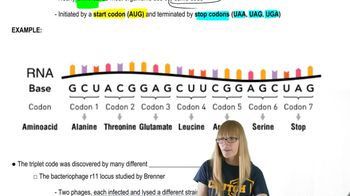
The Genetic Code
Mutations
Mutations are changes in the DNA sequence that can occur due to various factors, including environmental influences or errors during DNA replication. While many mutations are neutral or harmful, some can affect regulatory elements in non-coding regions, leading to altered gene expression patterns that may promote uncontrolled cell growth and cancer development.
Recommended video:
Guided course
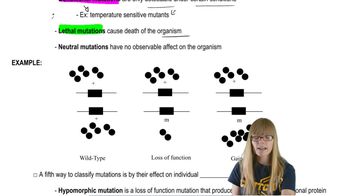
Mutations and Phenotypes
Cancer Development
Cancer development is a complex process characterized by uncontrolled cell division and growth, often resulting from genetic alterations. Mutations in both coding and non-coding regions can disrupt normal regulatory mechanisms, leading to the activation of oncogenes or the inactivation of tumor suppressor genes, ultimately contributing to tumor formation and progression.
Recommended video:
Guided course
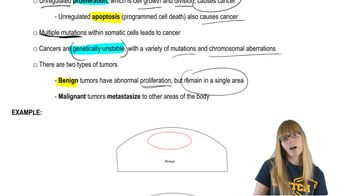
Cancer Characteristics
Related Practice
Textbook Question
723
views
Textbook Question
Where are the major regulatory points in the cell cycle?
595
views
Textbook Question
What is the difference between saying that cancer is inherited and saying that the predisposition to cancer is inherited?
561
views
Textbook Question
What is apoptosis, and under what circumstances do cells undergo this process?
897
views
Textbook Question
How do we know that cancer cells contain defects in DNA repair?
441
views
Textbook Question
List the functions of kinases and cyclins, and describe how they interact to cause cells to move through the cell cycle.
579
views
