
Ch. 22 The Digestive System
Amerman - Human Anatomy & Physiology 2nd Edition
Amerman2nd EditionHuman Anatomy & PhysiologyISBN: 9780136873822Not the one you use?Change textbook
Chapter 22, Problem 9d

Mark the following statements as true or false. If a statement is false, correct it to make a true statement.
The exocrine cells of the pancreas and salivary glands are islet cells.

Verified step by step guidance
1
Understand the terminology: Exocrine cells are responsible for secreting substances like enzymes or fluids into ducts, while islet cells (found in the pancreas) are endocrine cells that secrete hormones like insulin and glucagon directly into the bloodstream.
Identify the exocrine function of the pancreas: The pancreas has exocrine cells that produce digestive enzymes, such as amylase, lipase, and proteases, which are secreted into the pancreatic duct and then into the small intestine.
Clarify the role of salivary glands: Salivary glands are exocrine glands that produce saliva, which contains enzymes like amylase to aid in digestion. These glands do not contain islet cells.
Evaluate the statement: The statement claims that exocrine cells of the pancreas and salivary glands are islet cells. This is incorrect because islet cells are endocrine cells, not exocrine cells, and they are found only in the pancreas, not in salivary glands.
Correct the statement: The exocrine cells of the pancreas and salivary glands are not islet cells. Instead, they are specialized cells that produce and secrete enzymes or fluids into ducts for digestion.

Verified video answer for a similar problem:

This video solution was recommended by our tutors as helpful for the problem above.
Was this helpful?

Key Concepts

Here are the essential concepts you must grasp in order to answer the question correctly.

Exocrine Cells

Exocrine cells are specialized cells that secrete substances through ducts to external surfaces or into body cavities. In the pancreas, these cells produce digestive enzymes that are released into the small intestine, while in salivary glands, they secrete saliva into the oral cavity. Understanding the role of exocrine cells is crucial for distinguishing them from endocrine cells, which release hormones directly into the bloodstream.
Recommended video:
Guided course
04:39
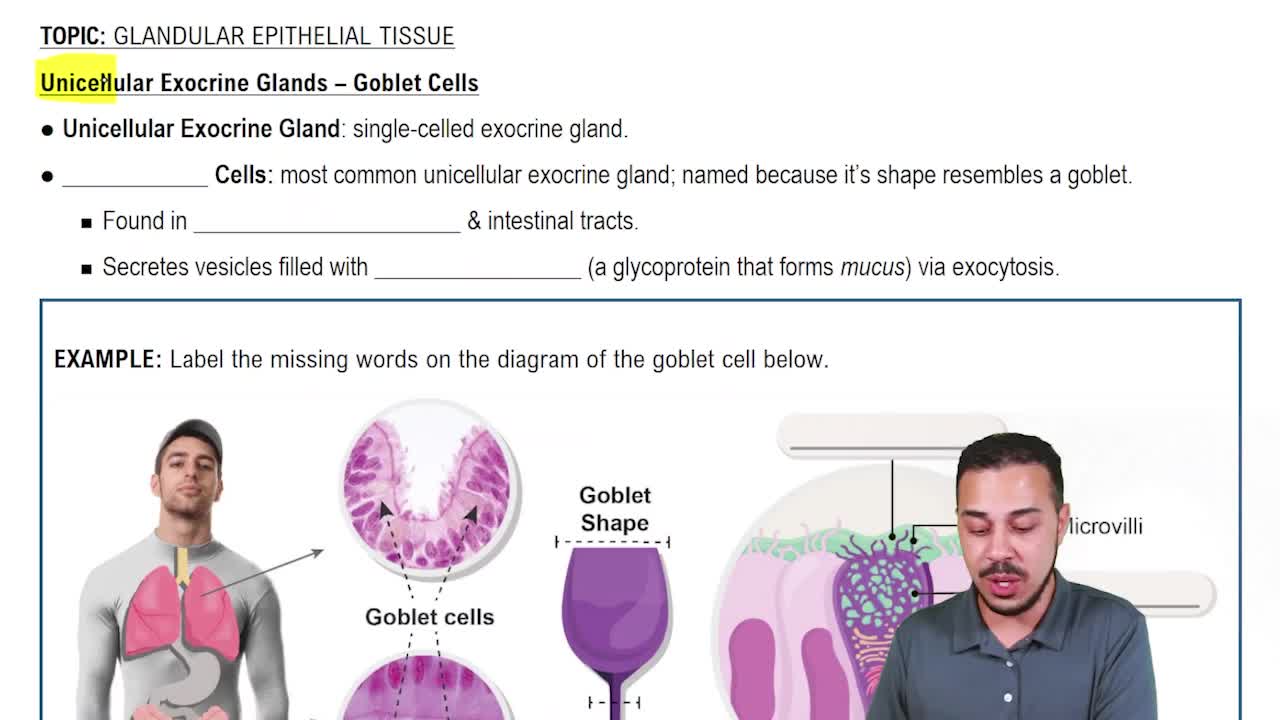
Unicellular Exocrine Glands - Goblet Cells

Islet Cells

Islet cells, or pancreatic islets, are clusters of cells in the pancreas that have an endocrine function. They are responsible for producing hormones such as insulin and glucagon, which regulate blood sugar levels. This concept is essential for understanding the distinction between the endocrine and exocrine functions of the pancreas, as islet cells are not involved in the secretion of digestive enzymes.
Recommended video:
05:33
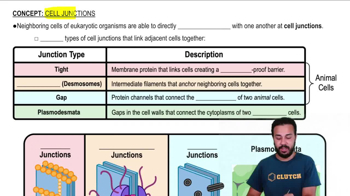
Cell Junctions

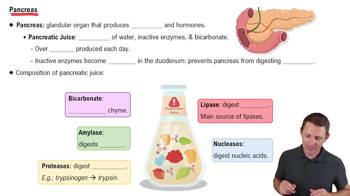
Pancreas Function

The pancreas serves both exocrine and endocrine functions, making it a vital organ in digestion and metabolism. The exocrine part produces digestive enzymes, while the endocrine part, composed of islet cells, regulates blood glucose levels. Recognizing this dual role is important for accurately assessing statements about pancreatic cells and their functions.
Recommended video:
Related Practice
Textbook Question

Which of the following best describes the role of bile salts in lipid digestion?

a. Bile salts begin chemical digestion of lipids.

b. Bile salts bind to lipids and physically break them apart into monoglycerides and free fatty acids.

c. Bile salts bind to lipids and physically break them apart into smaller pieces.

d. Bile salts interact with pancreatic lipase and catalyze lipid breakdown.

975
views
Textbook Question

The common hepatic duct and main pancreatic duct enter into the:

a. Pyloric sphincter

b. Duodenum

c. Ileum

d. Cecum

825
views
Textbook Question

Which of the following best describes the microscopic structure of the liver?

a. Hexagonal plates of hepatocytes surrounding a central vein with portal triads at each corner

b. Octagonal plates of hepatocytes surrounding a central artery with portal triads at each corner

c. Irregular groups of hepatocytes surrounding a central vein with bile ducts at each corner

d. Hexagonal plates of hepatocytes surrounding a portal vein with bile ducts at each corner

784
views
Textbook Question

Trace the pathway that food takes through the entire alimentary canal, from the oral cavity to the anal canal.

1141
views
Textbook Question

Which of the following statements about accessory organ secretions is not true?

a. Hepatocytes produce bile, which drains out of the liver via the common hepatic ducts.

b. Saliva contains secretory IgA and lysozyme, which play an important role in preventing the growth of pathogenic bacteria in the oral cavity.

c. Pancreatic juice contains digestive enzymes and bicarbonate ions to neutralize the acidic chyme.

d. The gallbladder produces bile, which drains out of the gallbladder via the cystic duct.

760
views
Textbook Question

What are the three folds of the small intestine called? What is their purpose?

1010
views