Ch. 18 The Cardiovascular System II: The Blood Vessels
Amerman - Human Anatomy & Physiology 2nd Edition
Amerman2nd EditionHuman Anatomy & PhysiologyISBN: 9780136873822Not the one you use?Change textbook
Chapter 18, Problem 1b

Mark the following statements as true or false. If a statement is false, correct it to make a true statement.
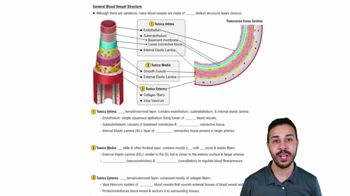
The tunica intima is composed of a sheet of endothelium, connective tissue, and the internal elastic lamina.

Verified step by step guidance
1
Step 1: Understand the structure of the tunica intima. The tunica intima is the innermost layer of a blood vessel and is primarily composed of a sheet of endothelium (a single layer of squamous epithelial cells) and a thin layer of connective tissue. In arteries, it also includes the internal elastic lamina, which provides elasticity.
Step 2: Analyze the statement provided. The statement claims that the tunica intima is composed of endothelium, connective tissue, and the internal elastic lamina.
Step 3: Verify the accuracy of the statement. Compare the components listed in the statement with the known structure of the tunica intima. Note that the internal elastic lamina is present in arteries but not in veins.
Step 4: Determine if the statement is true or false. If the statement is false, identify the incorrect part and correct it. For example, if the internal elastic lamina is incorrectly described as a universal feature of the tunica intima, clarify that it is specific to arteries.
Step 5: Conclude by marking the statement as true or false and providing the corrected version if necessary. For instance, if the statement is false, you might correct it to: 'The tunica intima is composed of a sheet of endothelium and connective tissue. In arteries, it also includes the internal elastic lamina.'

Verified video answer for a similar problem:

This video solution was recommended by our tutors as helpful for the problem above.
Was this helpful?

Key Concepts

Here are the essential concepts you must grasp in order to answer the question correctly.

Tunica Intima Structure

The tunica intima is the innermost layer of blood vessels, primarily composed of a single layer of endothelial cells that line the lumen. This layer is crucial for reducing friction as blood flows through the vessel and plays a role in vascular health. It may also include a thin layer of connective tissue and, in larger vessels, an internal elastic lamina.
Recommended video:
14:36
General Blood Vessel Structure

Endothelium Function

Endothelium is a specialized type of epithelium that lines blood vessels and lymphatic vessels. It serves several functions, including acting as a barrier to regulate the passage of materials and the transit of white blood cells into and out of the bloodstream. Additionally, it plays a vital role in maintaining vascular tone and homeostasis.
Recommended video:
06:04
Functional Groups

Internal Elastic Lamina

The internal elastic lamina is a layer of elastic tissue found between the tunica intima and the tunica media in larger blood vessels. It provides structural support and elasticity, allowing the vessel to withstand changes in pressure and volume. Its presence is more pronounced in arteries than in veins, contributing to the functional differences between these types of blood vessels.
Recommended video:
Guided course
03:34
Elastic Cartilage