Ch. 25 Fluids, Electrolytes, and Acid-Base Homeostasis
Amerman - Human Anatomy & Physiology 2nd Edition
Amerman2nd EditionHuman Anatomy & PhysiologyISBN: 9780136873822Not the one you use?Change textbook
Chapter 25, Problem 10a

Mark the following statements as true or false. If a statement is false, correct it to make a true statement.
a. Potassium ions are responsible for the repolarization phase of the action potential.

Verified step by step guidance
1
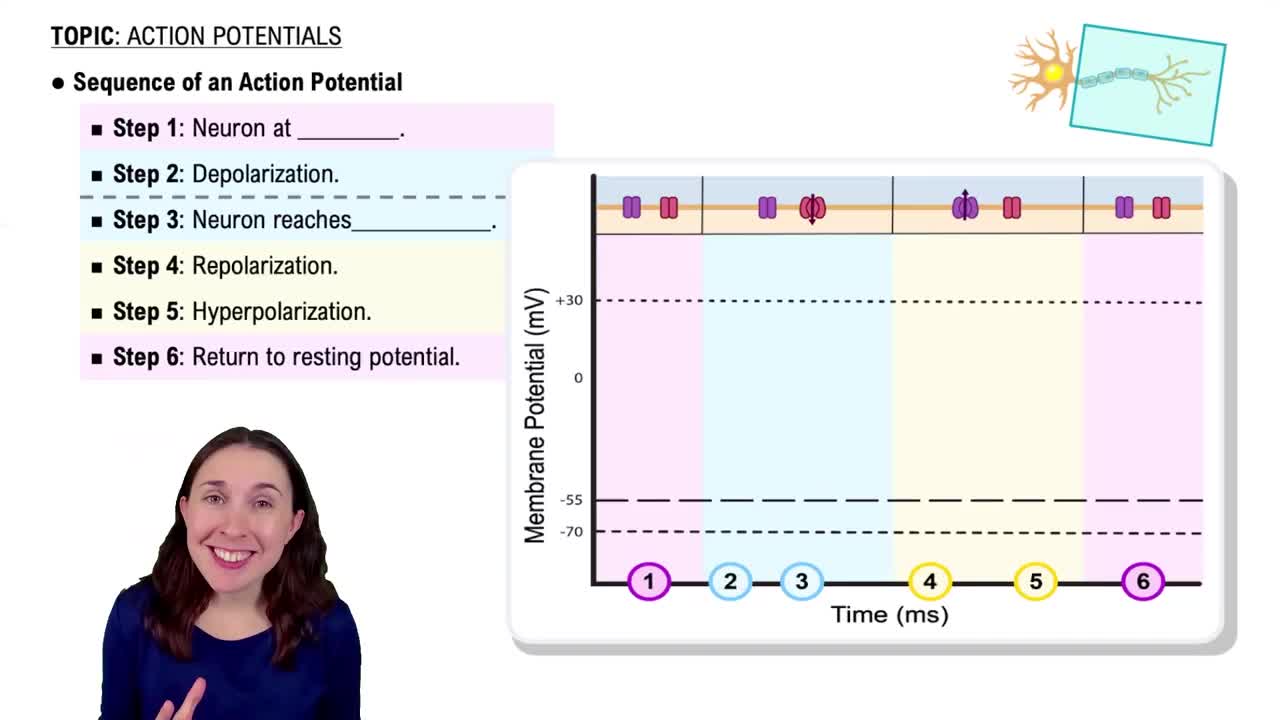
Understand the context: The problem is about the phases of an action potential, which is a rapid change in membrane potential in excitable cells like neurons and muscle cells. The repolarization phase specifically involves the return of the membrane potential to its resting state after depolarization.
Recall the role of ions in the action potential: During the depolarization phase, sodium (Na⁺) ions rush into the cell, making the inside more positive. During the repolarization phase, potassium (K⁺) ions move out of the cell, restoring the negative membrane potential.
Evaluate the statement: The statement claims that potassium ions are responsible for the repolarization phase. Based on the physiology of action potentials, this is correct because the efflux of K⁺ ions through voltage-gated potassium channels is the primary mechanism for repolarization.
Determine if the statement is true or false: Since potassium ions are indeed responsible for the repolarization phase, the statement is true.
If the statement were false, correct it: For educational purposes, if the statement had been false (e.g., if it incorrectly stated that sodium ions are responsible for repolarization), the correction would be: 'Potassium ions, not sodium ions, are responsible for the repolarization phase of the action potential.'

Verified video answer for a similar problem:

This video solution was recommended by our tutors as helpful for the problem above.
Was this helpful?

Key Concepts

Here are the essential concepts you must grasp in order to answer the question correctly.

Action Potential

An action potential is a rapid change in the electrical membrane potential of a neuron or muscle cell, which occurs when a stimulus causes the cell to depolarize. This process involves the influx of sodium ions (Na+) followed by the efflux of potassium ions (K+), leading to a brief reversal of the membrane potential. Understanding the phases of an action potential is crucial for analyzing neuronal signaling.
Recommended video:
03:53
Action Potential

Repolarization Phase

The repolarization phase of an action potential occurs after depolarization, where the membrane potential returns to a more negative value. This phase is primarily driven by the efflux of potassium ions (K+) through voltage-gated potassium channels, which helps restore the resting membrane potential. Recognizing the role of potassium ions in this phase is essential for understanding neuronal excitability.
Recommended video:
03:21
Phases of Mitosis

Ionic Movement in Neurons

Ionic movement in neurons refers to the flow of ions across the cell membrane, which is critical for generating and propagating action potentials. Sodium (Na+) and potassium (K+) ions play key roles in this process, with Na+ influx causing depolarization and K+ efflux leading to repolarization. A clear grasp of ionic movement is necessary to accurately assess the statements regarding action potentials.
Recommended video:
06:07
Ionic Bonds
Related Practice