Ch. 2 The Chemistry of Life
Amerman - Human Anatomy & Physiology 2nd Edition
Amerman2nd EditionHuman Anatomy & PhysiologyISBN: 9780136873822Not the one you use?Change textbook
Chapter 2, Problem 15

Compare and contrast the structures of phospholipids and triglycerides.

Verified step by step guidance
1
Phospholipids and triglycerides are both types of lipids, but they differ in their structure and function. Begin by identifying the basic building blocks of each molecule. Both are composed of glycerol and fatty acids, but their arrangements differ.
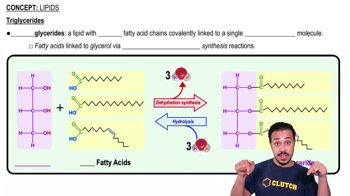
For triglycerides, note that they consist of one glycerol molecule bonded to three fatty acid chains. This structure is formed through ester bonds created during a dehydration synthesis reaction.
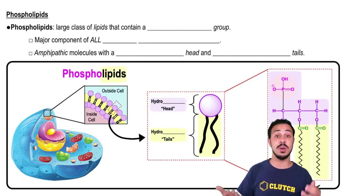
For phospholipids, explain that they consist of one glycerol molecule, two fatty acid chains, and a phosphate group. The phosphate group often has an additional polar molecule attached, making the head hydrophilic (water-attracting).
Compare the hydrophobic and hydrophilic properties of each molecule. Triglycerides are entirely hydrophobic due to their nonpolar fatty acid chains, while phospholipids have a hydrophilic head (phosphate group) and hydrophobic tails (fatty acids), making them amphipathic.
Conclude by discussing the functional implications of their structures. Triglycerides are primarily used for long-term energy storage, while phospholipids are key components of cell membranes, forming bilayers due to their amphipathic nature.

Verified video answer for a similar problem:

This video solution was recommended by our tutors as helpful for the problem above.
Was this helpful?

Key Concepts

Here are the essential concepts you must grasp in order to answer the question correctly.

Phospholipid Structure

Phospholipids are composed of a glycerol backbone, two fatty acid tails, and a phosphate group. The hydrophilic (water-attracting) phosphate head interacts with water, while the hydrophobic (water-repelling) fatty acid tails avoid water. This unique structure allows phospholipids to form bilayers, which are fundamental to cell membranes, creating a barrier that separates the interior of the cell from the external environment.
Recommended video:
04:05
Phospholipids

Triglyceride Structure

Triglycerides consist of a glycerol molecule bonded to three fatty acid chains. Unlike phospholipids, triglycerides are entirely hydrophobic due to their long fatty acid tails, making them efficient for energy storage. They are the main form of stored energy in animals and plants, and their structure allows them to pack tightly, providing a dense energy source.
Recommended video:
03:48
Triglycerides

Functional Differences

The structural differences between phospholipids and triglycerides lead to distinct functions. Phospholipids are crucial for forming cellular membranes, providing structural integrity and fluidity, while triglycerides serve primarily as energy reserves. This functional divergence is essential for understanding how these lipids contribute to biological processes and cellular organization.
Recommended video:
06:04
Functional Groups