
Ch. 21 The Respiratory System
Amerman - Human Anatomy & Physiology 2nd Edition
Amerman2nd EditionHuman Anatomy & PhysiologyISBN: 9780136873822Not the one you use?Change textbook
Chapter 21, Problem 10c

Mark the following statements as true or false. If a statement is false, correct it to make a true statement.
The inspiratory capacity is equal to the vital capacity plus the tidal volume.

Verified step by step guidance
1
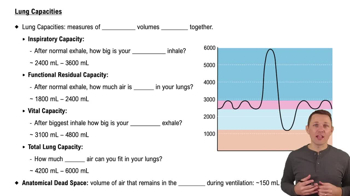
Step 1: Begin by understanding the terms involved in the problem. The inspiratory capacity (IC) is the maximum amount of air a person can inhale after a normal exhalation. It is calculated as the sum of the tidal volume (TV) and the inspiratory reserve volume (IRV).
Step 2: Define the vital capacity (VC). The vital capacity is the total amount of air that can be exhaled after a maximum inhalation. It is calculated as the sum of the tidal volume (TV), inspiratory reserve volume (IRV), and expiratory reserve volume (ERV).
Step 3: Compare the formula for inspiratory capacity (IC = TV + IRV) with the formula for vital capacity plus tidal volume (VC + TV = TV + IRV + ERV + TV). Notice that adding tidal volume to vital capacity includes the expiratory reserve volume (ERV), which is not part of the inspiratory capacity.
Step 4: Determine whether the statement is true or false based on the comparison. The statement 'The inspiratory capacity is equal to the vital capacity plus the tidal volume' is false because the inspiratory capacity does not include the expiratory reserve volume (ERV).
Step 5: Correct the false statement. The correct statement is: 'The inspiratory capacity is equal to the tidal volume plus the inspiratory reserve volume.'

Verified video answer for a similar problem:

This video solution was recommended by our tutors as helpful for the problem above.
Was this helpful?

Key Concepts

Here are the essential concepts you must grasp in order to answer the question correctly.

Inspiratory Capacity

Inspiratory capacity (IC) is the maximum amount of air that can be inhaled after a normal expiration. It is calculated by adding the tidal volume (the amount of air inhaled or exhaled in a normal breath) to the inspiratory reserve volume (the additional air that can be inhaled with effort). Understanding this concept is crucial for evaluating respiratory function.
Recommended video:
Guided course
6:38
Lung Capacities

Vital Capacity

Vital capacity (VC) is the total amount of air that can be exhaled after a maximum inhalation. It is the sum of the tidal volume, inspiratory reserve volume, and expiratory reserve volume. This concept is essential for assessing lung health and capacity, as it reflects the maximum volume of air a person can control during breathing.
Recommended video:
Guided course
6:38
Lung Capacities

Tidal Volume

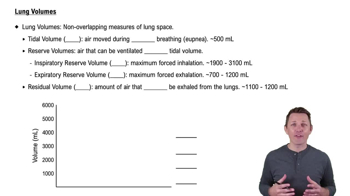
Tidal volume (TV) is the volume of air inhaled or exhaled during normal breathing. It is a key component of lung volumes and is important for understanding respiratory mechanics. In the context of the question, recognizing the role of tidal volume helps clarify the relationship between inspiratory capacity and vital capacity.
Recommended video:
Guided course
6:28
Lung Volumes
Related Practice
Textbook Question

Which of the following does not affect the efficiency of pulmonary gas exchange?

a. The surface area of the respiratory membrane

b. The degree of match of ventilation to perfusion

c. The percent saturation of hemoglobin

d. The thickness of the respiratory membrane

980
views
Textbook Question

Mark the following statements as true or false. If a statement is false, correct it to make a true statement.

The tidal volume is the amount of air left in the lungs after maximal expiration.

657
views
Textbook Question

Henry's law states that the degree to which a gas dissolves in a liquid is determined by its:

a. Partial pressure

b. Solubility

c. Surface tension

d. Both a and b are correct

e. All of the above are correct

899
views
Textbook Question

Mark the following statements as true or false. If a statement is false, correct it to make a true statement.

The vital capacity is the total amount of exchangeable air.

708
views
Textbook Question

Match each term with the correct definition. 

Airway resistance     

Surface tension     

Surfactant     

Pulmonary compliance     

V/Q ratio

a. A detergent-like chemical secreted by bronchial smooth muscle that reduces surface tension

b. The matching of ventilation to perfusion

c. Largely determined by the diameter of the airways

d. Caused by the formation of hydrogen bonds between water molecules

e. Determined by the surface tension of the alveoli, the elastic tissue of the lungs, and the condition of the chest wall

777
views
Textbook Question

Mark the following statements as true or false. If a statement is false, correct it to make a true statement.

The functional residual capacity is the volume of air normally left in the lungs after a tidal expiration.

711
views