Pearson+ LogoPearson+ Logo
Ch. 21 The Respiratory System
Amerman - Human Anatomy & Physiology 2nd Edition
Erin C. Amerman2nd EditionHuman Anatomy & PhysiologyISBN: 9780136873822Not the one you use?Change textbook
Chapter 21, Problem 9

Match each term with the correct definition. 
Airway resistance     
Surface tension     
Surfactant     
Pulmonary compliance     
V/Q ratio
a. A detergent-like chemical secreted by bronchial smooth muscle that reduces surface tension
b. The matching of ventilation to perfusion
c. Largely determined by the diameter of the airways
d. Caused by the formation of hydrogen bonds between water molecules
e. Determined by the surface tension of the alveoli, the elastic tissue of the lungs, and the condition of the chest wall

Verified step by step guidance
1
Step 1: Understand the terms provided in the problem. These include 'Airway resistance,' 'Surface tension,' 'Surfactant,' 'Pulmonary compliance,' and 'V/Q ratio.' Each term relates to respiratory physiology and has a specific definition.
Step 2: Analyze the definitions provided (a through e). For example, 'a' refers to a detergent-like chemical that reduces surface tension, 'b' refers to the matching of ventilation to perfusion, 'c' relates to the diameter of airways, 'd' involves hydrogen bonds between water molecules, and 'e' is determined by factors like alveolar surface tension and lung elasticity.
Step 3: Match 'Airway resistance' with the definition that describes how resistance is largely determined by the diameter of the airways. This is related to airflow dynamics in the respiratory system.
Step 4: Match 'Surface tension' with the definition that explains it is caused by hydrogen bonds between water molecules. This concept is crucial for understanding alveolar stability.
Step 5: Match 'Surfactant,' 'Pulmonary compliance,' and 'V/Q ratio' with their respective definitions based on their roles in reducing surface tension, determining lung elasticity, and matching ventilation to perfusion, respectively.

Verified video answer for a similar problem:

This video solution was recommended by our tutors as helpful for the problem above.
Was this helpful?

Key Concepts

Here are the essential concepts you must grasp in order to answer the question correctly.

Airway Resistance

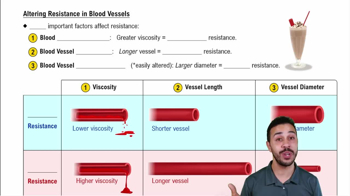
Airway resistance refers to the resistance to airflow within the respiratory tract, primarily influenced by the diameter of the airways. Smaller airways create higher resistance, making it more difficult for air to flow in and out of the lungs. Conditions such as asthma or bronchitis can increase airway resistance, leading to breathing difficulties.
Recommended video:
8:32
Altering Resistance in Blood Vessels

Surface Tension

Surface tension is the cohesive force exerted by water molecules at the surface of a liquid, which can affect the behavior of alveoli in the lungs. In the context of respiration, high surface tension can lead to alveolar collapse, making it harder for the lungs to expand. This phenomenon is crucial for understanding how surfactants function in reducing surface tension.
Recommended video:
4:05
Cell Surface Receptors

Surfactant

Surfactant is a substance composed of lipids and proteins secreted by the epithelial cells of the alveoli. Its primary role is to reduce surface tension within the alveoli, preventing their collapse during exhalation and facilitating easier lung expansion during inhalation. Surfactant is essential for maintaining proper lung function and gas exchange.
Recommended video:
Guided course
3:49
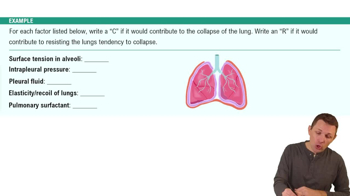
Pressure in the Lungs and Pleural Cavity Example 1
Related Practice
Textbook Question

Mark the following statements as true or false. If a statement is false, correct it to make a true statement.

The epithelium of the oropharynx changes from stratified columnar epithelium to simple squamous epithelium to enable it to resist abrasion from food.

73
views
Textbook Question

The function of the epiglottis is to:

a. Contract muscularly to cover the laryngopharynx

b. Vibrate to produce sound

c. Trigger a cough reflex

d. Cover the glottis during swallowing

103
views
Textbook Question

Which of the following statements about pulmonary ventilation is false?

a. Normal expiration requires the use of the expiratory muscles to decrease lung volume.

b. The inspiratory muscles increase lung volume, which decreases intrapulmonary pressure.

c. For inspiration to occur, intrapulmonary pressure must decrease below atmospheric pressure.

d. The intrapleural pressure is less than the intrapulmonary pressure; this prevents the lungs from collapsing during expiration.

599
views
Textbook Question

Mark the following statements as true or false. If a statement is false, correct it to make a true statement.

The functional residual capacity is the volume of air normally left in the lungs after a tidal expiration.

506
views
Textbook Question

Mark the following statements as true or false. If a statement is false, correct it to make a true statement.

The tidal volume is the amount of air left in the lungs after maximal expiration.

469
views
Textbook Question

Mark the following statements as true or false. If a statement is false, correct it to make a true statement.

The inspiratory capacity is equal to the vital capacity plus the tidal volume.

484
views