Ch. 4 Histology
Amerman - Human Anatomy & Physiology 2nd Edition
Amerman2nd EditionHuman Anatomy & PhysiologyISBN: 9780136873822Not the one you use?Change textbook
Chapter 4, Problem 5b

Mark the following statements as true or false. If a statement is false, correct it to make a true statement.
Epithelial tissues function in protection, immune defenses, secretion, transport, and sensation.

Verified step by step guidance
1
Step 1: Understand the role of epithelial tissues. Epithelial tissues are specialized to perform several key functions in the body, including protection, immune defense, secretion, transport, and sensation. These functions are carried out by different types of epithelial cells depending on their location and structure.
Step 2: Analyze the statement provided. The statement claims that epithelial tissues function in protection, immune defenses, secretion, transport, and sensation. Compare this claim with the known functions of epithelial tissues.
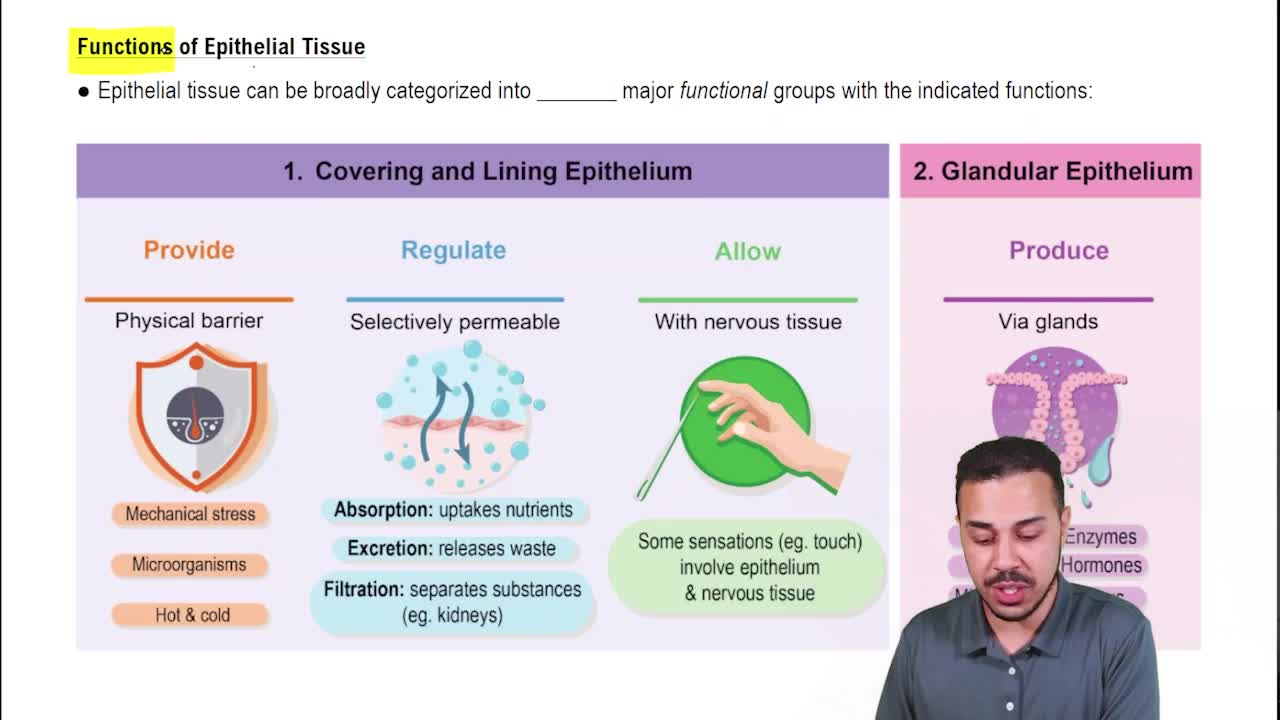
Step 3: Verify the accuracy of each function listed. For example, epithelial tissues provide protection by forming barriers (e.g., skin), contribute to immune defenses by preventing pathogen entry, assist in secretion (e.g., glands), facilitate transport (e.g., absorption in the intestines), and enable sensation (e.g., sensory receptors in the skin).
Step 4: Determine if the statement is true or false. Based on the verification in Step 3, confirm whether the statement accurately reflects the functions of epithelial tissues.
Step 5: If the statement is false, correct it. If any of the listed functions are incorrect or missing, rewrite the statement to accurately describe the functions of epithelial tissues. For example, if a function is incorrectly attributed to epithelial tissues, replace it with a correct function.

Verified video answer for a similar problem:

This video solution was recommended by our tutors as helpful for the problem above.
Was this helpful?

Key Concepts

Here are the essential concepts you must grasp in order to answer the question correctly.

Epithelial Tissue Functions

Epithelial tissues serve several critical functions in the body, including protection against physical damage, pathogens, and dehydration. They also play roles in secretion, such as producing mucus and hormones, and absorption, facilitating the transport of substances. Additionally, epithelial tissues are involved in sensation, containing specialized cells that respond to stimuli.
Recommended video:
Guided course
07:25
Functions of Epithelial Tissue

Types of Epithelial Tissue

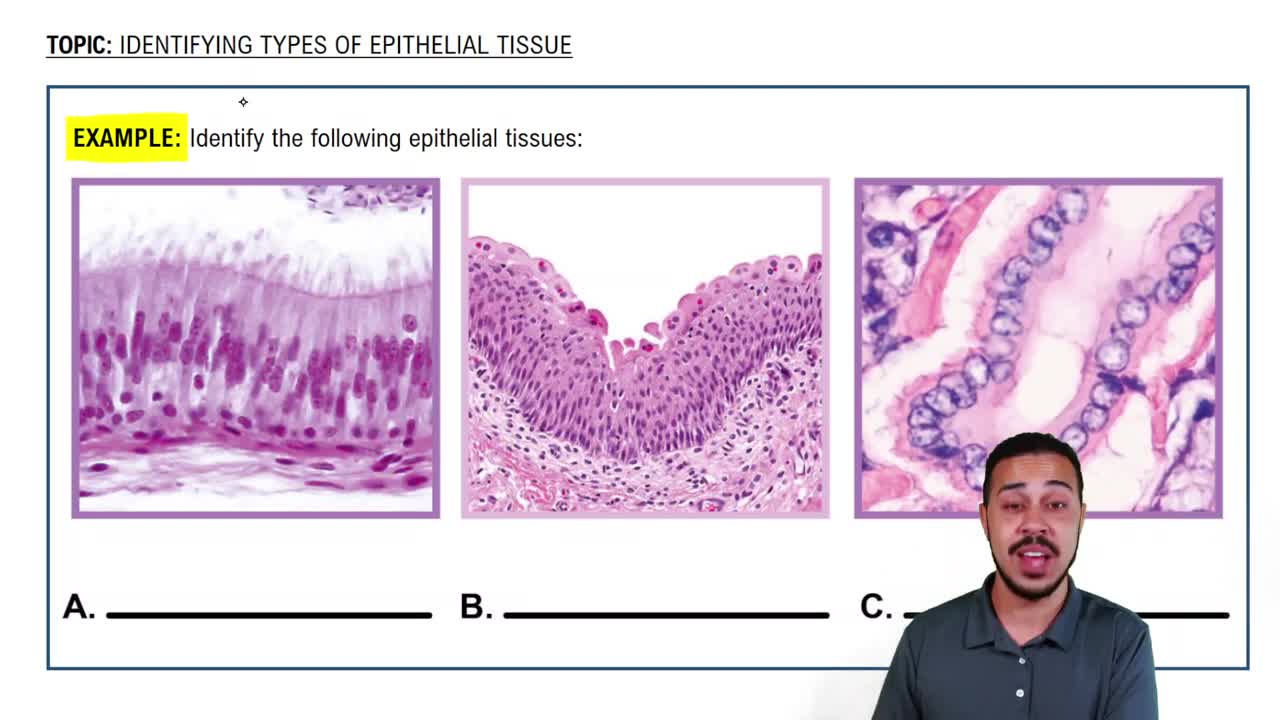
Epithelial tissues are classified into various types based on cell shape and arrangement. The main types include simple (single layer) and stratified (multiple layers) epithelium, as well as squamous (flat), cuboidal (cube-shaped), and columnar (tall and column-like) cells. Each type is adapted to specific functions, such as diffusion, filtration, or secretion.
Recommended video:
Guided course
07:25
Identifying Types of Epithelial Tissue Example 1

Epithelial Tissue and Immune Defense

Epithelial tissues contribute to immune defense by acting as a physical barrier to pathogens and producing antimicrobial substances. They also contain immune cells, such as Langerhans cells in the skin, which help detect and respond to infections. This protective role is essential for maintaining overall health and preventing disease.
Recommended video:
Guided course
07:25
Functions of Epithelial Tissue