Ch. 3 The Cell
Amerman - Human Anatomy & Physiology 2nd Edition
Amerman2nd EditionHuman Anatomy & PhysiologyISBN: 9780136873822Not the one you use?Change textbook
Chapter 3, Problem 18

Why is regulation of the cell cycle necessary?

Verified step by step guidance
1
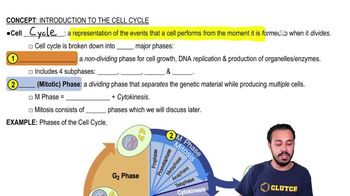
Understand that the cell cycle is the process by which cells grow, replicate their DNA, and divide. It consists of several phases: G1 (growth), S (DNA synthesis), G2 (preparation for division), and M (mitosis). Regulation ensures these phases occur in the correct sequence and timing.
Recognize that unregulated cell cycle progression can lead to uncontrolled cell division, which is a hallmark of cancer. Proper regulation prevents errors in DNA replication and division that could result in mutations or abnormal cells.
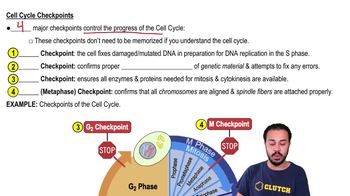
Learn about the role of checkpoints in the cell cycle. These checkpoints (G1, G2, and M) act as quality control mechanisms, ensuring that the cell is ready to proceed to the next phase. For example, the G1 checkpoint checks for DNA damage before allowing the cell to enter the S phase.
Explore the molecular mechanisms involved in regulation, such as cyclins and cyclin-dependent kinases (CDKs). These proteins work together to control the progression of the cell cycle by activating or inhibiting specific processes at each phase.
Understand the importance of external signals, such as growth factors, and internal signals, like DNA damage, in regulating the cell cycle. These signals ensure that cells divide only when necessary and under appropriate conditions, maintaining tissue health and preventing diseases.

Verified video answer for a similar problem:

This video solution was recommended by our tutors as helpful for the problem above.
Was this helpful?

Key Concepts

Here are the essential concepts you must grasp in order to answer the question correctly.

Cell Cycle Phases

The cell cycle consists of distinct phases: interphase (G1, S, G2) and mitotic phase (M). Each phase is crucial for cell growth, DNA replication, and division. Proper regulation ensures that cells progress through these phases in a controlled manner, preventing errors that could lead to malfunction or disease.
Recommended video:
04:46
Introduction to the Cell Cycle

Checkpoints

Cell cycle checkpoints are critical control mechanisms that monitor the integrity of the cell's DNA and the completion of essential processes before the cell proceeds to the next phase. These checkpoints help prevent the division of damaged or incomplete cells, thereby maintaining genomic stability and preventing cancerous growth.
Recommended video:
06:32
Cell Cycle Checkpoints

Oncogenes and Tumor Suppressors

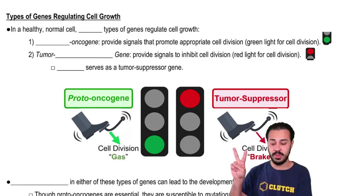
Oncogenes and tumor suppressor genes play vital roles in regulating the cell cycle. Oncogenes promote cell division and growth, while tumor suppressors inhibit it. An imbalance between these two types of genes can lead to uncontrolled cell proliferation, contributing to the development of cancer.
Recommended video:
04:02
Types of Genes Regulating Cell Growth
Related Practice
Textbook Question

Mark the following statements about the cell cycle as true or false. If a statement is false, correct it to make a true statement.

The main enzyme that builds the new DNA strands during DNA synthesis is RNA synthetase.

850
views

Textbook Question

Number the following steps of protein synthesis in the order in which they occur, starting with 1 and ending with 9.

a. _____The stop codon is reached, and the polypeptide is released. 

b. _____The small ribosomal subunit finds the start codon, and the large ribosomal subunit joins. 

c. _____The end of the gene is reached, and the pre-mRNA is released and then edited. 

d. _____The transcription factor binds the promoter. 

e. _____The protein is folded and modified to become functional. 

f. _____ RNA polymerase builds the mRNA transcript. 

g. _____mRNA and initiator tRNA bind the small ribosomal subunit. 

h. _____ New tRNAs are brought into the A site successively, and the peptide chain of the tRNA in the P site is joined to the amino acid of the tRNA in the A site.

i. ______mRNA exits the nucleus via a nuclear pore.

874
views
Textbook Question

Mark the following statements about the cell cycle as true or false. If a statement is false, correct it to make a true statement.

During metaphase, the sister chromatids are pulled apart and the chromosomes move to the opposite poles of the cell.

810
views
Textbook Question

Which of the following is not a phase of mitosis?

a. Interphase

b. Prophase

c. Anaphase

d. Metaphase

883
views
Textbook Question

Each of the following statements about protein synthesis is false. Correct each to make a true statement.

During translation, amino acids are delivered by the messenger RNA transcript.

676
views
Textbook Question

Mark the following statements about the cell cycle as true or false. If a statement is false, correct it to make a true statement.

During the S phase of the cell cycle, the cell stalls until conditions for division are more favorable

1048
views