Ch. 21 The Respiratory System
Amerman - Human Anatomy & Physiology 2nd Edition
Amerman2nd EditionHuman Anatomy & PhysiologyISBN: 9780136873822Not the one you use?Change textbook
Chapter 21, Problem 14d

Mark the following statements as true or false. If a statement is false, correct it to make a true statement.
When the PO₂ of arterial blood drops slightly, the percent saturation of Hb drops dramatically.

Verified step by step guidance
1
Understand the relationship between partial pressure of oxygen (Po₂) and hemoglobin (Hb) saturation. This is described by the oxygen-hemoglobin dissociation curve, which is sigmoidal in shape.
Recall that at high Po₂ levels (such as in arterial blood), hemoglobin is nearly fully saturated with oxygen. Small decreases in Po₂ in this range result in minimal changes in Hb saturation.
Recognize that dramatic drops in Hb saturation occur in the steep portion of the dissociation curve, which corresponds to lower Po₂ levels (such as in tissues).
Evaluate the statement: 'When the Po₂ of arterial blood drops slightly, the percent saturation of Hb drops dramatically.' Based on the dissociation curve, this is false because arterial blood Po₂ is in the flat portion of the curve, where Hb saturation remains relatively stable.
Correct the statement: 'When the Po₂ of arterial blood drops slightly, the percent saturation of Hb remains relatively stable due to the flat portion of the oxygen-hemoglobin dissociation curve.'

Verified video answer for a similar problem:

This video solution was recommended by our tutors as helpful for the problem above.
Was this helpful?

Key Concepts

Here are the essential concepts you must grasp in order to answer the question correctly.

Oxygen Saturation and Partial Pressure

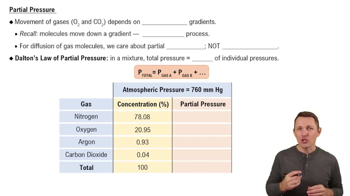
Oxygen saturation refers to the percentage of hemoglobin molecules in the blood that are bound to oxygen. The partial pressure of oxygen (Po₂) is a measure of the amount of oxygen dissolved in the blood. A drop in Po₂ can lead to a decrease in oxygen saturation, but the relationship is not always dramatic, especially within certain physiological ranges.
Recommended video:
Guided course
6:12
Partial Pressure

Hemoglobin-Oxygen Dissociation Curve

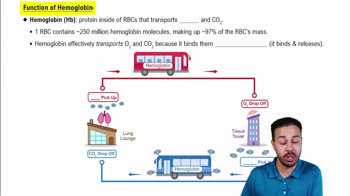
The hemoglobin-oxygen dissociation curve illustrates how hemoglobin's affinity for oxygen changes with varying levels of Po₂. This curve is sigmoidal, indicating that small changes in Po₂ at higher levels can lead to relatively small changes in saturation, while larger changes occur at lower levels. Understanding this curve is crucial for interpreting how oxygen transport is affected by changes in Po₂.
Recommended video:
7:52
Function of Hemoglobin

Physiological Response to Hypoxia

Hypoxia refers to a deficiency in the amount of oxygen reaching the tissues. The body has various physiological responses to hypoxia, including increased heart rate and respiratory rate, as well as adjustments in hemoglobin affinity for oxygen. Recognizing these responses helps in understanding how the body compensates for changes in oxygen availability and the implications for oxygen saturation.
Recommended video:
9:59
Steps of the Interferon Response