
Textbook Question
The biggest source of metabolic acids in the body is:
a. Lactic acid
b. Ketone bodies
c. Carbon dioxide
d. Uric acid
424
views

 Verified step by step guidance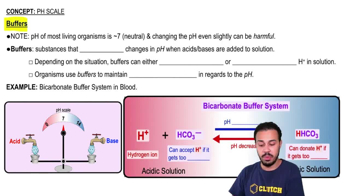
 05:38
05:38
 04:19
04:19 2:39
2:39The biggest source of metabolic acids in the body is:
a. Lactic acid
b. Ketone bodies
c. Carbon dioxide
d. Uric acid
Explain what happens to the pH of a buffered solution when hydrogen ions are added. Why does this happen?
Mark the following statements as true or false. If a statement is false, correct it to make a true statement.
d. Hypocalcemia causes neurons to become hyperexcitable, leading to potential tetanic contractions.
Which of the following mechanisms is/are used by the kidneys to regulate the pH of the blood? Circle all that apply.
a. Hydrogen ions are secreted from the proximal and distal tubules and the collecting system.
b. Hydrogen ions are reabsorbed from the nephron loop.
c. New bicarbonate ions are formed from glutamine and carbon dioxide in the interstitial fluid that enters proximal tubule cells.
d. Bicarbonate ions can be secreted.
e. Bicarbonate ions are reabsorbed directly from the filtrate.
An increase in ventilation ________ the pH of the blood due to a/an ________ of carbon dioxide in the blood. A decrease in ventilation ________ the pH of the blood due to a/an ________ of carbon dioxide in the blood.
Mark the following statements as true or false. If a statement is false, correct it to make a true statement.
e. Chloride ions are generally reabsorbed from the kidneys, along with bicarbonate ions.