
Textbook Question
Which two cranial nerves mediate the gag reflex?
1270
views

 Verified step by step guidance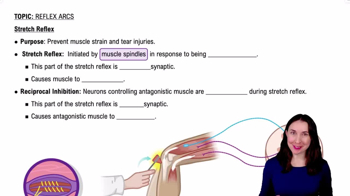
 3:37
3:37 3:37
3:37 06:04
06:04Which two cranial nerves mediate the gag reflex?
Which of the following somatic sensations is not carried by the posterior columns?
a. Tactile senses
b. Temperature
c. Proprioception
d. Stretch
Mark the following statements as true or false. If a statement is false, correct it to make a true statement.
b. The Golgi tendon organs detect stretch in a simple stretch reflex.
Mark the following statements as true or false. If a statement is false, correct it to make a true statement.
b. Thermoreceptors send temperature information to centers in the hypothalamus.
Mark the following statements as true or false. If a statement is false, correct it to make a true statement.
a. The simple stretch reflex is a monosynaptic reflex with only a single synapse in the spinal cord between the sensory and motor neurons.
Label the following components of the corticospinal tracts with numbers 1 through 6, with 1 being the origin of the tracts and 6 their destination.
_____ Medullary pyramids where most fibers decussate.
_____ Anterior horn of the spinal gray matter.
_____ Midbrain and pons.
_____ Upper motor neurons in the primary motor and premotor cortices.
_____ Corona radiata and internal capsule.
_____ Lateral funiculus of the spinal cord.