Pearson+ LogoPearson+ Logo
Ch. 1 Introduction to Anatomy and Physiology
Amerman - Human Anatomy & Physiology 2nd Edition
Erin C. Amerman2nd EditionHuman Anatomy & PhysiologyISBN: 9780136873822Not the one you use?Change textbook
Chapter 1, Problem 10

A parasagittal section divides the body or body part into:
a. Equal right and left parts
b. Front and back parts
c. Superior/proximal and inferior/distal parts
d. Unequal right and left parts

Verified step by step guidance
1
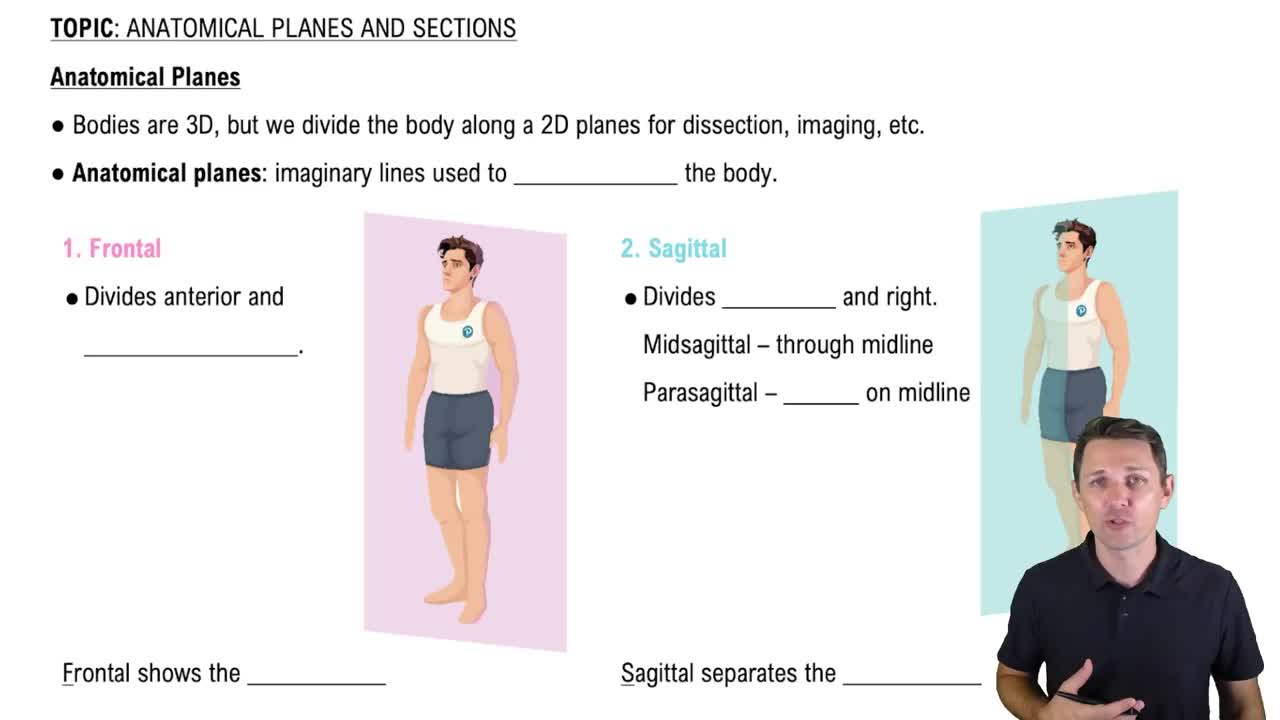
Understand the term 'parasagittal section': A parasagittal section refers to a plane that divides the body or a body part into right and left portions, but not necessarily into equal halves. This is different from a midsagittal section, which divides the body into equal right and left halves.
Review the anatomical planes: The sagittal plane divides the body into right and left portions. A parasagittal plane is any sagittal plane that is offset from the midline, resulting in unequal right and left parts.
Analyze the options provided: a) Equal right and left parts refers to a midsagittal section, not a parasagittal section. b) Front and back parts are divided by the coronal (frontal) plane. c) Superior/proximal and inferior/distal parts are divided by the transverse (horizontal) plane. d) Unequal right and left parts align with the definition of a parasagittal section.
Eliminate incorrect options: Based on the definitions of anatomical planes, options a, b, and c do not describe a parasagittal section. Only option d matches the description of a parasagittal section.
Conclude that the correct answer is d: A parasagittal section divides the body or body part into unequal right and left parts.

Verified video answer for a similar problem:

This video solution was recommended by our tutors as helpful for the problem above.
Was this helpful?

Key Concepts

Here are the essential concepts you must grasp in order to answer the question correctly.

Anatomical Planes

Anatomical planes are imaginary lines that divide the body into sections for the purpose of study and description. The three primary planes are the sagittal, coronal (frontal), and transverse planes. Each plane provides a different perspective on the body's structure and organization.
Recommended video:
Guided course
04:01
Anatomical Planes

Parasagittal Plane

A parasagittal plane is a vertical plane that divides the body into unequal right and left parts, as opposed to the midsagittal plane, which divides the body into equal halves. This distinction is crucial for understanding how various anatomical structures are oriented and related to one another.
Recommended video:
Guided course
04:01
Anatomical Planes

Body Orientation Terminology

Body orientation terminology includes terms that describe the location and position of body parts relative to one another. Key terms include superior (above), inferior (below), anterior (front), and posterior (back). Understanding these terms is essential for accurately interpreting anatomical sections and their implications.
Recommended video:
Guided course
1:21
Organization of the Body: Body Cavities Example 1