Ch. 11 Introduction to the Nervous System and Nervous Tissue
Chapter 11, Problem L3.6

Explain what would happen if depolarization of the trigger zone led to a negative feedback loop instead of a positive one.

Verified step by step guidance
1
Understand the normal process: In a typical neuron, depolarization of the trigger zone (axon hillock) leads to a positive feedback loop. This means that as voltage-gated sodium (Na⁺) channels open, sodium ions rush into the cell, causing further depolarization and opening of more Na⁺ channels. This amplifies the signal and allows the action potential to propagate down the axon.
Define a negative feedback loop: A negative feedback loop works to counteract a change rather than amplify it. If depolarization triggered a negative feedback loop, the system would act to reduce or stop the depolarization rather than enhance it.
Predict the outcome: If a negative feedback loop occurred, mechanisms would activate to oppose the depolarization. For example, potassium (K⁺) channels might open earlier or more extensively, allowing K⁺ to leave the cell and repolarize the membrane, or chloride (Cl⁻) channels might open to hyperpolarize the membrane.
Explain the physiological impact: The action potential would likely fail to propagate because the depolarization would be counteracted before it could reach the threshold needed to open additional Na⁺ channels. This would disrupt communication between neurons and other cells, impairing processes like muscle contraction, sensory perception, and reflexes.
Summarize the significance: A negative feedback loop at the trigger zone would fundamentally alter the function of the nervous system, preventing the rapid and efficient transmission of electrical signals necessary for normal physiological activities.

Verified video answer for a similar problem:

This video solution was recommended by our tutors as helpful for the problem above.
Was this helpful?

Key Concepts

Here are the essential concepts you must grasp in order to answer the question correctly.

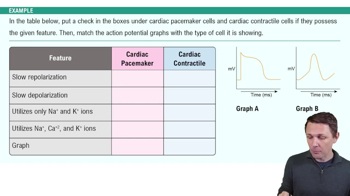
Depolarization

Depolarization refers to the process by which the membrane potential of a neuron becomes less negative (or more positive) than the resting potential. This occurs when sodium channels open, allowing Na+ ions to flow into the cell, which is crucial for the initiation of action potentials. In the context of the trigger zone, depolarization is essential for the propagation of nerve impulses.
Recommended video:
Guided course
3:49
Cardiac Action Potentials Example 1

Feedback Loops

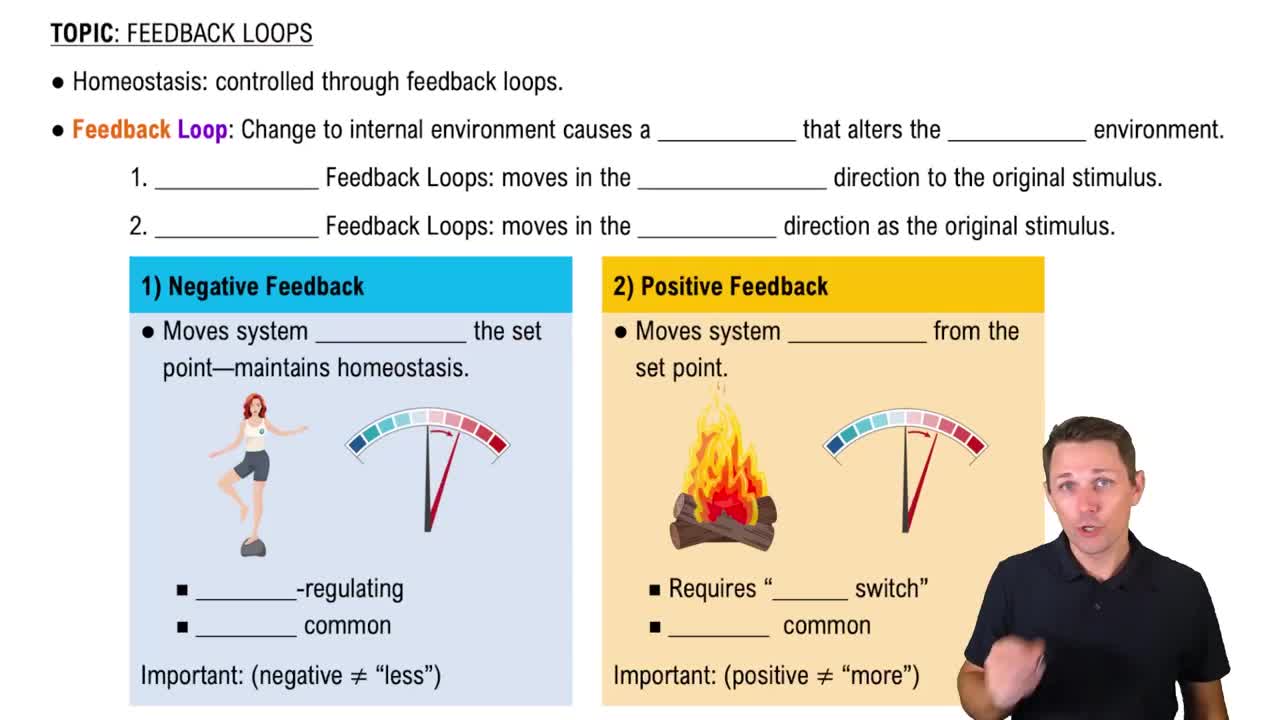
Feedback loops are processes in which the output of a system influences its own operation. In biological systems, positive feedback amplifies a response, while negative feedback reduces it. A positive feedback loop in neuronal activity would enhance depolarization and action potential generation, whereas a negative feedback loop would inhibit these processes, potentially leading to reduced neuronal excitability.
Recommended video:
Guided course
04:09
Introduction to Feedback Loops

Neuronal Excitability

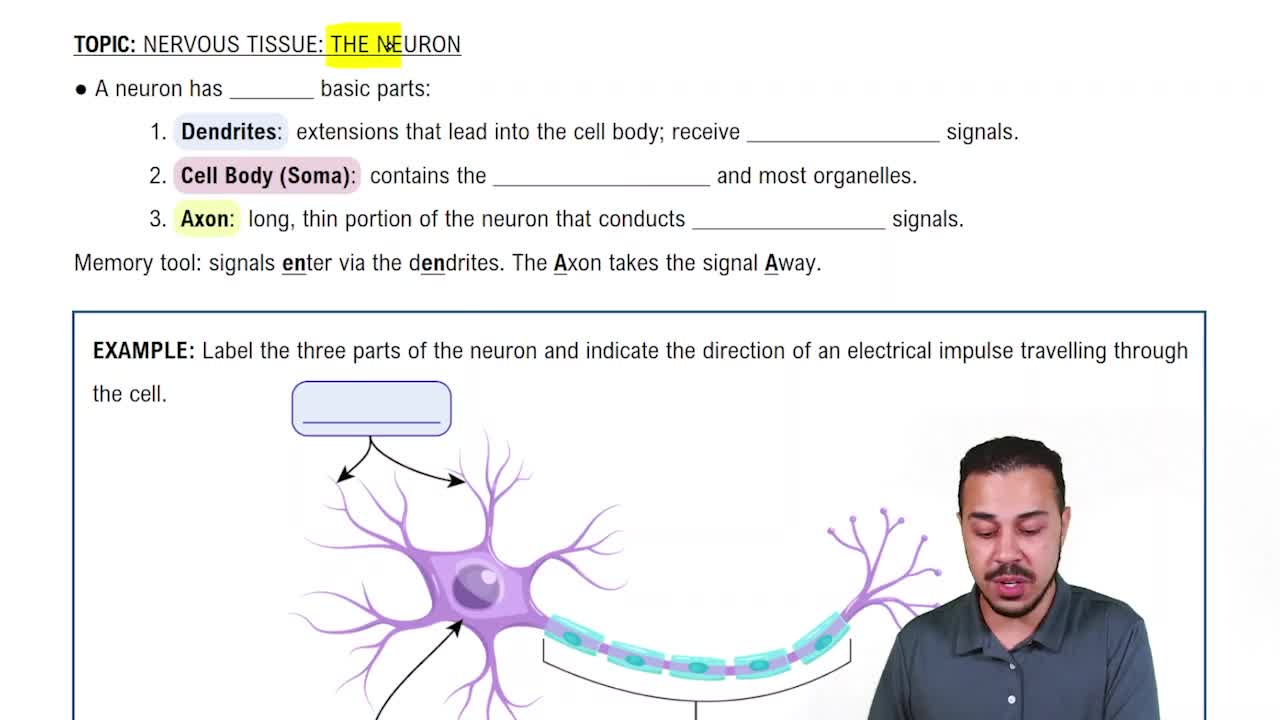
Neuronal excitability refers to the ability of a neuron to respond to stimuli and generate action potentials. This property is influenced by ion channel dynamics and the balance of excitatory and inhibitory signals. If depolarization at the trigger zone led to a negative feedback loop, it would decrease neuronal excitability, making it harder for the neuron to fire and transmit signals effectively.
Recommended video:
Related Practice
Textbook Question

Albert accidentally ingests the poison tetrodotoxin from the pufferfish, which you know blocks voltage-gated Na+ channels. Predict the symptoms Albert will experience from this poisoning.

425
views
Textbook Question

Albert, the patient in question 3, takes the drug lithium, which reduces the permeability of the neuronal axolemma to Na+ (that is, it allows fewer Na+ to enter the axon). Predict the effect this would normally have on his neuronal action potentials. Do you think this drug would be beneficial or harmful, considering his condition?

470
views
Textbook Question

Predict the effect that tetrodotoxin would have on Albert's muscle fiber action potentials (see question 3). Would it affect end-plate potentials at the motor end plate? Why or why not?

385
views
Textbook Question

Mark the following statements as true or false. If a statement is false, correct it to make a true statement.

The resting membrane potential refers to the voltage difference across the membranes of excitable cells at rest.

573
views
Textbook Question

Mark the following statements as true or false. If a statement is false, correct it to make a true statement.

The concentration of Na+ is highest in the cytosol, and the concentration of K+ is highest in the extracellular fluid.

611
views
Textbook Question

Mark the following statements as true or false. If a statement is false, correct it to make a true statement.

The Na+/K+ pumps and gated channels maintain the Na+ and K+ gradients necessary for action potentials to occur.

477
views