
Ch. 21 The Respiratory System
Amerman - Human Anatomy & Physiology 2nd Edition
Erin C. Amerman2nd EditionHuman Anatomy & PhysiologyISBN: 9780136873822Not the one you use?Change textbook
Chapter 21, Problem L2.3

Predict what would happen to the tidal volume and inspiratory reserve volume if the phrenic nerves were severed. Which muscles would contract to try to compensate for this?

Verified step by step guidance
1
Understand the role of the phrenic nerves: The phrenic nerves control the diaphragm, which is the primary muscle responsible for inspiration (inhalation). Severing these nerves would impair the diaphragm's ability to contract, significantly affecting normal breathing.
Predict the effect on tidal volume: Tidal volume is the amount of air inhaled or exhaled during a normal breath. If the diaphragm cannot contract, tidal volume would decrease because the primary mechanism for drawing air into the lungs is compromised.
Predict the effect on inspiratory reserve volume: Inspiratory reserve volume is the additional air that can be inhaled beyond a normal breath. Without the diaphragm's function, the ability to take a deep breath would also be reduced, leading to a decrease in inspiratory reserve volume.
Identify compensatory muscles: To compensate for the loss of diaphragm function, accessory muscles of respiration, such as the external intercostal muscles, sternocleidomastoid, and scalene muscles, would contract to assist in expanding the rib cage and drawing air into the lungs.
Summarize the physiological impact: The severing of the phrenic nerves would lead to a significant reduction in both tidal volume and inspiratory reserve volume. The body would rely on accessory muscles to partially compensate for the loss of diaphragm function, but breathing efficiency would be greatly diminished.

Verified video answer for a similar problem:

This video solution was recommended by our tutors as helpful for the problem above.
Was this helpful?

Key Concepts

Here are the essential concepts you must grasp in order to answer the question correctly.

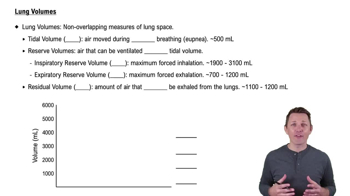
Tidal Volume

Tidal volume refers to the amount of air inhaled or exhaled during normal breathing. It is a critical measure of lung function and respiratory health. If the phrenic nerves, which innervate the diaphragm, are severed, the tidal volume would likely decrease due to the diaphragm's inability to contract effectively, leading to shallower breaths.
Recommended video:
Guided course
6:28
Lung Volumes

Inspiratory Reserve Volume

Inspiratory reserve volume (IRV) is the additional amount of air that can be inhaled after a normal inhalation. Severing the phrenic nerves would impair the diaphragm's function, potentially reducing the IRV as the body struggles to take deeper breaths. This could lead to a reliance on accessory muscles for deeper inhalation.
Recommended video:
Guided course
6:28
Lung Volumes

Accessory Muscles of Breathing

Accessory muscles of breathing, such as the sternocleidomastoid and scalene muscles, assist in inhalation, especially when the primary muscles (like the diaphragm) are compromised. If the phrenic nerves are severed, these muscles would contract more actively to compensate for the reduced tidal volume and inspiratory reserve volume, allowing for some degree of respiratory function despite the loss of diaphragm control.
Recommended video:
3:21
Accessory Organs