Pearson+ LogoPearson+ Logo
Ch. 27 Development and Heredity
Amerman - Human Anatomy & Physiology 2nd Edition
Erin C. Amerman2nd EditionHuman Anatomy & PhysiologyISBN: 9780136873822Not the one you use?Change textbook
Chapter 27, Problem 19

________ are segments of DNA that code for a specific protein, and the human ________ includes over 20,000 of these segments.

Verified step by step guidance
1
Step 1: Understand the context of the question. The problem is asking about segments of DNA that code for specific proteins and the total collection of these segments in humans.
Step 2: Recall that DNA contains specific sequences that serve as instructions for building proteins. These sequences are known as 'genes.'
Step 3: Recognize that the complete set of genes in an organism is referred to as its 'genome.'
Step 4: Note that the human genome contains over 20,000 genes, which are responsible for coding the proteins necessary for various biological functions.
Step 5: Combine the information to understand that the blanks in the problem should be filled with 'genes' and 'genome,' respectively.

Verified video answer for a similar problem:

This video solution was recommended by our tutors as helpful for the problem above.
Was this helpful?

Key Concepts

Here are the essential concepts you must grasp in order to answer the question correctly.

Genes

Genes are segments of DNA that contain the instructions for synthesizing proteins. Each gene is responsible for producing a specific protein that plays a crucial role in the body's structure and function. In humans, genes are fundamental to heredity and influence traits and biological processes.
Recommended video:
Guided course
2:39
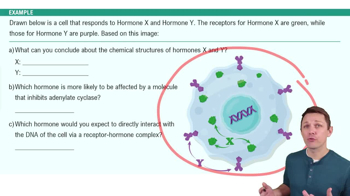
Intracellular Receptors and Direct Gene Action Example 1

Human Genome

The human genome is the complete set of genetic information for humans, consisting of over 20,000 genes. It encompasses all the DNA in an organism, including both coding regions (genes) and non-coding regions. Understanding the human genome is essential for studying genetics, evolution, and various diseases.
Recommended video:
4:48
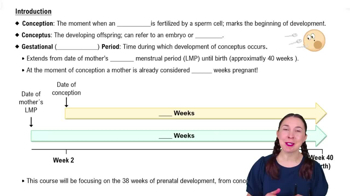
Introduction to Human Development

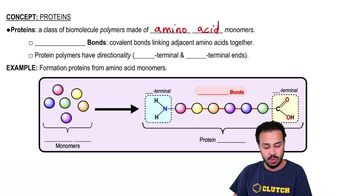
Proteins

Proteins are large, complex molecules made up of amino acids, and they perform a vast array of functions within living organisms. They are essential for the structure, function, and regulation of the body's tissues and organs. The specific sequence of amino acids in a protein is determined by the corresponding gene, linking genetics to biological function.
Recommended video:
02:50
Proteins