Ch. 27 Development and Heredity
Amerman - Human Anatomy & Physiology 2nd Edition
Erin C. Amerman2nd EditionHuman Anatomy & PhysiologyISBN: 9780136873822Not the one you use?Change textbook
Chapter 27, Problem 20

Which pattern of inheritance includes examples of codominance?
a. Autosomal dominant and recessive traits
b. Multiple-allele traits
c. Sex-linked traits
d. Polygenic inheritance

Verified step by step guidance
1
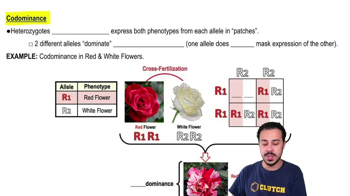
Understand the concept of codominance: Codominance occurs when two alleles for a gene are expressed equally in the phenotype of an organism. This means that neither allele is dominant or recessive, and both traits are visible simultaneously.
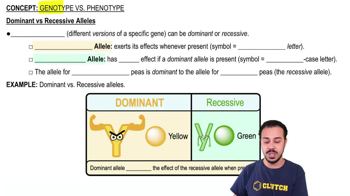
Review the inheritance patterns provided in the options: Autosomal dominant and recessive traits involve one allele being dominant over the other, so codominance does not apply here. Sex-linked traits are associated with genes located on sex chromosomes, and codominance is not typically a feature of this pattern. Polygenic inheritance involves multiple genes contributing to a single trait, which is different from codominance.
Focus on the 'multiple-allele traits' option: Multiple-allele traits involve more than two alleles for a single gene. Codominance can occur in this pattern when two alleles are expressed equally in the phenotype. A classic example is the ABO blood group system, where both A and B alleles are codominant.
Relate codominance to real-world examples: In the ABO blood group system, individuals with genotype 'IAIB' express both A and B antigens on their red blood cells, demonstrating codominance.
Conclude that the correct answer is the inheritance pattern that includes examples of codominance, which is 'multiple-allele traits.'

Verified video answer for a similar problem:

This video solution was recommended by our tutors as helpful for the problem above.
Was this helpful?

Key Concepts

Here are the essential concepts you must grasp in order to answer the question correctly.

Codominance

Codominance is a genetic scenario where two different alleles for a gene are both expressed equally in the phenotype of an organism. This results in a phenotype that displays characteristics of both alleles simultaneously, such as in the case of AB blood type in humans, where both A and B alleles are fully expressed.
Recommended video:
02:59
Codominance

Multiple-allele traits

Multiple-allele traits refer to situations where a gene has more than two alleles in the population. This allows for a variety of phenotypes to emerge, as seen in the ABO blood group system, where three alleles (IA, IB, and i) determine the blood type, including codominance between IA and IB.
Recommended video:
03:39
Dominant vs. Recessive Alleles

Patterns of inheritance

Patterns of inheritance describe how traits are passed from parents to offspring through genetic mechanisms. Understanding these patterns, such as autosomal dominant, autosomal recessive, and codominance, is crucial for predicting phenotypic outcomes in offspring based on parental genotypes.
Recommended video:
01:02
Autosomal Inheritance