Ch. 8 Articulations
Chapter 8, Problem 3

Identify each of the following joints as synovial, fibrous, or cartilaginous.
a. Pubic symphysis______           
b. Elbow joint_____             
c. Epiphyseal plate_______         
d. Frontal suture_________          
e. Gomphosis___________           

Verified step by step guidance
1
Step 1: Understand the three types of joints: Synovial joints are freely movable and have a fluid-filled cavity (e.g., elbow joint). Fibrous joints are immovable or slightly movable and are connected by dense connective tissue (e.g., sutures in the skull). Cartilaginous joints are slightly movable and connected by cartilage (e.g., pubic symphysis).
Step 2: Analyze the pubic symphysis. This joint is located between the left and right pubic bones and is connected by fibrocartilage, making it a cartilaginous joint.
Step 3: Examine the elbow joint. This joint is freely movable and contains a synovial cavity filled with fluid, making it a synovial joint.
Step 4: Consider the epiphyseal plate. This structure is a cartilaginous joint found in growing bones, where hyaline cartilage allows for bone growth.
Step 5: Review the frontal suture and gomphosis. The frontal suture is a fibrous joint found in the skull, while gomphosis is a fibrous joint that anchors teeth to their sockets in the jaw.

Verified video answer for a similar problem:

This video solution was recommended by our tutors as helpful for the problem above.
Was this helpful?

Key Concepts

Here are the essential concepts you must grasp in order to answer the question correctly.

Types of Joints

Joints are classified into three main types based on their structure and function: synovial, fibrous, and cartilaginous. Synovial joints, such as the elbow, allow for a wide range of motion and are characterized by a fluid-filled joint cavity. Fibrous joints, like the frontal suture, are connected by dense connective tissue and allow little to no movement. Cartilaginous joints, such as the pubic symphysis and epiphyseal plate, are connected by cartilage and permit limited movement.
Recommended video:
05:39
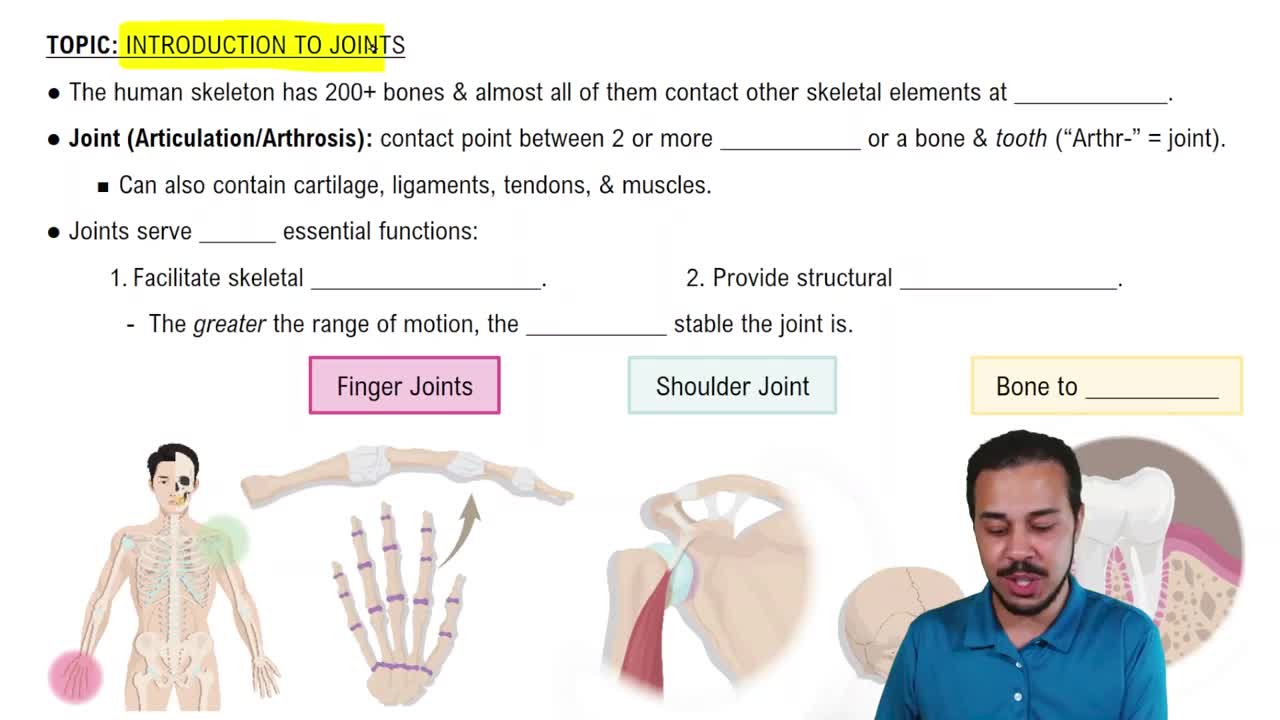
Introduction to Joints

Synovial Joints

Synovial joints are the most mobile type of joint in the human body, featuring a synovial cavity filled with synovial fluid that lubricates the joint. They are surrounded by a joint capsule and often have additional structures like ligaments and cartilage that provide stability and support. Examples include the elbow and knee joints, which allow for flexion, extension, and rotation.
Recommended video:
8:20
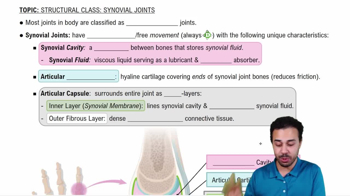
Synovial Joints

Fibrous and Cartilaginous Joints

Fibrous joints are connected by fibrous connective tissue and are typically immovable, as seen in sutures of the skull. Cartilaginous joints, on the other hand, are connected by cartilage and allow for slight movement, such as in the pubic symphysis and epiphyseal plates, which are crucial during growth. Understanding these distinctions is essential for identifying the type of joint based on its structure and function.
Recommended video:
02:17
Introduction to Cartilaginous Joints