Ch. 8 Articulations
Amerman - Human Anatomy & Physiology 2nd Edition
Erin C. Amerman2nd EditionHuman Anatomy & PhysiologyISBN: 9780136873822Not the one you use?Change textbook
Chapter 8, Problem 2

Which functional joint class includes freely moveable joints?
a. Amphiarthroses
b. Synarthroses
c. Diarthroses
d. All functional joint classes are freely movable.

Verified step by step guidance
1
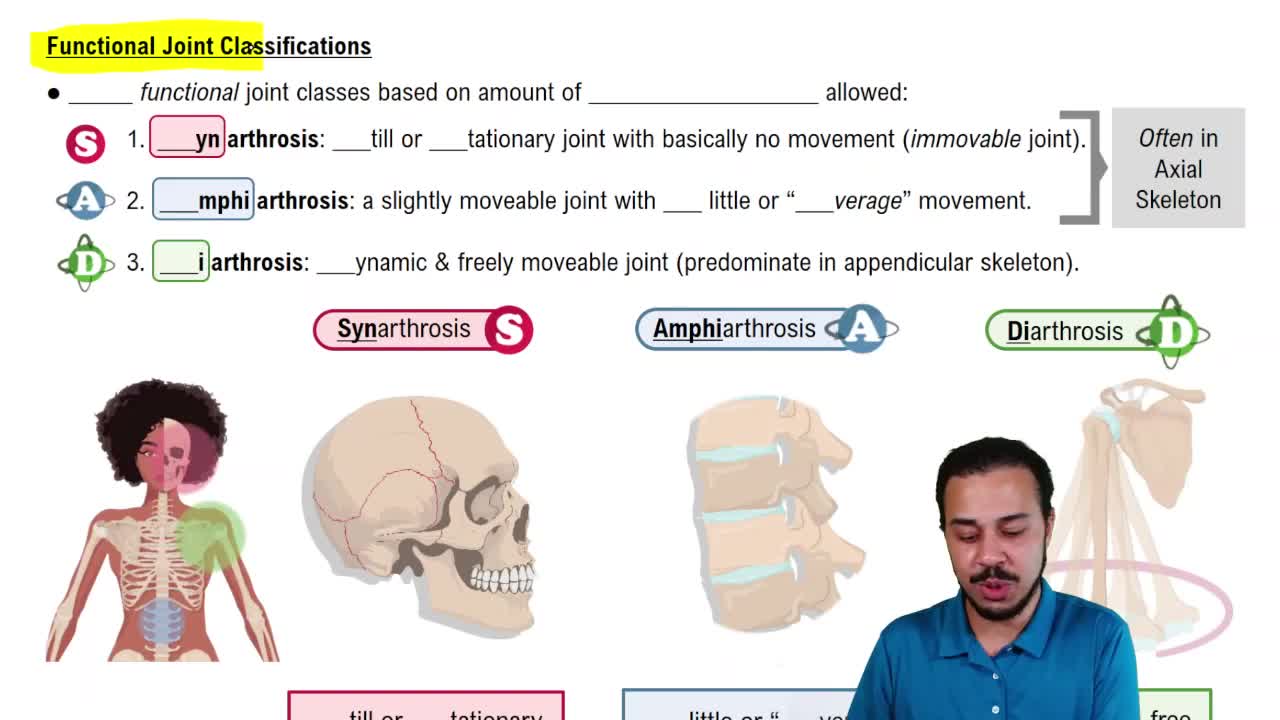
Understand the three functional joint classes: Synarthroses (immovable joints), Amphiarthroses (slightly movable joints), and Diarthroses (freely movable joints).
Recall that functional joint classification is based on the degree of movement allowed by the joint.
Focus on the term 'freely movable joints' in the question, which corresponds to the functional joint class that allows the greatest range of motion.
Eliminate incorrect options: Synarthroses are immovable, and Amphiarthroses are only slightly movable, so they do not fit the description of 'freely movable.'
Conclude that the correct functional joint class for freely movable joints is Diarthroses.

Verified video answer for a similar problem:

This video solution was recommended by our tutors as helpful for the problem above.
Was this helpful?

Key Concepts

Here are the essential concepts you must grasp in order to answer the question correctly.

Functional Joint Classes

Functional joint classes categorize joints based on their movement capabilities. The three main classes are synarthroses (immovable joints), amphiarthroses (slightly movable joints), and diarthroses (freely movable joints). Understanding these classifications is essential for identifying the type of movement allowed at each joint.
Recommended video:
2:15
Structural Class: Synovial Joints Example 1

Diarthroses

Diarthroses, also known as synovial joints, are characterized by a joint cavity filled with synovial fluid, allowing for a wide range of motion. Examples include the knee, elbow, and shoulder joints. Recognizing diarthroses is crucial for understanding the functional capabilities of joints in the human body.
Recommended video:
08:43
Functional Joint Classifications

Synarthroses and Amphiarthroses

Synarthroses are joints that do not allow any movement, such as sutures in the skull, while amphiarthroses permit limited movement, like the joints between vertebrae. These concepts contrast with diarthroses and help clarify the spectrum of joint mobility, which is vital for answering questions about joint classifications.
Recommended video:
08:43
Functional Joint Classifications