Pearson+ LogoPearson+ Logo
Ch. 8 Articulations
Amerman - Human Anatomy & Physiology 2nd Edition
Erin C. Amerman2nd EditionHuman Anatomy & PhysiologyISBN: 9780136873822Not the one you use?Change textbook
Chapter 8, Problem 1

Which of the following is not a function of articulations?
a. Movement
b. Blood cell formation
c. Stability
d. Providing growth in length for long bones

Verified step by step guidance
1
Step 1: Begin by understanding the term 'articulations.' Articulations, also known as joints, are the points where two or more bones meet. Their primary functions include enabling movement, providing stability, and facilitating growth in length for long bones during development.
Step 2: Analyze each option provided in the question to determine whether it aligns with the functions of articulations. For example, movement is a key function of joints, as they allow bones to move relative to one another.
Step 3: Consider the role of articulations in stability. Certain types of joints, such as immovable or slightly movable joints, contribute to the stability of the skeletal system.
Step 4: Evaluate the option 'providing growth in length for long bones.' During development, growth plates (epiphyseal plates) located at the ends of long bones are associated with articulations and contribute to bone growth in length.
Step 5: Examine the option 'blood cell formation.' Blood cell formation, or hematopoiesis, occurs in the bone marrow, which is not a function of articulations. Therefore, this option does not align with the functions of joints.

Verified video answer for a similar problem:

This video solution was recommended by our tutors as helpful for the problem above.
Was this helpful?

Key Concepts

Here are the essential concepts you must grasp in order to answer the question correctly.

Functions of Articulations

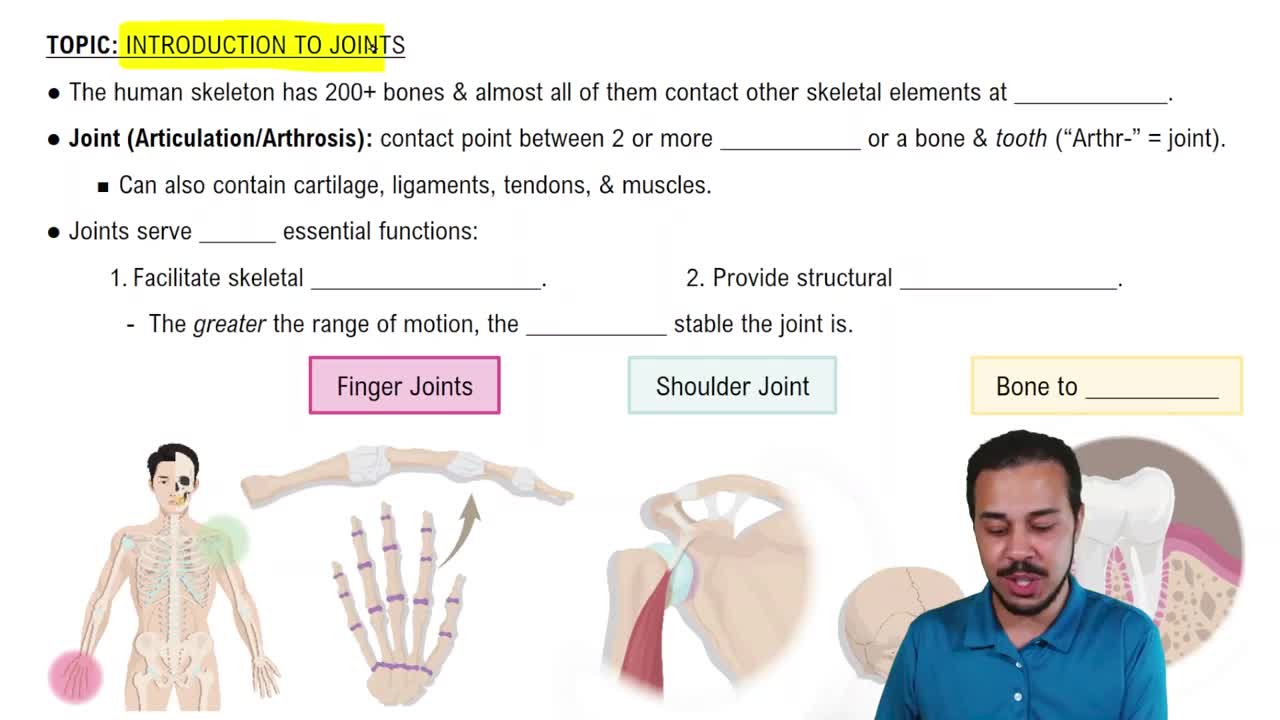
Articulations, or joints, serve several key functions in the human body, including facilitating movement, providing stability, and allowing for growth in length in certain bones. They connect bones and enable a range of motions, from simple hinge movements to complex rotations, depending on the type of joint.
Recommended video:
06:04
Functional Groups

Types of Joints

Joints can be classified into several types, including synovial, fibrous, and cartilaginous joints. Synovial joints, such as the knee and elbow, are particularly important for movement and flexibility, while fibrous joints, like those in the skull, provide stability and minimal movement.
Recommended video:
05:39
Introduction to Joints

Hematopoiesis

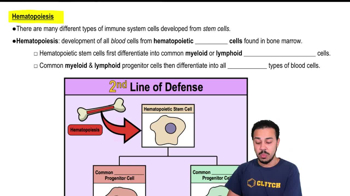
Hematopoiesis is the process of blood cell formation, primarily occurring in the bone marrow. While bones play a crucial role in this process, it is not a direct function of articulations themselves, which are primarily involved in movement and stability rather than blood cell production.
Recommended video:
2:33
Hematopoeisis