Ch. 21 The Immune System: Innate and Adaptive Body Defenses
Hoehn - Marieb Human Anatomy & Physiology, 12th edition
Hoehn, Haynes, Abbott12th EditionMarieb Human Anatomy & PhysiologyISBN: 9780138242732Not the one you use?Change textbook
Chapter 21, Problem 21

Define hypersensitivity. List three types of hypersensitivity reactions. For each, note whether antibodies or T cells are involved and provide examples.

Verified step by step guidance
1
Hypersensitivity is defined as an exaggerated or inappropriate immune response to an antigen that leads to tissue damage or dysfunction. It occurs when the immune system reacts excessively to harmless substances or self-antigens.
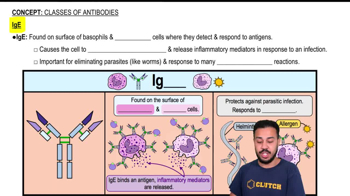
Type I hypersensitivity (Immediate hypersensitivity): This type involves antibodies, specifically IgE. When an allergen binds to IgE on mast cells or basophils, it triggers the release of histamine and other inflammatory mediators. Examples include allergic reactions such as hay fever, asthma, and anaphylaxis.
Type II hypersensitivity (Cytotoxic hypersensitivity): This type involves antibodies, primarily IgG or IgM. These antibodies bind to antigens on the surface of cells, leading to cell destruction via complement activation or antibody-dependent cellular cytotoxicity (ADCC). Examples include hemolytic anemia and Rh incompatibility in newborns.
Type III hypersensitivity (Immune complex-mediated hypersensitivity): This type involves antibodies, specifically IgG or IgM, forming immune complexes with antigens. These complexes deposit in tissues, causing inflammation and tissue damage through complement activation and recruitment of neutrophils. Examples include systemic lupus erythematosus (SLE) and post-streptococcal glomerulonephritis.
Type IV hypersensitivity (Delayed-type hypersensitivity): This type involves T cells rather than antibodies. It is mediated by CD4+ helper T cells or CD8+ cytotoxic T cells, which release cytokines to recruit macrophages and other immune cells, leading to tissue damage. Examples include contact dermatitis (e.g., poison ivy reaction) and the tuberculin skin test.

Verified video answer for a similar problem:

This video solution was recommended by our tutors as helpful for the problem above.
Video duration:
5m
Was this helpful?

Key Concepts

Here are the essential concepts you must grasp in order to answer the question correctly.

Hypersensitivity

Hypersensitivity refers to an exaggerated immune response to a foreign substance (antigen) that can lead to tissue damage and various clinical symptoms. It occurs when the immune system reacts excessively to harmless substances, resulting in inflammation and other adverse effects. Understanding hypersensitivity is crucial for identifying and managing allergic reactions and autoimmune diseases.
Recommended video:

Types of Hypersensitivity Reactions

There are four main types of hypersensitivity reactions: Type I (immediate hypersensitivity), Type II (antibody-mediated), Type III (immune complex-mediated), and Type IV (delayed-type hypersensitivity). Each type is characterized by different immune mechanisms and responses, with Type I involving IgE antibodies, Type II involving IgG or IgM antibodies, Type III involving immune complexes, and Type IV primarily involving T cells.
Recommended video:
Guided course
05:48
Types of Chemical Reactions

Role of Antibodies and T Cells

In hypersensitivity reactions, antibodies and T cells play distinct roles. Type I, II, and III hypersensitivity reactions primarily involve antibodies (IgE, IgG, or IgM), which mediate the immune response against antigens. In contrast, Type IV hypersensitivity is mediated by T cells, specifically CD4+ helper T cells and CD8+ cytotoxic T cells, which respond to antigens without the involvement of antibodies.
Recommended video:
Guided course
3:53
Regulatory T Cells