Pearson+ LogoPearson+ Logo
Ch. 33 - An introduction to Invertebrates
Campbell - Campbell Biology 12th Edition
Urry12th EditionCampbell BiologyISBN: 9785794169850Not the one you use?Change textbook
Chapter 33, Problem 5

In the following figure, which two main clades branch from the most recent common ancestor of the eumetazoans?
a. Porifera and Cnidaria
b. Lophotrochozoa and Ecdysozoa
c. Cnidaria and Bilateria
d. Deuterostomia and Bilateria
<IMAGE>

Verified step by step guidance
1
Identify the term 'eumetazoans' in the question. Eumetazoans are animals with true tissues, which excludes sponges (Porifera).
Understand the concept of clades. A clade is a group of organisms that includes a common ancestor and all its descendants.
Examine the evolutionary relationships among the groups mentioned in the options. Cnidaria (jellyfish, corals, etc.) and Bilateria (animals with bilateral symmetry) are two major clades within Eumetazoa.
Recall that Cnidaria represents a simpler body plan with radial symmetry, while Bilateria includes more complex animals with bilateral symmetry and three germ layers.
Conclude that the two main clades branching from the most recent common ancestor of eumetazoans are Cnidaria and Bilateria, as they represent the primary division within this group.

Verified video answer for a similar problem:

This video solution was recommended by our tutors as helpful for the problem above.
Video duration:
40s
Was this helpful?

Key Concepts

Here are the essential concepts you must grasp in order to answer the question correctly.

Eumetazoans

Eumetazoans are a major clade within the animal kingdom, characterized by having true tissues. This group excludes sponges and includes all other animals, such as cnidarians and bilaterians. Understanding eumetazoans is crucial for identifying evolutionary relationships among animals, as they represent a significant divergence point in the animal phylogenetic tree.

Cnidaria

Cnidaria is a phylum within the eumetazoans that includes jellyfish, corals, and sea anemones. These organisms are primarily aquatic and are known for their radial symmetry and specialized cells called cnidocytes, which contain stinging structures. Cnidarians are one of the earliest diverging groups within eumetazoans, providing insight into early animal evolution.
Recommended video:
Guided course
10:21
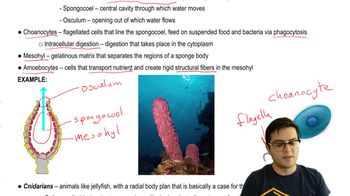
Porifera and Cnideria

Bilateria

Bilateria is a clade within the eumetazoans characterized by bilateral symmetry and three germ layers. This group includes most animal phyla, such as arthropods, mollusks, and vertebrates. Bilaterians are significant in evolutionary biology because their body plan allows for greater complexity and specialization, marking a major evolutionary advancement from simpler organisms like cnidarians.
Recommended video:
Guided course
04:31
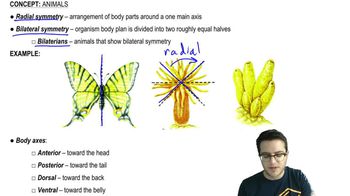
Overview of Animals - 4