Pearson+ LogoPearson+ Logo
Ch. 17 - Gene Expression: From Gene to Protein
Campbell - Campbell Biology 11th Edition
Urry11th EditionCampbell BiologyISBN: 9789357423311Not the one you use?Change textbook
Chapter 17, Problem 2

Which of the following is not true of a codon?
a. It may code for the same amino acid as another codon.
b. It never codes for more than one amino acid.
c. It extends from one end of a tRNA molecule.
d. It is the basic unit of the genetic code.

Verified step by step guidance
1
Understand the definition of a codon: A codon is a sequence of three nucleotides on mRNA that corresponds to a specific amino acid or a stop signal during protein synthesis.
Review the concept of redundancy in the genetic code: Multiple codons can code for the same amino acid, which is known as redundancy or degeneracy of the genetic code.
Consider the specificity of codons: Each codon codes for only one amino acid or a stop signal, ensuring precise translation during protein synthesis.
Examine the role of tRNA: Codons do not extend from tRNA molecules; instead, anticodons on tRNA molecules pair with codons on mRNA during translation.
Identify the basic unit of the genetic code: Codons are indeed the basic units of the genetic code, as they determine the sequence of amino acids in a protein.

Verified video answer for a similar problem:

This video solution was recommended by our tutors as helpful for the problem above.
Video duration:
57s
Was this helpful?

Key Concepts

Here are the essential concepts you must grasp in order to answer the question correctly.

Codon

A codon is a sequence of three nucleotides in mRNA that specifies a particular amino acid or a stop signal during protein synthesis. Codons are the basic units of the genetic code, and each corresponds to a specific amino acid or function in the translation process.
Recommended video:
Guided course
11:39
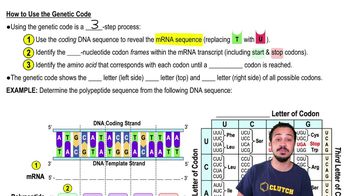
How to Use the Genetic Code

Genetic Code

The genetic code is a set of rules by which information encoded in genetic material (DNA or RNA sequences) is translated into proteins by living cells. It is universal among organisms and consists of 64 codons, where multiple codons can code for the same amino acid, a phenomenon known as redundancy.
Recommended video:

tRNA and Anticodon

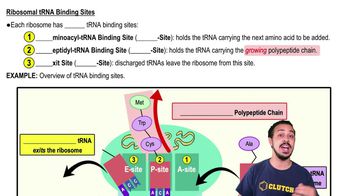
Transfer RNA (tRNA) is a type of RNA molecule that helps decode a messenger RNA (mRNA) sequence into a protein. Each tRNA has an anticodon region that is complementary to a codon on the mRNA, allowing it to bring the correct amino acid to the ribosome during translation. Codons do not extend from tRNA; rather, anticodons do.
Recommended video:
Guided course
06:16
Ribosomal tRNA Binding Sites