
Pearson+ LogoPearson+ Logo
Ch. 21 - Genomes and Their Evolution
Campbell - Campbell Biology 11th Edition
Urry11th EditionCampbell BiologyISBN: 9789357423311Not the one you use?Change textbook
Chapter 21, Problem 4b

Use a highlighter to color any amino acid that varies among the species. (Color that amino acid in all sequences.)
a. The C, G, R sequences are identical. Identify which lines correspond to those sequences.


Verified step by step guidance
1
Examine the sequences provided for each species: Human, Mouse, Chimpanzee, Frog, and Fish.
Identify the amino acids that are identical across all species. These are the ones that do not vary and should not be highlighted.
For each position in the sequence, compare the amino acids across all species. Highlight any amino acid that differs from the others at that position.
Look for sequences that are identical among the species. In this case, the sequences for Human, Mouse, and Chimpanzee are identical.
Identify the lines corresponding to the identical sequences: Human, Mouse, and Chimpanzee. These lines should not have any highlighted amino acids since they are identical.

Verified video answer for a similar problem:

This video solution was recommended by our tutors as helpful for the problem above.
Video duration:
1m
Was this helpful?

Key Concepts

Here are the essential concepts you must grasp in order to answer the question correctly.

Amino Acid Sequence Alignment

Amino acid sequence alignment is a method used to identify regions of similarity that may indicate functional, structural, or evolutionary relationships between the sequences. In this context, the alignment helps to compare sequences from different species to identify conserved and variable regions, which can provide insights into evolutionary changes and functional conservation.
Recommended video:

Conserved and Variable Regions

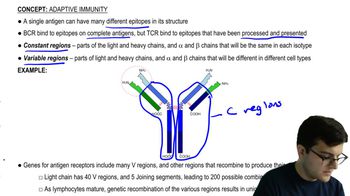
Conserved regions in protein sequences are areas where the amino acids remain unchanged across different species, indicating essential functional or structural roles. Variable regions, on the other hand, show differences in amino acids, suggesting areas of evolutionary divergence. Identifying these regions helps in understanding the evolutionary relationships and functional adaptations among species.
Recommended video:
Guided course
04:13
Constant and Variable Regions

Phylogenetic Relationships

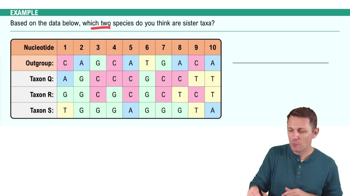
Phylogenetic relationships refer to the evolutionary connections between different species, often inferred from genetic or protein sequence data. By analyzing similarities and differences in amino acid sequences, scientists can construct phylogenetic trees that depict the evolutionary pathways and common ancestors of the species involved, providing a framework for understanding biological diversity and evolution.
Recommended video:
04:13
Building Phylogenetic Trees Example 2
Related Practice
Textbook Question

Bioinformatics includes all of the following except

a. Using computer programs to align DNA sequences.

b. Using DNA technology to combine DNA from two different sources in a test tube.

c. Developing computer-based tools for genome analysis.

d. Using mathematical tools to make sense of biological systems.

1751
views
Textbook Question

Homeotic genes

a. Encode transcription factors that control the expression of genes responsible for specific anatomical structures.

b. Are found only in Drosophila and other arthropods.

c. Are the only genes that contain the homeobox domain.

d. Encode proteins that form anatomical structures in the fly.

1601
views
Textbook Question

Two eukaryotic proteins have one domain in common but are otherwise very different. Which of the following processes is most likely to have contributed to this similarity?

a. Gene duplication

b. Alternative splicing

c. Exon shuffling

d. Random point mutations

1483
views
Textbook Question

Use a highlighter to color any amino acid that varies among the species. (Color that amino acid in all sequences.)

b. The H sequence differs from that of the C, G, R species at two amino acids. Underline the two differences in the H sequence.

889
views
Textbook Question

Use a highlighter to color any amino acid that varies among the species. (Color that amino acid in all sequences.)

c. The O sequence differs from the C, G, R sequences at one amino acid (having V instead of A) and from the H sequence at three amino acids. Identify the O sequence.

825
views
Textbook Question

Use a highlighter to color any amino acid that varies among the species. (Color that amino acid in all sequences.)

d. In the M sequence, circle the amino acid(s) that differ from the C, G, R sequences, and draw a square around those that differ from the H sequence.

835
views