
Pearson+ LogoPearson+ Logo
Ch. 22 - Descent with Modification: A Darwininan View of Life
Campbell - Campbell Biology 11th Edition
Urry11th EditionCampbell BiologyISBN: 9789357423311Not the one you use?Change textbook
Chapter 22, Problem 2

Which of the following observations helped Darwin shape his concept of descent with modification?
a. Species diversity declines farther from the equator.
b. Fewer species live on islands than on the nearest continents.
c. Birds live on islands located farther from the mainland than the birds' maximum nonstop flight distance.
d. South American temperate plants are more similar to the tropical plants of South America than to the temperate plants of Europe.

Verified step by step guidance
1
Understand the concept of 'descent with modification': This is a key principle of Darwin's theory of evolution, which suggests that species change over time, giving rise to new species, and share a common ancestor.
Analyze the options provided: Each option represents an observation that could potentially support the idea of descent with modification.
Option a: Consider how species diversity might relate to evolutionary processes and environmental factors at different latitudes.
Option b: Think about how the isolation of islands could lead to fewer species and how this might support the idea of species evolving differently in isolated environments.
Option d: Reflect on how the similarity between South American temperate and tropical plants, compared to European temperate plants, might suggest a common ancestry and adaptation to local environments, supporting descent with modification.

Verified video answer for a similar problem:

This video solution was recommended by our tutors as helpful for the problem above.
Video duration:
1m
Was this helpful?

Key Concepts

Here are the essential concepts you must grasp in order to answer the question correctly.

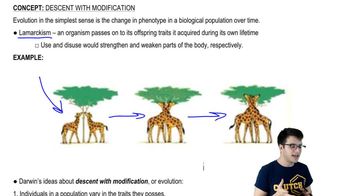
Descent with Modification

Descent with modification is a fundamental concept in Darwin's theory of evolution, suggesting that species change over time and give rise to new species, sharing a common ancestor. This process involves gradual changes in traits, influenced by natural selection, leading to adaptations that enhance survival and reproduction in specific environments.
Recommended video:
Guided course
04:52
Descent With Modification

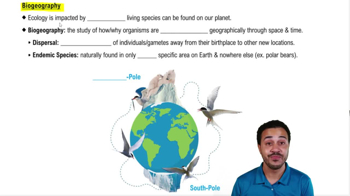
Biogeography

Biogeography is the study of the distribution of species and ecosystems in geographic space and through geological time. Observations of species distribution, such as fewer species on islands compared to continents, provide evidence for evolution, as they suggest that isolation and environmental factors influence species diversity and adaptation.
Recommended video:

Comparative Anatomy

Comparative anatomy involves comparing the anatomical structures of different species to understand evolutionary relationships. Darwin noted similarities between South American temperate and tropical plants, which supported the idea that species with common ancestry can diverge and adapt to different environments, illustrating descent with modification.
Recommended video:
Guided course
08:18
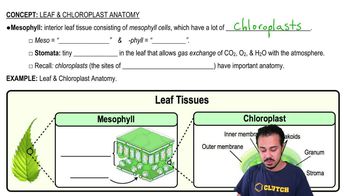
Leaf & Chloroplast Anatomy
Related Practice
Textbook Question

Which of the following is not an observation or inference on which natural selection is based?

a. There is heritable variation among individuals.

b. Poorly adapted individuals never produce offspring.

c. Species produce more offspring than the environment can support.

d. Only a fraction of an individual's offspring may survive.

1586
views
Textbook Question

Within six months of effectively using methicillin to treat S. aureus infections in a community, all new S. aureus infections were caused by MRSA. How can this best be explained?

a. A patient must have become infected with MRSA from another community.

b. In response to the drug, S. aureus began making drug- resistant versions of the protein targeted by the drug.

c. Some drug-resistant bacteria were present at the start of treatment, and natural selection increased their frequency.

d. S. aureus evolved to resist vaccines.

1988
views
Textbook Question

The upper forelimbs of humans and bats have fairly similar skeletal structures, whereas the corresponding bones in whales have very different shapes and proportions. However, genetic data suggest that all three kinds of organisms diverged from a common ancestor at about the same time. Which of the following is the most likely explanation for these data?

a. Forelimb evolution was adaptive in people and bats, but not in whales.

b. Natural selection in an aquatic environment resulted in significant changes to whale forelimb anatomy.

c. Genes mutate faster in whales than in humans or bats.

d. Whales are not properly classified as mammals.

3108
views
Textbook Question

DNA sequences in many human genes are very similar to the sequences of corresponding genes in chimpanzees. The most likely explanation for this result is that

a. Humans and chimpanzees share a relatively recent common ancestor.

b. Humans evolved from chimpanzees.

c. Chimpanzees evolved from humans.

d. Convergent evolution led to the DNA similarities.

1943
views