Pearson+ LogoPearson+ Logo
Ch. 27 - Bacteria and Archaea
Campbell - Campbell Biology 11th Edition
Urry11th EditionCampbell BiologyISBN: 9789357423311Not the one you use?Change textbook
Chapter 27, Problem 3

Which of the following statements is not true?
a. Archaea and bacteria have different membrane lipids.
b. The cell walls of archaea lack peptidoglycan.
c. Only bacteria have histones associated with DNA.
d. Only some archaea use CO2 to oxidize H2, releasing methane.

Verified step by step guidance
1
Step 1: Understand the characteristics of Archaea and Bacteria. Archaea and bacteria are both prokaryotes, but they have distinct differences in their cellular structures and biochemical processes.
Step 2: Analyze statement (a): 'Archaea and bacteria have different membrane lipids.' Archaea have unique ether-linked lipids in their membranes, while bacteria have ester-linked lipids. This statement is true.
Step 3: Analyze statement (b): 'The cell walls of archaea lack peptidoglycan.' Archaea do not have peptidoglycan in their cell walls; instead, they have pseudopeptidoglycan or other polymers. This statement is true.
Step 4: Analyze statement (c): 'Only bacteria have histones associated with DNA.' Histones are proteins associated with DNA in eukaryotes and some archaea, not bacteria. This statement is not true because some archaea also have histones.
Step 5: Analyze statement (d): 'Only some archaea use CO2 to oxidize H2, releasing methane.' This describes methanogenesis, a process unique to some archaea. This statement is true.

Verified video answer for a similar problem:

This video solution was recommended by our tutors as helpful for the problem above.
Video duration:
1m
Was this helpful?

Key Concepts

Here are the essential concepts you must grasp in order to answer the question correctly.

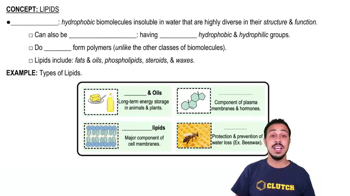
Membrane Lipids in Archaea and Bacteria

Archaea and bacteria have distinct membrane lipid compositions. Archaea possess ether-linked lipids, which are more stable in extreme conditions, while bacteria have ester-linked lipids. This difference is crucial for their adaptation to various environments and is a key factor in distinguishing these two domains of life.
Recommended video:

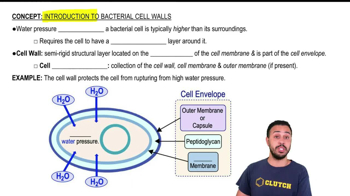
Cell Wall Composition in Archaea

The cell walls of archaea are unique in that they lack peptidoglycan, a polymer found in bacterial cell walls. Instead, archaea may have pseudopeptidoglycan or other polymers, which provide structural support and protection. This distinction is important for understanding the evolutionary divergence between archaea and bacteria.
Recommended video:
Guided course
03:44
Introduction to Bacterial Cell Walls

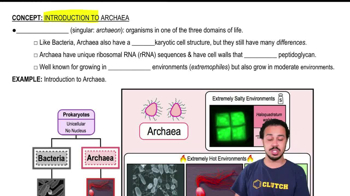
Histones in Archaea and Bacteria

Histones are proteins associated with DNA packaging in eukaryotes, and some archaea also have histone-like proteins. However, bacteria generally do not have histones; instead, they use other proteins for DNA organization. This concept is essential for understanding the differences in genetic material organization between these two groups.
Recommended video:
Guided course
04:39
Introduction to Archaea