Pearson+ LogoPearson+ Logo
Ch. 32 - An Overview of Animal Diversity
Campbell - Campbell Biology 11th Edition
Urry11th EditionCampbell BiologyISBN: 9789357423311Not the one you use?Change textbook
Chapter 32, Problem 4

Based on the tree in Figure 32.11, which statement is false?
<IMAGE>
a. The animal kingdom is monophyletic.
b. Acoelomate flatworms are more closely related to echinoderms than to annelids.
c. Sponges are basal animals.
d. Bilaterians form a clade.

Verified step by step guidance
1
Step 1: Understand the concept of monophyletic groups. A monophyletic group consists of an ancestor and all its descendants. In the context of the animal kingdom, this means all animals share a common ancestor.
Step 2: Examine the relationship between acoelomate flatworms, echinoderms, and annelids. Acoelomate flatworms lack a body cavity, while echinoderms and annelids have different body structures. Consider their evolutionary relationships based on the tree.
Step 3: Identify the basal animals in the phylogenetic tree. Basal animals are those that diverged early in the evolutionary history of a group. Sponges are often considered basal due to their simple structure and early divergence.
Step 4: Define what a clade is. A clade is a group of organisms that includes a common ancestor and all its descendants. Bilaterians, which have bilateral symmetry, form a clade in the animal kingdom.
Step 5: Analyze each statement in the context of the phylogenetic tree in Figure 32.11. Determine which statement does not align with the evolutionary relationships depicted in the tree.

Verified video answer for a similar problem:

This video solution was recommended by our tutors as helpful for the problem above.
Video duration:
2m
Was this helpful?

Key Concepts

Here are the essential concepts you must grasp in order to answer the question correctly.

Monophyletic Group

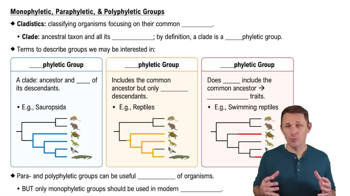
A monophyletic group, or clade, consists of an ancestor and all its descendants, representing a single branch on the tree of life. In the context of the animal kingdom, being monophyletic means all animals share a common ancestor, forming a distinct lineage separate from other life forms.
Recommended video:
06:37
Monophyletic, Paraphyletic, & Polyphyletic Group

Phylogenetic Relationships

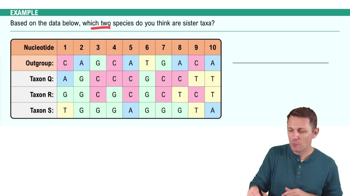
Phylogenetic relationships refer to the evolutionary connections between different species or groups, often depicted in a phylogenetic tree. Understanding these relationships helps determine how closely related different organisms are, such as whether acoelomate flatworms are more closely related to echinoderms or annelids.
Recommended video:
04:13
Building Phylogenetic Trees Example 2

Basal Animals

Basal animals are those that diverged early in the evolutionary history of a group, often retaining primitive characteristics. Sponges are considered basal animals because they represent one of the earliest branches in the animal kingdom, providing insights into the early evolution of multicellular organisms.
Recommended video:
Guided course
05:58
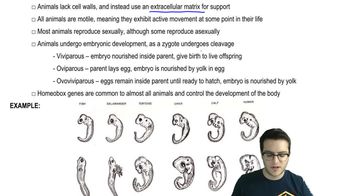
Overview of Animals - 1