
Ch. 49 - Nervous Systems
Chapter 49, Problem 4

The cerebral cortex does not play a major role in
a. Short-term memory
b. Long-term memory
c. Circadian rhythm
d. Breath holding

Verified step by step guidance
1
Identify the primary functions of the cerebral cortex, which include processing sensory information, voluntary motor control, and higher cognitive functions such as reasoning and memory.
Understand that short-term memory and long-term memory are cognitive functions that involve the cerebral cortex, particularly the prefrontal cortex and the hippocampus.
Recognize that circadian rhythm is primarily regulated by the hypothalamus, specifically the suprachiasmatic nucleus, rather than the cerebral cortex.
Consider that breath holding is a function controlled by the brainstem, which manages involuntary actions such as breathing, rather than the cerebral cortex.
Based on the understanding of these functions, determine which option does not primarily involve the cerebral cortex.

Verified video answer for a similar problem:

This video solution was recommended by our tutors as helpful for the problem above.
Video duration:
2m
Was this helpful?

Key Concepts

Here are the essential concepts you must grasp in order to answer the question correctly.

Cerebral Cortex

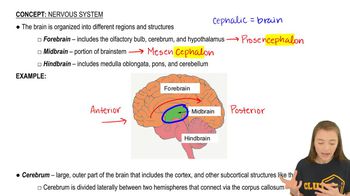
The cerebral cortex is the outer layer of the brain, involved in complex functions such as perception, thought, and decision-making. It plays a significant role in memory, attention, awareness, and consciousness. Understanding its functions helps in determining its involvement in various cognitive processes.
Recommended video:
Guided course
11:10
Cerebrum and Cerebral Cortex

Memory Types

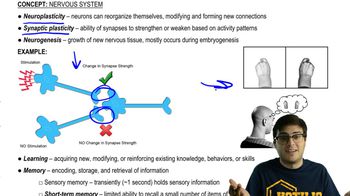
Memory is categorized into short-term and long-term memory. Short-term memory involves temporary storage of information, while long-term memory is responsible for storing information over extended periods. The cerebral cortex is crucial for long-term memory, but short-term memory involves other brain regions like the hippocampus.
Recommended video:
Guided course
07:41
Neuroplasticity, Learning, and Memory

Circadian Rhythm

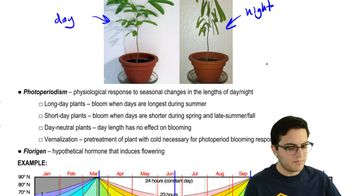
Circadian rhythms are natural, internal processes that regulate the sleep-wake cycle and repeat roughly every 24 hours. They are primarily controlled by the suprachiasmatic nucleus in the hypothalamus, not the cerebral cortex. Understanding this helps in identifying the cerebral cortex's limited role in circadian rhythm regulation.
Recommended video:
Guided course
04:34
Photoderiodism
Related Practice
Textbook Question

Activation of the parasympathetic branch of the autonomic nervous system

a. Increases heart rate

b. Enhances digestion

c. Triggers release of epinephrine

d. Causes conversion of glycogen to glucose

1742
views
Textbook Question

Which of the following structures or regions is incorrectly paired with its function?

a. Limbic system—motor control of speech

b. Medulla oblongata—homeostatic control

c. Cerebellum—coordination of movement and balance

d. Amygdala—emotional memory

1383
views
Textbook Question

Patients with damage to Wernicke's area have difficulty

a. Coordinating limb movement

b. Generating speech

c. Recognizing faces

d. Understanding language

1084
views
Textbook Question

After suffering a stroke, a patient can see objects anywhere in front of him but pays attention only to objects in his right field of vision. When asked to describe these objects, he has difficulty judging their size and distance. What part of the brain was likely damaged by the stroke?

a. The left frontal lobe

b. The right frontal lobe

c. The right parietal lobe

d. The corpus callosum

1196
views
Textbook Question

Injury localized to the hypothalamus would most likely disrupt

a. Regulation of body temperature

b. Short-term memory

c. Executive functions, such as decision making

d. Sorting of sensory information

1279
views
Textbook Question

The reflex that pulls your hand away when you prick your finger on a sharp object relies on a neuronal circuit with two synapses in the spinal cord. Using a circle to represent a cross-section of the spinal cord, draw the circuit. Label the types of neurons, the direction of information flow in each, and the locations of synapses.

1354
views